


An inside job: hacking into Janus kinase/signal transducer and activator of transcription signaling cascades by the intracellular protozoan Toxoplasma gondii
- PMID: 22104110
- PMCID: PMC3264314
- DOI: 10.1128/IAI.05974-11
An inside job: hacking into Janus kinase/signal transducer and activator of transcription signaling cascades by the intracellular protozoan Toxoplasma gondii
Abstract
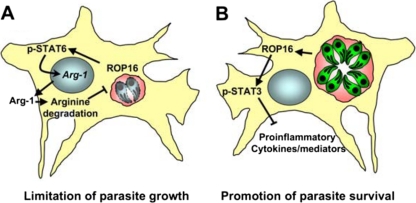
The intracellular protozoan Toxoplasma gondii is well known for its skill at invading and living within host cells. New discoveries are now also revealing the astounding ability of the parasite to inject effector proteins into the cytoplasm to seize control of the host cell. This review summarizes recent advances in our understanding of one such secretory protein called ROP16. This molecule is released from rhoptries into the host cell during invasion. The ROP16 molecule acts as a kinase, directly activating both signal transducer and activator of transcription 3 (STAT3) and STAT6 signaling pathways. In macrophages, an important and preferential target cell of parasite infection, the injection of ROP16 has multiple consequences, including downregulation of proinflammatory cytokine signaling and macrophage deviation to an alternatively activated phenotype.
Figures
References
-
- Aliberti J, et al. 2003. Molecular mimicry of a CCR5 binding-domain in the microbial activation of dendritic cells. Nat. Immunol. 4:485–490 - PubMed
-
- Bliss SK, Marshall AJ, Zhang Y, Denkers EY. 1999. Human polymorphonuclear leukocytes produce IL-12, TNF-α, and the chemokines macrophage-inflammatory protein-1a and -1b in response to Toxoplasma gondii antigens. J. Immunol. 162:7369–7375 - PubMed
Publication types
MeSH terms
Substances
Grants and funding
LinkOut - more resources
Full Text Sources
Research Materials
Miscellaneous
