


Impact of metabolic syndrome and its components on cardiovascular disease event rates in 4900 patients with type 2 diabetes assigned to placebo in the FIELD randomised trial
- PMID: 22104275
- PMCID: PMC3286386
- DOI: 10.1186/1475-2840-10-102
Impact of metabolic syndrome and its components on cardiovascular disease event rates in 4900 patients with type 2 diabetes assigned to placebo in the FIELD randomised trial
Abstract
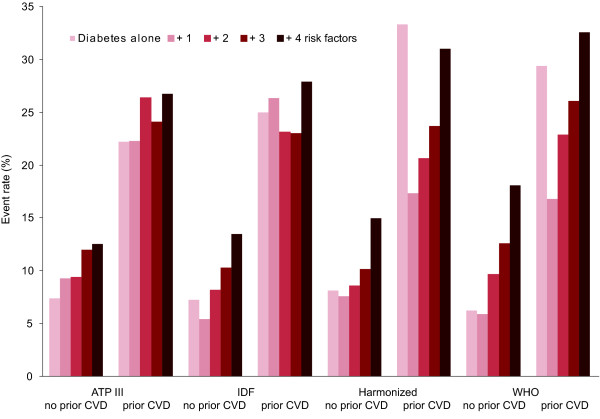
Background: Patients with the metabolic syndrome are more likely to develop type 2 diabetes and may have an increased risk of cardiovascular disease (CVD) events.We aimed to establish whether CVD event rates were influenced by the metabolic syndrome as defined by the World Health Organisation (WHO), the National Cholesterol Education Program (NCEP) Adult Treatment Panel III (ATP III) and the International Diabetes Federation (IDF) and to determine which component(s) of the metabolic syndrome (MS) conferred the highest cardiovascular risk in in 4900 patients with type 2 diabetes allocated to placebo in the Fenofibrate Intervention and Event Lowering in Diabetes (FIELD) trial.
Research design and methods: We determined the influence of MS variables, as defined by NCEP ATPIII, IDF and WHO, on CVD risk over 5 years, after adjustment for CVD, sex, HbA1c, creatinine, and age, and interactions between the MS variables in a Cox proportional-hazards model.
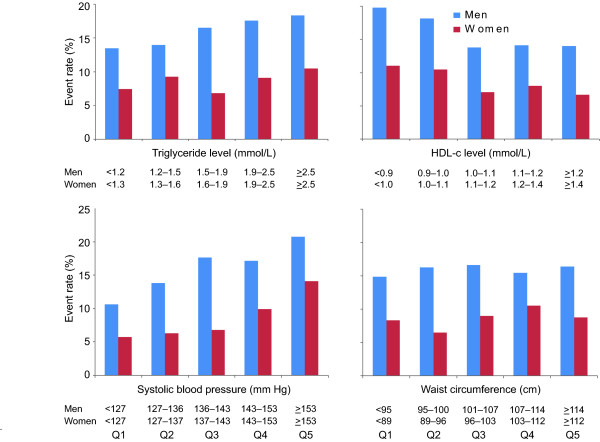
Results: About 80% had hypertension, and about half had other features of the metabolic syndrome (IDF, ATPIII). There was no difference in the prevalence of metabolic syndrome variables between those with and without CVD at study entry. The WHO definition identified those at higher CVD risk across both sexes, all ages, and in those without prior CVD, while the ATPIII definition predicted risk only in those aged over 65 years and in men but not in women. Patients meeting the IDF definition did not have higher risk than those without IDF MS.CVD risk was strongly influenced by prior CVD, sex, age (particularly in women), baseline HbA1c, renal dysfunction, hypertension, and dyslipidemia (low HDL-c, triglycerides > 1.7 mmol/L). The combination of low HDL-c and marked hypertriglyceridemia (> 2.3 mmol/L) increased CVD risk by 41%. Baseline systolic blood pressure increased risk by 16% per 10 mmHg in those with no prior CVD, but had no effect in those with CVD. In those without prior CVD, increasing numbers of metabolic syndrome variables (excluding waist) escalated risk.
Conclusion: Absence of the metabolic syndrome (by the WHO definition) identifies diabetes patients without prior CVD, who have a lower risk of future CVD events. Hypertension and dyslipidemia increase risk.
© 2011 Scott et al; licensee BioMed Central Ltd.
Figures
References
-
- NCEP Expert Panel. Summary of the third report of the National Cholesterol Education Program (NCEP) Expert Panel on detection evaluation, and treatment of high blood cholesterol in adults (Adult Treatment Panel III) JAMA-Journal Of The American Medical Association. 2001;285:2486–2497. doi: 10.1001/jama.285.19.2486. - DOI - PubMed
-
- Alberti KG, Zimmet PZ. Definition, diagnosis and classification of diabetes mellitus and its complications. Part 1: diagnosis and classification of diabetes mellitus provisional report of a WHO consultation. Diabetic Medicine. 1998;15(7):539–553. doi: 10.1002/(SICI)1096-9136(199807)15:7<539::AID-DIA668>3.0.CO;2-S. - DOI - PubMed
-
- Alberti KG, Eckel RH, Grundy SM, Zimmet PZ, Cleeman JI, Donato KA, Fruchart J-C, James WPT, Loria CM, Smith SCJ. Harmonizing the Metabolic Syndrome: a joint interim statement of the International Diabetes Federation Task Force on Epidemiology and Prevention; National Heart, Lung, and Blood Institute; American Heart Association; World Heart Federation; International Atherosclerosis Society; and International Association for the Study of Obesity. Circulation October. 2009;120(16):1640–1645. - PubMed
Publication types
MeSH terms
Substances
LinkOut - more resources
Full Text Sources
Medical
