


Comment
doi: 10.1172/JCI61367.
Epub 2011 Nov 21.
Slowing down with age: lung DCs do it too
Affiliations
- PMID: 22105176
- PMCID: PMC3226069
- DOI: 10.1172/JCI61367
Item in Clipboard
Comment
Slowing down with age: lung DCs do it too
J Clin Invest.
2011 Dec.
Abstract
Decline in immune function with age has been attributed to defects or alterations in both the innate and the adaptive immune system. In this issue of the JCI, Zhao and coworkers provide evidence for a novel mechanism of immune dysfunction in aging mice. They show that migration of respiratory DCs from the site of virus replication to the draining lymph nodes in response to infection with several different respiratory viruses is markedly diminished with increasing age. The impaired DC migration was a result of increased levels of the lipid mediator prostaglandin D(2) (PGD(2)) in the respiratory tract with age and could be partially reversed by blockade of PGD(2) synthesis or action.
Figures
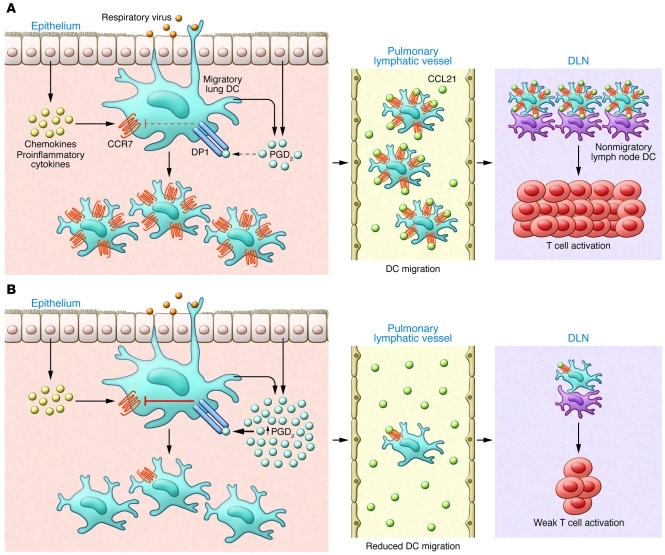
(A) Recognition of the invading respiratory virus by innate immune receptors expressed by epithelial cells and innate immune cells, including mast cells and DCs, in the lungs leads to the production of proinflammatory cytokines (i.e., IL-1β, IL-18, and type I IFNs), chemokines (i.e., MCP-1 and CCL2), and AA-derived metabolites (i.e., PGD2, PGE2, and LTC4). Of note, basal levels of prostanoids, in particular PGD2, are increased in the lungs of aged mice. The lipid and soluble mediators in turn enhance the expression of receptors such as DP1 on DCs in the lungs. Typically in young individuals, the proinflammatory milieu in the lungs created in response to viral infection recruits and activates adjacent DCs. Activated lung DCs undergo a maturation process that includes upregulation of costimulatory ligands, antigen-presenting complexes, and, importantly, chemokine receptors (such as CCR7 and sphingosine-1-phosphate receptors [S1P1–5]). The elevated levels of chemokine receptors facilitate emigration of antigen-bearing lung DCs to the local secondary lymphoid organs draining the infected lung (DLNs), in which they participate in initiating adaptive immune response to the respiratory virus. (B) However, in the lungs of the aged, the elevated basal levels of PGD2 in the lung tissue suppress CCR7 expression on lung DCs with migratory capacity. This reduced CCR7 expression by the lung DCs impairs DC migration from the infected lung to the DLN and results in fewer viral antigen-bearing lung DCs available to activate naive virus-specific T cells.
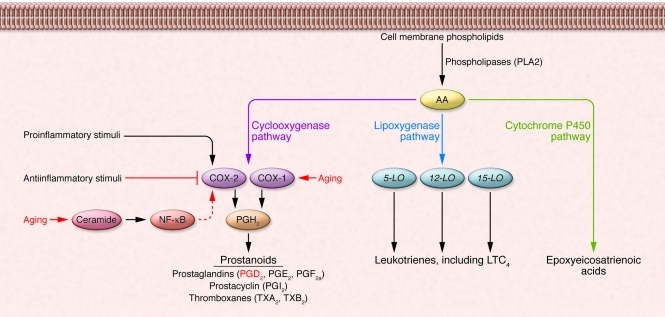
AA is released from cellular membrane phospholipids by phospholipases such as PLA2 in response to microbial infections and nonspecific stimuli, such as cytokines, hormones, and stress. Released AA can be converted to bioactive eicosanoids through the COX, lipoxygenase, or P450 epoxygenase pathways. Of interest, COX isozymes are composed of COX-1 (expression of which is constitutive) and COX-2 (expression of which is inducible). Both COX enzymes catalyze the formation of PGH2, which is converted by cell-specific prostaglandin synthases to biologically active products, collectively known as prostanoids (e.g., PGD2 and PGE2). Expression of COX-2 is induced by proinflammatory mediators and inhibited by antiinflammatory cytokines. In addition, the basal activity of COX-2 and its products, prostanoids, is observed to be elevated in both senescent cells and cells derived from aged mice. This is associated with increased amounts of ceramide, which activates NF-κB activity, leading to the transcription of COX2 mRNA. Modified from reference 10. Adapted with permission from Trends in Molecular Medicine (ref. 10).
Comment on
-
Age-related increases in PGD(2) expression impair respiratory DC migration, resulting in diminished T cell responses upon respiratory virus infection in mice.J Clin Invest. 2011 Dec;121(12):4921-30. doi: 10.1172/JCI59777. Epub 2011 Nov 21. J Clin Invest. 2011. PMID: 22105170 Free PMC article.
References
Publication types
MeSH terms
Substances
Grants and funding
LinkOut - more resources
Full Text Sources
Medical
Miscellaneous
