


doi: 10.1093/sysbio/syr107.
Epub 2011 Nov 21.
Best practices for justifying fossil calibrations
Affiliations
- PMID: 22105867
- PMCID: PMC3280042
- DOI: 10.1093/sysbio/syr107
Item in Clipboard
Best practices for justifying fossil calibrations
Syst Biol.
2012 Mar.
No abstract available
Figures
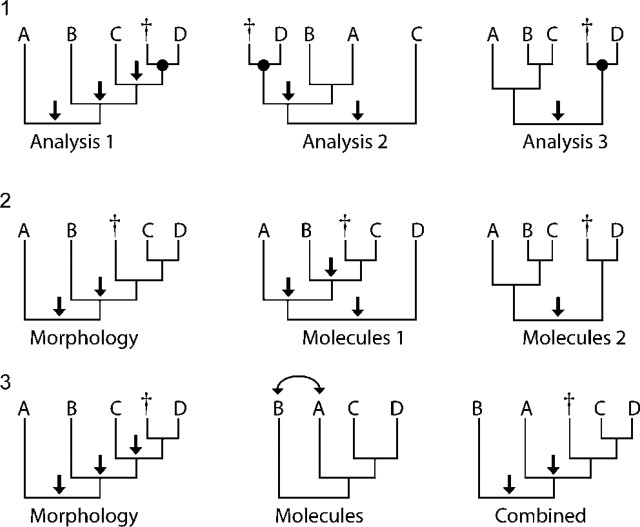
Example 1: A fossil (†) with unambiguous synapomorphies can be assigned to a specific lineage (D) with confidence. Regardless of the topology, the fossil will track the extant lineage and serve as a candidate calibration for all nodes above which it is nested. Example 2: Competing phylogenetic hypotheses from different data sets can change the position of fossil calibrations. In the morphological analysis, a fossil is found to be closely related to lineages C and D. Two arrows show the nodes that the fossil could calibrate. A molecular study with a different topology separates lineages C and D, making the placement of the fossil ambiguous. If the fossil is closely related to C, then it could calibrate three nodes. If the fossil is closely related to D, then it is a candidate calibration for just one node. Example 3: Changes to outgroup topology can change the polarization of morphological characters and placement of fossils. In the morphological analysis, a fossil (†) is placed in the C + D clade, sister to D. A molecular analysis changes the relationships of the outgroups (A and B). In a combined analysis, the morphological characters for the C + D clade are polarized in a different way and so using the fossil to calibrate clade C + D would be inappropriate.

Every fossil taxon has geographic and geological contexts that provide a basis for determining its age. The example given here is for Diacodexis ilicis. Depending on the phylogeny used, D. ilicis can be a useful minimum calibration for artiodactyl mammals. Six specimens of D. ilicis are known (Gingerich 1989) and the holotype, UM (University of Michigan) 87854, is among the oldest well-dated specimens. UM 87854 is from the Clarks Fork depositional basin in northern Wyoming. Within the Clarks Fork Basin, it is from the Willwood Formation. Within the Willwood Formation, it is from Locality UM SC-67. Locality UM SC-67 is part of a well-studied stratigraphic section for the Early Eocene. Within the Early Eocene, Locality UM SC-67 can be placed in the Wasatchian Land-Mammal Age. Within the Wasatchian, Locality UM SC-67 can be assigned to the biozone Wa-0 and occurs within a global negative carbon isotopic excursion. Wa-0 spans the latter part of this carbon isotope excursion and is inferred to represent ∼95 ky in the stratigraphic section, where UM 87854 occurs (Abdul Aziz et al. 2008); the entire global carbon isotope excursion is currently dated to 55.65–55.93 on the basis of radioisotopic ages and orbital tuning methods based on the earth's precessional cycles (Westerhold et al. 2009), giving specimen UM 87854 a minimum age of 55.65 Ma.

Examples of variation among constraint ages for two commonly calibrated nodes. Dark circles show point calibrations, lines show constraint intervals. Top: Archosauria, crocodile–bird node. Bottom: Homini, human–chimpanzee node. The data for this figure can be found in online Appendix 2.
References
-
- Abdul Aziz H, Hilgen FJ, van Luijk GM, Sluijs A, Kraus MJ, Pares JM, Gingerich PD. Astronomical climate control on paleosol stacking patterns in the upper Paleocene—lower Eocene Willwood Formation, Bighorn Basin, Wyoming. Geology. 2008;36:531–534.
-
- Archibald JD. Fossil evidence for a Late Cretaceous origin of “hoofed” mammals. Science. 1996;272:1150–1153. - PubMed
-
- Archibald JD, Averianov AO, Ekdale EG. Late Cretaceous relatives of rabbits, rodents, and other extant eutherian mammals. Nature. 2001;414:62–65. - PubMed
-
- Asher RJ, Bennett N, Lehmann T. The new framework for understanding placental mammal evolution. BioEssays. 2009;31:853–864. - PubMed
Publication types
MeSH terms
Grants and funding
LinkOut - more resources
Full Text Sources
Other Literature Sources
