


Acute β-adrenergic blockade increases aortic wave reflection in young men and women: differing mechanisms between sexes
- PMID: 22106401
- PMCID: PMC3241907
- DOI: 10.1161/HYPERTENSIONAHA.111.182337
Acute β-adrenergic blockade increases aortic wave reflection in young men and women: differing mechanisms between sexes
Abstract
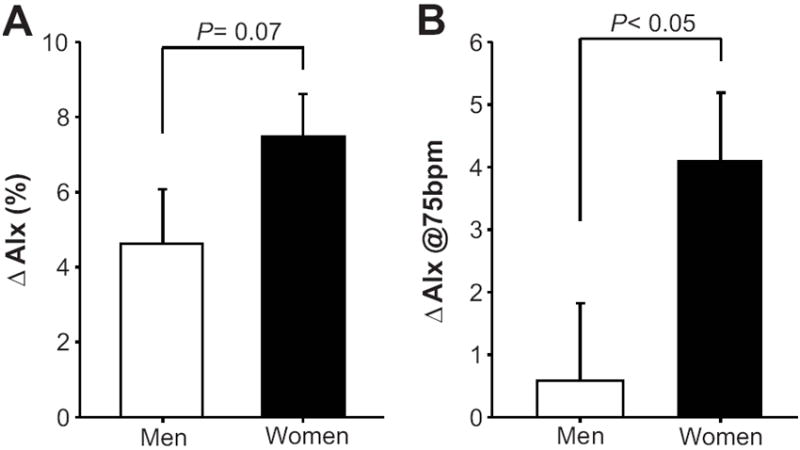
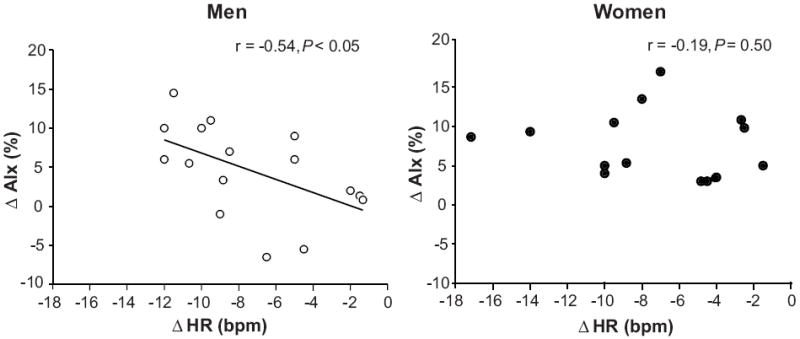
Acute β-adrenergic blockade increases aortic wave reflection; however, the mechanisms remain unclear. Evidence suggests that β-adrenergic receptor sensitivity in the peripheral vasculature differs between sexes. Therefore, the goal of this study was to examine whether β-adrenergic blockade alters aortic wave reflection to a similar extent in young men and women. In 31 subjects (16 men and 15 women; 26±1 years) noninvasive aortic pressure waveforms were synthesized from high-fidelity radial pressure waveforms via applanation tonometry before and during systemic β-blockade (0.25 mg/kg bolus, followed by 0.004 mg/kg per minute of continuous infusion of propranolol). β-Blockade increased aortic augmentation index and wave reflection amplitude (aortic augmented pressure) in both sexes (P<0.01). Although the increase in augmentation index was not significantly different between sexes (7.5±1.1% versus 4.6±1.5%; P=0.07), the increase in aortic augmented pressure was greater in women compared with men (2.8±0.5 versus 1.4±0.5 mm Hg; P<0.05). Aortic augmentation index adjusted for a heart rate of 75 bp increased in women (4.1±1.1%; P<0.05) after β-blockade, whereas it was unchanged in men (0.6±1.3%; P=0.33). Moreover, the change in aortic augmentation index was inversely associated with the change in heart rate only in men (r=-0.54; P<0.05). Our data suggest that aortic wave reflection is increased to a greater extent in women after systemic β-blockade, and enhanced aortic wave reflection appears to be mediated by a reduced heart rate in men, whereas the mechanism is unclear in women.
Figures
References
-
- Chobanian AV, Bakris GL, Black HR, Cushman WC, Green LA, Izzo JL, Jr, Jones DW, Materson BJ, Oparil S, Wright JT, Jr, Roccella EJ. Seventh report of the joint national committee on prevention, detection, evaluation, and treatment of high blood pressure. Hypertension. 2003;42:1206–1252. - PubMed
-
- Dahlof B, Devereux RB, Kjeldsen SE, Julius S, Beevers G, de Faire U, Fyhrquist F, Ibsen H, Kristiansson K, Lederballe-Pedersen O, Lindholm LH, Nieminen MS, Omvik P, Oparil S, Wedel H. Cardiovascular morbidity and mortality in the losartan intervention for endpoint reduction in hypertension study (life): A randomised trial against atenolol. Lancet. 2002;359:995–1003. - PubMed
-
- Dahlof B, Sever PS, Poulter NR, Wedel H, Beevers DG, Caulfield M, Collins R, Kjeldsen SE, Kristinsson A, McInnes GT, Mehlsen J, Nieminen M, O’Brien E, Ostergren J. Prevention of cardiovascular events with an antihypertensive regimen of amlodipine adding perindopril as required versus atenolol adding bendroflumethiazide as required, in the anglo-scandinavian cardiac outcomes trial-blood pressure lowering arm (ascot-bpla): A multicentre randomised controlled trial. Lancet. 2005;366:895–906. - PubMed
-
- Lindholm LH, Carlberg B, Samuelsson O. Should beta blockers remain first choice in the treatment of primary hypertension? A meta-analysis. Lancet. 2005;366:1545–1553. - PubMed
-
- Dhakam Z, McEniery CM, Yasmin, Cockcroft JR, Brown MJ, Wilkinson IB. Atenolol and eprosartan: Differential effects on central blood pressure and aortic pulse wave velocity. Am J Hypertens. 2006;19:214–219. - PubMed
Publication types
MeSH terms
Substances
Grants and funding
LinkOut - more resources
Full Text Sources
