


A neuropsychological perspective on the link between language and praxis in modern humans
- PMID: 22106433
- PMCID: PMC3223785
- DOI: 10.1098/rstb.2011.0122
A neuropsychological perspective on the link between language and praxis in modern humans
Abstract
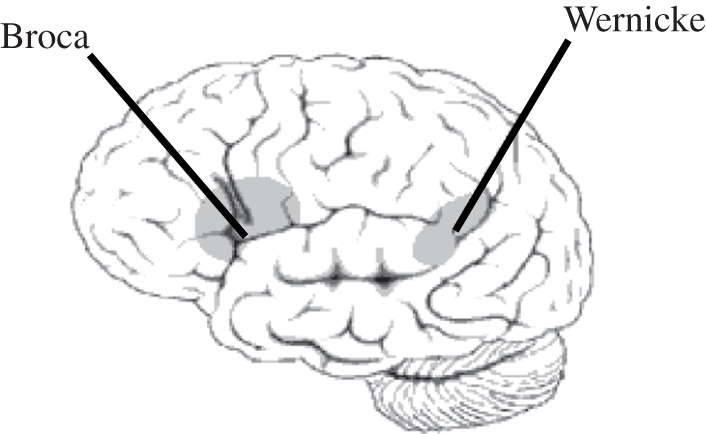
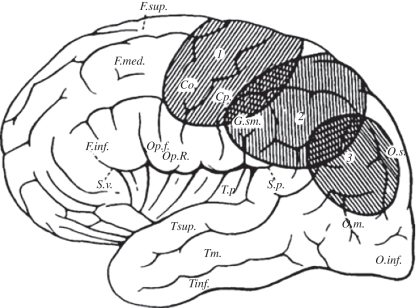
Hypotheses about the emergence of human cognitive abilities postulate strong evolutionary links between language and praxis, including the possibility that language was originally gestural. The present review considers functional and neuroanatomical links between language and praxis in brain-damaged patients with aphasia and/or apraxia. The neural systems supporting these functions are predominantly located in the left hemisphere. There are many parallels between action and language for recognition, imitation and gestural communication suggesting that they rely partially on large, common networks, differentially recruited depending on the nature of the task. However, this relationship is not unequivocal and the production and understanding of gestural communication are dependent on the context in apraxic patients and remains to be clarified in aphasic patients. The phonological, semantic and syntactic levels of language seem to share some common cognitive resources with the praxic system. In conclusion, neuropsychological observations do not allow support or rejection of the hypothesis that gestural communication may have constituted an evolutionary link between tool use and language. Rather they suggest that the complexity of human behaviour is based on large interconnected networks and on the evolution of specific properties within strategic areas of the left cerebral hemisphere.
Figures
References
-
- Annett M. 2006. The distribution of handedness in chimpanzees: estimating right shift in Hopkins' sample. Laterality 11, 101–109 - PubMed
-
- Kimura D., Archibald Y. 1974. Motor functions of the left hemisphere. Brain 97, 337–350 10.1093/brain/97.1.337 (doi:10.1093/brain/97.1.337) - DOI - PubMed
-
- Corbetta D. 2003. Right-handedness may have come first: evidence from studies in human infants and nonhuman primates. Behav. Brain Sci. 26, 217–218 10.1017/S0140525X03320060 (doi:10.1017/S0140525X03320060) - DOI
-
- Bradshaw J. L., Nettleton N. C. 1982. Language lateralization to the dominant hemisphere: tool use, gesture and language in hominid evolution. Curr. Psychol. Rev. 2, 171–192 10.1007/BF02684498 (doi:10.1007/BF02684498) - DOI
-
- Corballis M. C. 2003. From mouth to hand: gesture, speech, and the evolution of right-handedness. Behav. Brain Sci. 26, 199–208 (doi:10.1017/S0140525X03000062) - DOI - PubMed
Publication types
MeSH terms
LinkOut - more resources
Full Text Sources
