


Adenosine in cold blood cardioplegia--a placebo-controlled study
- PMID: 22108937
- PMCID: PMC3420270
- DOI: 10.1093/icvts/ivr027
Adenosine in cold blood cardioplegia--a placebo-controlled study
Abstract
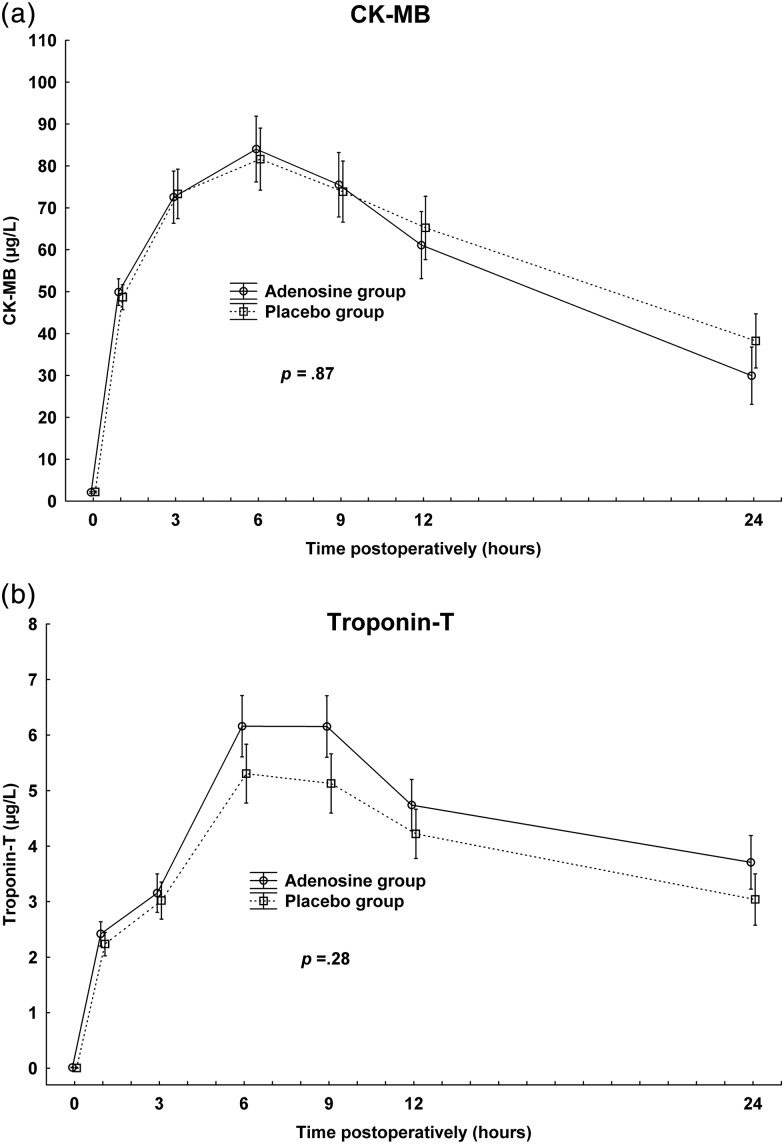
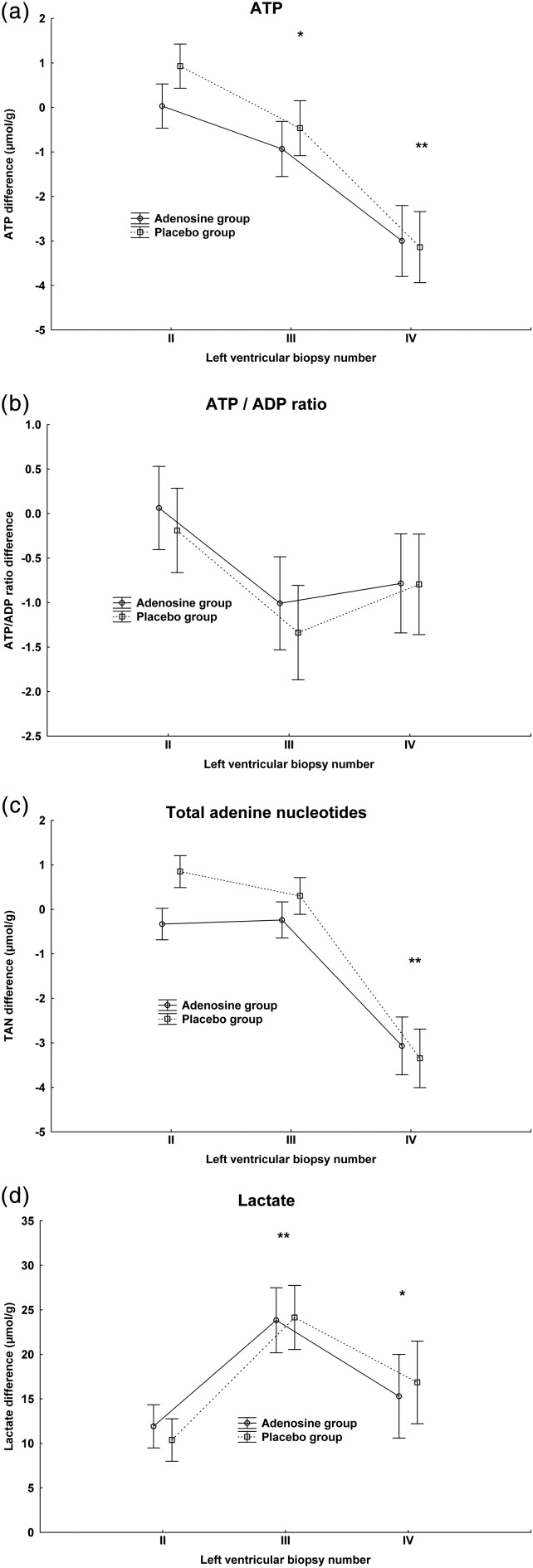
OBJECTIVE Adenosine as an additive in blood cardioplegia is cardioprotective in animal studies, but its clinical role in myocardial protection remains controversial. The aim of this study was to investigate whether the addition of adenosine in continuous cold blood cardioplegia would enhance myocardial protection. METHODS In a prospective double-blind study comparing adenosine 400 μmol l(-1) to placebo in continuous cold blood cardioplegia, 80 patients undergoing isolated aortic valve replacement were randomized into four groups: antegrade cardioplegia with adenosine (n = 19), antegrade cardioplegia with placebo (n = 21), retrograde cardioplegia with adenosine (n = 21) and retrograde cardioplegia with placebo (n = 19). Myocardial arteriovenous differences in oxygen and lactate were measured before, during and after aortic occlusion. Myocardial concentrations of adenine nucleotides and lactate were determined from left ventricular biopsies obtained before aortic occlusion, after bolus cardioplegia, at 60 min of aortic occlusion and at 20 min after aortic occlusion. Plasma creatine kinase (CK-MB) and troponin T were measured at 1, 3, 6, 9, 12 and 24 h after aortic occlusion. Haemodynamic profiles were obtained before surgery and 1, 8 and 24 h after cardiopulmonary bypass. Repeated-measures analysis of variance was used for significance testing. RESULTS Adenosine had no effects on myocardial metabolism of oxygen, lactate and adenine nucleotides, postoperative enzyme release or haemodynamic performance. When compared with the antegrade groups, the retrograde groups showed higher myocardial oxygen uptake (17.3 ± 11.4 versus 2.5 ± 3.6 ml l(-1) at 60 min of aortic occlusion, P < 0.001) and lactate accumulation (43.1 ± 20.7 versus 36.3 ± 23.0 µmol g(-1) at 60 min of aortic occlusion, P = 0.052) in the myocardium during aortic occlusion, and lower postoperative left ventricular stroke work index (27.2 ± 8.4 versus 30.1 ± 7.9 g m m(-2), P = 0.034). CONCLUSIONS Adenosine 400 μmol l(-1) in cold blood cardioplegia showed no cardioprotective effects on the parameters studied. Myocardial ischaemia was more pronounced in patients receiving retrograde cardioplegia.
Figures


References
-
- Doenst T, Bugger H, Schwarzer M, Faerber G, Borger MA, Mohr FW. Three good reasons for heart surgeons to understand cardiac metabolism. Eur J Cardiothorac Surg. 2008;33:862–71. doi:10.1016/j.ejcts.2008.02.015. - DOI - PubMed
-
- Hudspeth DA, Nakanishi K, Vinten-Johansen J, Zhao ZQ, McGee DS, Williams MW, Hammon JW., Jr. Adenosine in blood cardioplegia prevents postischemic dysfunction in ischemically injured hearts. Ann Thorac Surg. 1994;58:1637–44. doi:10.1016/0003-4975(94)91650-0. - DOI - PubMed
-
- Vinten-Johansen J, Zhao ZQ, Corvera JS, Morris CD, Budde JM, Thourani VH, et al. Adenosine in myocardial protection in on-pump and off-pump cardiac surgery. Ann Thorac Surg. 2003;75:S691–9. doi:10.1016/S0003-4975(02)04694-5. - DOI - PubMed
-
- Bolling SF, Childs KF, Ning XH. Adenosine's effect on myocardial functional recovery: substrate or signal? J Surg Res. 1994;57:591–5. doi:10.1006/jsre.1994.1188. - DOI - PubMed
-
- Belhomme D, Peynet J, Florens E, Tibourtine O, Kitakaze M, Menasche P. Is adenosine preconditioning truly cardioprotective in coronary artery bypass surgery? Ann Thorac Surg. 2000;70:590–4. doi:10.1016/S0003-4975(00)01502-2. - DOI - PubMed
Publication types
MeSH terms
Substances
LinkOut - more resources
Full Text Sources
Other Literature Sources
Medical
Research Materials
Miscellaneous
