


Long-Term Results of Radiofrequency Energy Delivery for the Treatment of GERD: Results of a Prospective 48-Month Study
- PMID: 22110288
- PMCID: PMC3202130
- DOI: 10.1155/2011/507157
Long-Term Results of Radiofrequency Energy Delivery for the Treatment of GERD: Results of a Prospective 48-Month Study
Abstract
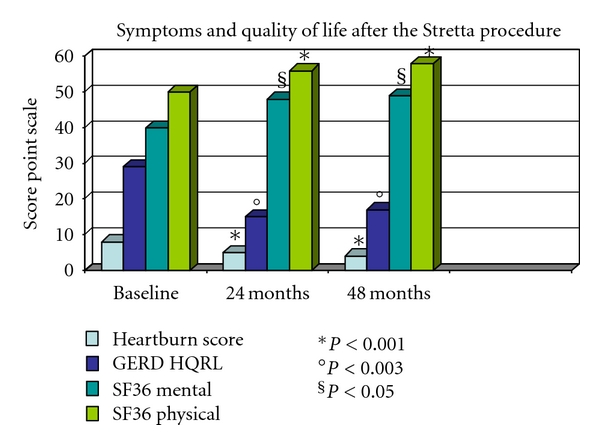
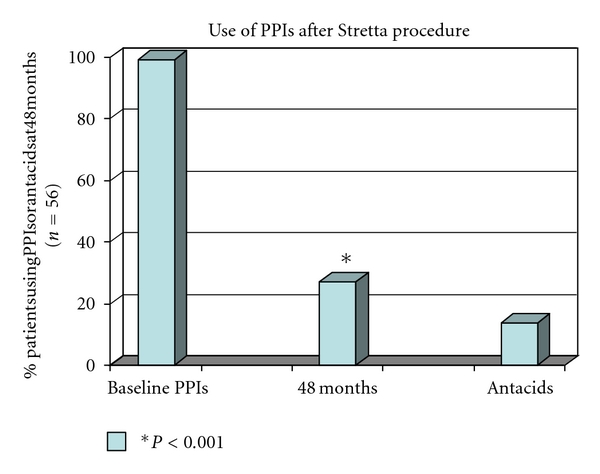
Since 2000, radiofrequency (RF) energy treatment has been increasingly offered as an alternative option to invasive surgical procedures for selected patients with gastroesophageal reflux disease (GERD). Out of 69 patients treated since June 2002 to December 2007 with the Stretta procedure, 56 of them reached by the end of 2010 a 48-month followup. RF treatment significantly improved heartburn scores, GERD-specific quality of life scores, and general quality of life scores at 24 and 48 months in 52 out of 56 patients (92,8%). At each control time both mean heartburn and GERD HRQL scores decreased (P = 0.001 and P = 0.003, resp.) and both mental SF-36 and physical SF-36 ameliorated (P = 0.001 and 0.05, resp.). At 48 months, 41 out of 56 patients (72,3%) were completely off PPIs. Morbidity was minimal, with only one relevant but transient complication. According to other literature data, this study shows that RF delivery to LES is safe and durably improves symptoms and quality of life in well-selected GERD patients.
Figures
References
-
- Freston JW, Triadafilopoulos G. Review article: approaches to the long-term management of adults with GERD—proton pump inhibitor therapy, laparoscopic fundoplication or endoscopic therapy? Alimentary Pharmacology and Therapeutics, Supplement. 2004;19(1):35–42. - PubMed
-
- Reavis KM, Melvin WS. Advanced endoscopic technologies. Surgical Endoscopy. 2008;22(6):1533–1546. - PubMed
-
- Triadafilopoulos G. Endotherapy and surgery for GERD. Journal of Clinical Gastroenterology. 2007;41(2, supplement 7):S87–S96. - PubMed
LinkOut - more resources
Full Text Sources
