


The development of severe neonatal alloimmune thrombocytopenia due to anti-HPA-1a antibodies is correlated to maternal ABO genotypes
- PMID: 22110529
- PMCID: PMC3216343
- DOI: 10.1155/2012/156867
The development of severe neonatal alloimmune thrombocytopenia due to anti-HPA-1a antibodies is correlated to maternal ABO genotypes
Abstract
Background: Maternal alloantibodies against HPA-1a can cross placenta, opsonize foetal platelets, and induce neonatal alloimmune thrombocytopenia (NAIT). In a study of 100, 448 pregnant women in Norway during 1995-2004, 10.6% of HPA-1a negative women had detectable anti-HPA-1a antibodies.
Design and methods: A possible correlation between the maternal ABO blood group phenotype, or underlying genotype, and severe thrombocytopenia in the newborn was investigated.
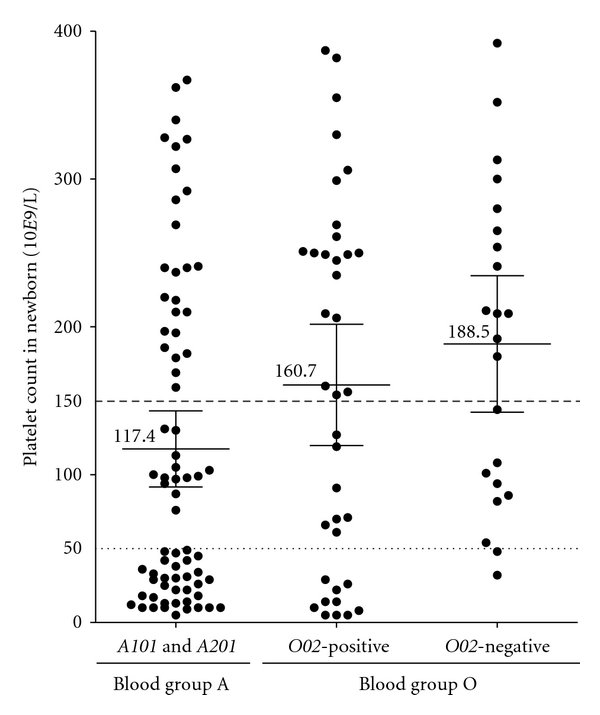
Results: We observed that immunized women with blood group O had a lower risk of having a child with severe NAIT than women with group A; 20% with blood group O gave birth to children with severe NAIT, compared to 47% among the blood group A mothers (relative risk 0.43; 95% CI 0.25-0.75).
Conclusion: The risk of severe neonatal alloimmune thrombocytopenia due to anti-HPA-1a antibodies is correlated to maternal ABO types, and this study indicates that the observation is due to genetic properties on the maternal side.
Figures
References
-
- Cooling LLW, Kelly K, Barton J, Hwang D, Koerner TAW, Olson JD. Determinants of ABH expression on human blood platelets. Blood. 2005;105(8):3356–3364. - PubMed
-
- Kjeldsen-Kragh J, Killie MK, Tomter G, et al. A screening and intervention program aimed to reduce mortality and serious morbidity associated with severe neonatal alloimmune thrombocytopenia. Blood. 2007;110(3):833–839. - PubMed
-
- Bertrand G, Martageix C, Jallu V, Vitry F, Kaplan C. Predictive value of sequential maternal anti-HPA-1a antibody concentrations for the severity of fetal alloimmune thrombocytopenia. Journal of Thrombosis and Haemostasis. 2006;4(3):628–637. - PubMed
-
- Jægtvik S, Husebekk A, Aune B, Øian P, Dahl LB, Skogen B. Neonatal alloimmune thrombocytopenia due to anti-HPA 1a antibodies; the level of maternal antibodies predicts the severity of thrombocytopenia in the newborn. British Journal of Obstetrics and Gynaecology. 2000;107(5):691–694. - PubMed
Publication types
MeSH terms
Substances
LinkOut - more resources
Full Text Sources
