


Total and high molecular weight adiponectin and hepatocellular carcinoma with HCV infection
- PMID: 22110596
- PMCID: PMC3215705
- DOI: 10.1371/journal.pone.0026840
Total and high molecular weight adiponectin and hepatocellular carcinoma with HCV infection
Abstract
Background: Adiponectin is shown to be inversely associated with development and progression of various cancers. We evaluated whether adiponectin level was associated with the prevalence and histological grade of hepatocellular carcinoma (HCC), and liver fibrosis in patients with hepatitis C virus (HCV) infection.
Methods: A case-control study was conducted on 97 HCC patients (cases) and 97 patients (controls) matched for sex, Child-Pugh grade and platelet count in patients with HCV infection. The serum total and high molecular weight (HMW) adiponectin levels were measured by enzyme-linked immunosorbent assays and examined in their association with the prevalence of HCC. In addition, the relationship between these adiponectin levels and body mass index (BMI), progression of liver fibrosis, and histological grade of HCC was also evaluated. Liver fibrosis was assessed using the aspartate aminotransferase to platelet ratio index (APRI).
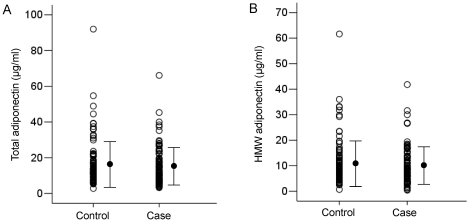
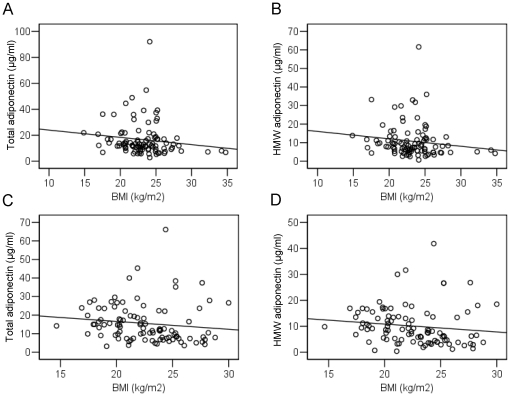
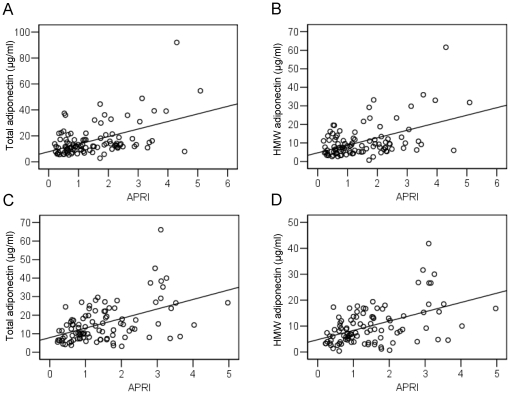
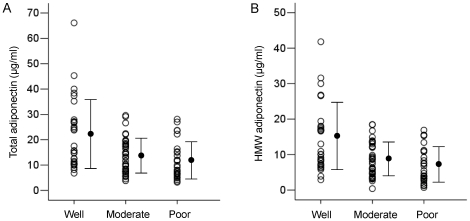
Results: There were no significant differences in the serum total and HMW adiponectin levels between cases and controls. Moreover, there were no inverse associations between serum total and HMW adiponectin levels and BMI in both cases and controls. On the other hand, serum total and HMW adiponectin levels are positively correlated with APRI in both cases (r = 0.491, P<0.001 and r = 0.485, P<0.001, respectively) and controls (r = 0.482, P<0.001 and r = 0.476, P<0.001, respectively). Interestingly, lower serum total (OR 11.76, 95% CI: 2.97-46.66 [P<0.001]) and HMW (OR 10.24, CI: 2.80-37.40 [P<0.001] adiponectin levels were independent risk factors of worse histological grade of HCC.
Conclusions: Our results suggested that serum total and HMW adiponectin levels were predictors of liver fibrosis, but not prevalence of HCC in patients with HCV infection. Moreover, low these adiponectin levels were significantly associated with worse histological grades.
Conflict of interest statement
Figures
References
-
- Bosch FX, Ribes J, Diaz M, Cleries R. Primary liver cancer: worldwide incidence and trends. Gastroenterology. 2004;127:S5–S16. - PubMed
-
- Kiyosawa K, Umemura T, Ichijo T, Matsumoto A, Yoshizawa K, et al. Hepatocellular carcinoma: recent trends in Japan. Gastroenterology. 2004;127:S17–26. - PubMed
-
- Bergstrom A, Pisani P, Tenet V, Wolk A, Adami HO. Overweight as an avoidable cause of cancer in Europe. Int J Cancer. 2001;91:421–430. - PubMed
-
- Monto A, Alonzo J, Watson JJ, Grunfeld C, Wright TL. Steatosis in chronic hepatitis C: relative contributions of obesity, diabetes mellitus, and alcohol. Hepatology. 2002;36:729–736. - PubMed
-
- Jonsson JR, Barrie HD, O'Rourke P, Clouston AD, Powell EE. Obesity and steatosis influence serum and hepatic inflammatory markers in chronic hepatitis C. Hepatology. 2008;48:80–87. - PubMed
Publication types
MeSH terms
Substances
LinkOut - more resources
Full Text Sources
Medical
