


Synchronized drumming enhances activity in the caudate and facilitates prosocial commitment--if the rhythm comes easily
- PMID: 22110623
- PMCID: PMC3217964
- DOI: 10.1371/journal.pone.0027272
Synchronized drumming enhances activity in the caudate and facilitates prosocial commitment--if the rhythm comes easily
Abstract
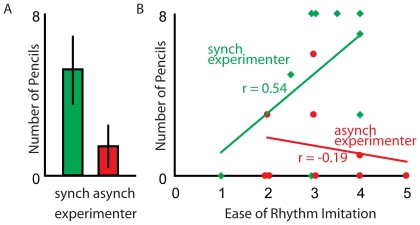
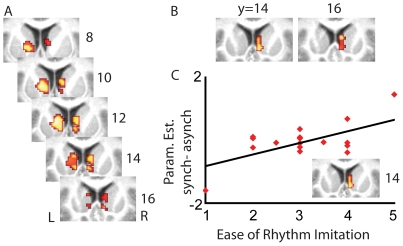
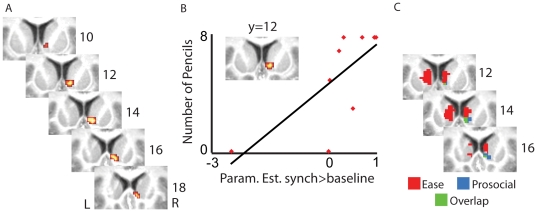
Why does chanting, drumming or dancing together make people feel united? Here we investigate the neural mechanisms underlying interpersonal synchrony and its subsequent effects on prosocial behavior among synchronized individuals. We hypothesized that areas of the brain associated with the processing of reward would be active when individuals experience synchrony during drumming, and that these reward signals would increase prosocial behavior toward this synchronous drum partner. 18 female non-musicians were scanned with functional magnetic resonance imaging while they drummed a rhythm, in alternating blocks, with two different experimenters: one drumming in-synchrony and the other out-of-synchrony relative to the participant. In the last scanning part, which served as the experimental manipulation for the following prosocial behavioral test, one of the experimenters drummed with one half of the participants in-synchrony and with the other out-of-synchrony. After scanning, this experimenter "accidentally" dropped eight pencils, and the number of pencils collected by the participants was used as a measure of prosocial commitment. Results revealed that participants who mastered the novel rhythm easily before scanning showed increased activity in the caudate during synchronous drumming. The same area also responded to monetary reward in a localizer task with the same participants. The activity in the caudate during experiencing synchronous drumming also predicted the number of pencils the participants later collected to help the synchronous experimenter of the manipulation run. In addition, participants collected more pencils to help the experimenter when she had drummed in-synchrony than out-of-synchrony during the manipulation run. By showing an overlap in activated areas during synchronized drumming and monetary reward, our findings suggest that interpersonal synchrony is related to the brain's reward system.
Conflict of interest statement
Figures

References
-
- Fitch W. The biology and evolution of music: A comparative perspective. Cognition. 2006;100:173–215. - PubMed
-
- Wallin NL, Merker B, Brown SE. The Origins of Music. Cambridge, MA: The MIT Press; 2000. 3
-
- Kirschner S, Tomasello M. Joint drumming: social context facilitates synchronization in preschool children. J Exp Child Psychol. 2009;102:299–314. - PubMed
-
- Huron D. Is music an evolutionary adaptation? Annals-New York Academy of Sciences. 2001;930:43–61. - PubMed
-
- McNeil W. Keeping together in time: Dance and drill in human history. Cambridge, MA: Harvard University Press; 1995. 20
Publication types
MeSH terms
LinkOut - more resources
Full Text Sources
