


doi: 10.1155/2011/647987.
Epub 2011 Oct 5.
Role of signaling transduction pathways in development of castration-resistant prostate cancer
Affiliations
- PMID: 22110995
- PMCID: PMC3197001
- DOI: 10.1155/2011/647987
Item in Clipboard
Role of signaling transduction pathways in development of castration-resistant prostate cancer
Prostate Cancer.
2011.
Abstract
Almost all patients who succumb to prostate cancer die of metastatic castration-resistant disease. Although docetaxel is the standard treatment for this disease and is associated with modest prolongation of survival, there is an urgent need for novel treatments for castration-resistant prostate cancer (CRPC). Great advances in our understanding of the biological and molecular mechanisms of prostate cancer progression have resulted in many clinical trials of numerous targeted therapies. In this paper, we review mechanisms of CRPC development, with particular focus on recent advances in the understanding of specific intracellular signaling pathways participating in the proliferation of CRPC cells.
Figures
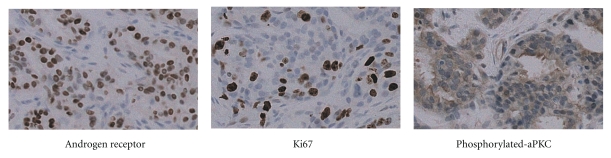
Representative immunohistochemical staining of castration-resistant prostate cancer tissues by specific antibodies against androgen receptor, Ki67, and phosphorylated atypical PKC.
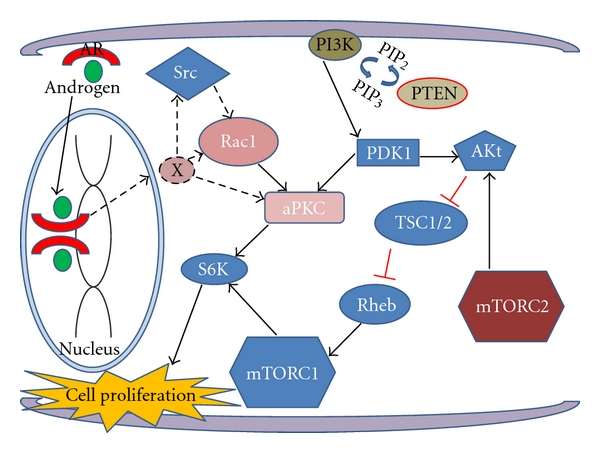
Intracellular signaling pathways including Rac1/atypical PKC (aPKC)/S6K pathways and androgen signaling. An unknown molecule (X) downstream of androgen/androgen receptor (AR) may activate Rac1 and Src (depicted as dotted arrows) and may contribute to androgen-dependent cell proliferation. In castration-resistant prostate cancers, AR activity is upregulated by specific mutations for a promiscuous ligand-dependent manner or by other mechanisms, resulting in constitutive activation of Rac1/aPKC/S6K signaling through the same “X” or others.
References
-
- American Cancer Society. Cancer Facts and Figures. Atlanta, Ga, USA: American Cancer Society; 2010.
-
- 2. Cancer Statistics in Japan, 2005, http://ganjoho.jp/public/statistics/backnumber/2005_en.html.
-
- Feldman BJ, Feldman D. The development of androgen-independent prostate cancer. Nature Reviews Cancer. 2001;1(1):34–45. - PubMed
-
- Inoue T, Kobayashi T, Terada N, et al. Roles of androgen-dependent and -independent activation of signal transduction pathways for cell proliferation of prostate cancer cells. Expert Review of Endocrinology and Metabolism. 2007;2(5):689–704. - PubMed
LinkOut - more resources
Full Text Sources
