


A comparison of specialist rehabilitation and care assistant support with specialist rehabilitation alone and usual care for people with Parkinson's living in the community: study protocol for a randomised controlled trial
- PMID: 22112960
- PMCID: PMC3261836
- DOI: 10.1186/1745-6215-12-250
A comparison of specialist rehabilitation and care assistant support with specialist rehabilitation alone and usual care for people with Parkinson's living in the community: study protocol for a randomised controlled trial
Abstract
Background: Parkinson's Disease is a degenerative neurological condition that causes movement problems and other distressing symptoms. People with Parkinson's disease gradually lose their independence and strain is placed on family members. A multidisciplinary approach to rehabilitation for people with Parkinson's is recommended but has not been widely researched. Studies are needed that investigate cost-effective community-based service delivery models to reduce disability and dependency and admission to long term care, and improve quality of life.
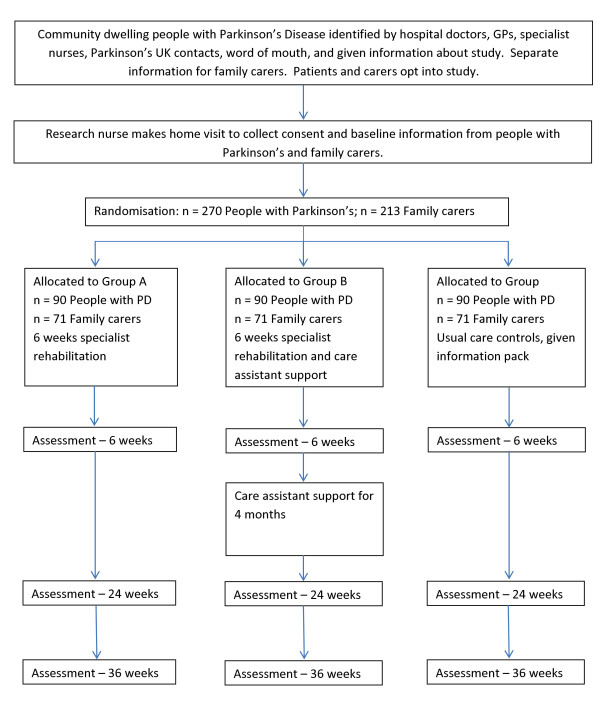
Methods: A pragmatic three parallel group randomised controlled trial involving people with Parkinson's Disease and live-in carers (family friends or paid carers), and comparing: management by a specialist multidisciplinary team for six weeks, according to a care plan agreed between the professionals and the patient and carer (Group A); multidisciplinary team management and additional support for four months from a trained care assistant (Group B); usual care, no coordinated team care planning or ongoing support (Group C). Follow up will be for six months to determine the impact and relative cost-effectiveness of the two interventions, compared to usual care. The primary outcomes are disability (patients) and strain (carers). Secondary outcomes include patient mobility, falls, speech, pain, self efficacy, health and social care use; carer general health; patient and carer social functioning, psychological wellbeing, health related quality of life. Semi structured interviews will be undertaken with providers (team members, care assistants), service commissioners, and patients and carers in groups A and B, to gain feedback about the acceptability of the interventions. A cost - effectiveness evaluation is embedded in the trial.
Discussion: The trial investigates components of recent national policy recommendations for people with long term conditions, and Parkinson's Disease in particular, and will provide guidance to inform local service planning and commissioning.
Trial registration: ISRCTN: ISRCTN44577970.
Figures
References
-
- National Institute of Health and Clinical Excellence. Parkinson's disease: diagnosis and management in primary and secondary care, CG 035. London; 2006.
-
- Post B, van der Eijk M, Munneke M, Bloem BR. Multidisciplinary care for Parkinson's disease: not if, but how? Pract Neurol. 2011;11:58–61. - PubMed
-
- Gage H, Storey L. Rehabilitation for Parkinson's disease: a systematic review of available evidence. Clin Rehab. 2004;18:463–482. - PubMed
Publication types
MeSH terms
Associated data
Grants and funding
LinkOut - more resources
Full Text Sources
Medical
