. 2012 Jan 15;28(2):286-7.
doi: 10.1093/bioinformatics/btr651. Epub 2011 Nov 22.

FTSite: high accuracy detection of ligand binding sites on unbound protein structures

Affiliations

FTSite: high accuracy detection of ligand binding sites on unbound protein structures

Chi-Ho Ngan et al. Bioinformatics. .

Abstract

Motivation: Binding site identification is a classical problem that is important for a range of applications, including the structure-based prediction of function, the elucidation of functional relationships among proteins, protein engineering and drug design. We describe an accurate method of binding site identification, namely FTSite. This method is based on experimental evidence that ligand binding sites also bind small organic molecules of various shapes and polarity. The FTSite algorithm does not rely on any evolutionary or statistical information, but achieves near experimental accuracy: it is capable of identifying the binding sites in over 94% of apo proteins from established test sets that have been used to evaluate many other binding site prediction methods.

Availability: FTSite is freely available as a web-based server at http://ftsite.bu.edu.


Figures
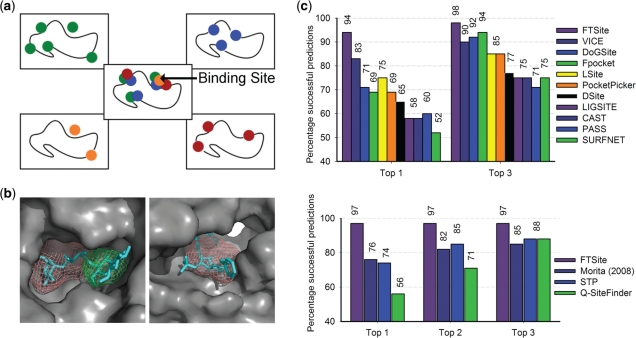
Fig. 1.
Fig. 1.
Methodology of FTSite and its performance on two sets of test proteins. (a) FTSite identifies regions that have the highest number of non-bonded interactions with overlapping low energy clusters of several small molecular probes. (b) Two successful examples are shown. The ligands of each respective target are shown as cyan sticks and the putative ligand binding sites are colored salmon and green for the first and second highest ranked sites, respectively. Left: β-amylase (PDB ID: 1BYA (apo) and 1BYB (holo)). Right: HIV-2 protease (PDB ID 1HSI (apo) and 1IDA (holo)). (c) Top: on the LIGSITECSC test set, FTSite has an accuracy of 94% using only the top ranked prediction of the ligand binding site, and 98% using the top three. Bottom: on the QSiteFinder test set, FTSite has an accuracy of 97% using only the top ranked prediction.

References

    1. Brenke R., et al. Fragment-based identification of druggable “hot spots” of proteins using Fourier domain correlation techniques. Bioinformatics. 2009;25:621–627. - PMC - PubMed
    1. Hajduk P.J., et al. Druggability indices for protein targets derived from NMR-based screening data. J. Med. Chem. 2005;48:2518–2525. - PubMed
    1. Huang B., Schroeder M. LIGSITE^csc: predicting ligand binding sites using the Connolly surface and degree of conservation. BMC Struct. Biol. 2006;6:19–29. - PMC - PubMed
    1. Kozakov D., et al. Structural conservation of druggable hot spots in protein-protein interfaces. Proc. Natl Acad. Sci. USA. 2011;108:13528–13533. - PMC - PubMed
    1. Laskowski R. SURFNET: a program for visualizing molecular surfaces, cavities, and intermolecular interactions. J. Mol. Graph. 1995;13:323–330. - PubMed

Publication types
