


The psychometric properties of the K10 and K6 scales in screening for mood and anxiety disorders in the South African Stress and Health study
- PMID: 22113964
- PMCID: PMC6878543
- DOI: 10.1002/mpr.351
The psychometric properties of the K10 and K6 scales in screening for mood and anxiety disorders in the South African Stress and Health study
Abstract
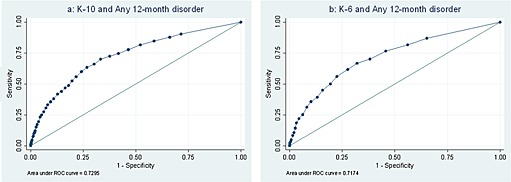
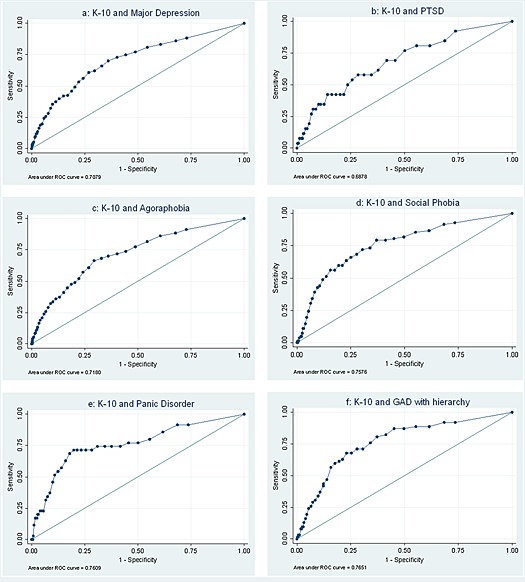
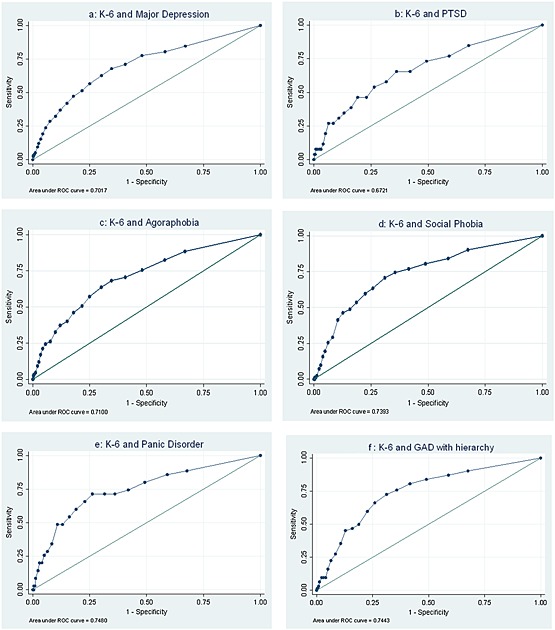
Emerging research has provided support for the use of the Kessler Psychological Distress Scales in developing countries; however, this research has yet to be extended to southern Africa. This study sought to evaluate the performance of the Kessler scales in screening for depression and anxiety disorders in the South African population. The scales along with the Composite International Diagnostic Interview (CIDI) were included in the South African Stress and Health study, a nationally representative household survey. The K10/K6 demonstrated moderate discriminating ability in detecting depression and anxiety disorders in the general population; evidenced by area under the receiver operating curves of 0.73 and 0.72 respectively. However, both scales failed to meet our acceptability criteria of high sensitivity and high positive predictive value. Examinations of differences in responding by race/ethnicity revealed that the K10/K6 [Kessler Psychological Distress Scale 10-item (K10) and the abbreviated six-item (K6)] had significantly lower discriminating ability with respect to depression and anxiety disorders among the Black group (0.71) than among the combined minority race/ethnic groups of White, Colored, and Indian/Asian (0.78; p = 0.016). The difference in time period assessed on the K10/K6 (past 30 days) versus the CIDI (past 12 months) was a notable limitation of this study. Additional validation studies using clinician diagnostic instruments are recommended.
Copyright © 2011 John Wiley & Sons, Ltd.
Figures
References
-
- Cairney J., Veldhuizen S., Wade T.J., Kurdyak P., Streiner D.L. (2007) Evaluation of 2 measures of psychological distress as screeners for depression in the general population. Canadian Journal of Psychiatry, 52(2), 111–120. - PubMed
-
- DeLong E.R., DeLong M., Clarke‐Pearson D.L. (1988) Comparing the areas under two or more correlated receiver operating characteristic curves: A nonparametric approach. Biometrics, 44(3), 837–845. - PubMed
-
- Fassaert T., De Wit M.A.S., Tuinebreijer W.C., Wouters H., Verhoeff A.P., Beekman A.T.F., Dekker J. (2009) Psychometric properties of an interviewer‐administered version of the Kessler Psychological Distress scale (K10) among Dutch, Moroccan, and Turkish respondents. International Journal of Methods in Psychiatric Research, 18(3), 159–168, DOI: 10.1002/mpr.288 - DOI - PMC - PubMed
Publication types
MeSH terms
Grants and funding
LinkOut - more resources
Full Text Sources
Medical
Research Materials
Miscellaneous
