


Elevated androgens during puberty in female rhesus monkeys lead to increased neuronal drive to the reproductive axis: a possible component of polycystic ovary syndrome
- PMID: 22114112
- PMCID: PMC3258033
- DOI: 10.1093/humrep/der393
Elevated androgens during puberty in female rhesus monkeys lead to increased neuronal drive to the reproductive axis: a possible component of polycystic ovary syndrome
Abstract
Background: Hyperandrogenemia is associated with several clinical disorders in which both reproductive dysfunction and metabolic changes may coexist [i.e. polycystic ovary syndrome (PCOS), obesity and congenital adrenal hyperplasia]. Moreover, there is growing evidence that the elevated levels of circulating androgens in obese girls may lead to an increased neuroendocrine drive to the reproductive axis, similar to that associated with PCOS.
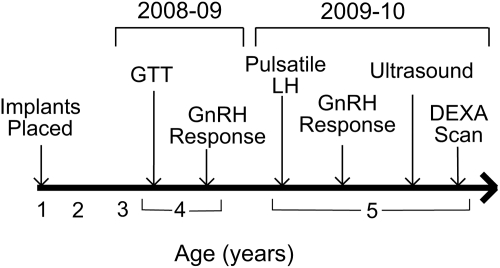
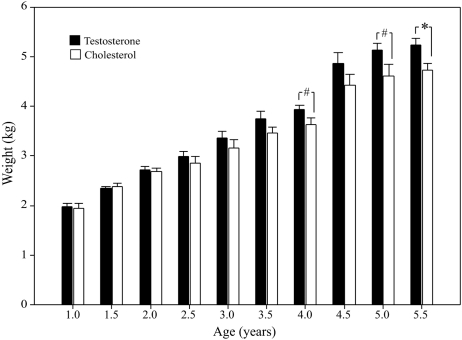
Methods: To test whether androgen exposure in the childhood and adolescent period could lead to pubertal alterations in LH secretory patterns, female rhesus monkeys received subcutaneous testosterone implants prepubertally beginning at 1 year of age, maintaining a 3.7-fold increase (P = 0.001) in circulating testosterone levels over cholesterol-implant controls (n = 6/group) into the post-pubertal period. In early adulthood, pulsatile secretion of LH was measured over 12 h during the early follicular phase of a menstrual cycle, and responsiveness of the pituitary to gonadotrophin-releasing hormone was determined. In addition, ultrasounds were performed to assess ovarian morphology and glucose tolerance testing was performed to assess insulin sensitivity.
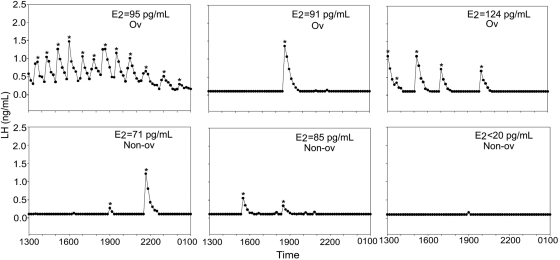
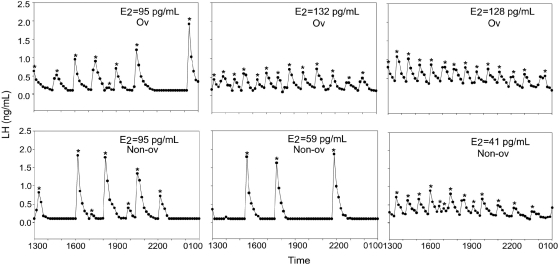
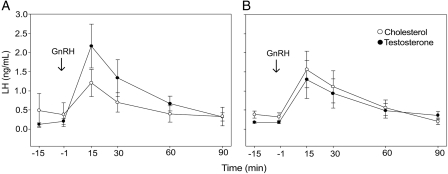
Results: The timing of menarche was similar between groups. Testosterone-treated animals had a significantly greater LH pulse frequency during the early follicular phase compared with controls (P = 0.039) when measured at 5 years of age. There was a larger LH response to GnRH when testosterone-treated animals were 4 years of age (P = 0.042), but not when the animals were 5 years old (P = 0.57). No differences were seen in insulin sensitivity or ovarian morphology, and the groups showed similar rates of ovulation in early adulthood.
Conclusions: Exposure to increased levels of androgens over the course of pubertal development appears to trigger physiological changes in the neural drive to the reproductive axis that resemble those of obese hyperandrogenemic girls in early adulthood and are characteristic of PCOS.
Figures
References
-
- Abbott DH, Dumesic DA, Eisner JR, Colman JR, Kemnitz JW. Insights into the development of polycystic ovary syndrome (PCOS) from studies of prenatally androgenized female rhesus monkeys. Trends Endocrinol Metab. 1998;9:62–67. doi:10.1016/S1043-2760(98)00019-8. - DOI - PubMed
-
- Abbott DH, Barnett DK, Bruns CM, Dumesic DA. Androgen excess fetal programming of female reproduction: a developmental aetiology for polycystic ovary syndrome? Hum Reprod Update. 2005;11:357–374. doi:10.1093/humupd/dmi013. - DOI - PubMed
-
- Abbott DH, Barnett DK, Levine JE, Padmanabhan V, Dumesic DA, Jacoris S, Tarantal AF. Endocrine antecedents of polycystic ovary syndrome in fetal and infant prenatally androgenized female rhesus monkeys. Biol Reprod. 2008;79:154–163. doi:10.1095/biolreprod.108.067702. - DOI - PMC - PubMed
-
- Apter D, Cacciatore B, Alfthan H, Stenman U. Serum luteinizing hormone concentrations increase 100-fold in females from 7 years to adulthood, as measured by time-resolved immunofluorometric assay. J Clin Endocrinol Metab. 1989;68:53–57. doi:10.1210/jcem-68-1-53. - DOI - PubMed
-
- Apter D, Butzow T, Laughlin GA, Yen SSC. Accelerated 24-hour luteinizing hormone pulsatile activity in adolescent girls with ovarian hyperandrogenism: relevance to the developmental phase of polycystic ovarian syndrome. J Clin Endocrinol Metab. 1994;79:119–125. doi:10.1210/jc.79.1.119. - DOI - PubMed
Publication types
MeSH terms
Substances
Grants and funding
LinkOut - more resources
Full Text Sources
Medical
