


The Lichfield bone study: the skeletal response to exercise in healthy young men
- PMID: 22114178
- PMCID: PMC3289434
- DOI: 10.1152/japplphysiol.00788.2011
The Lichfield bone study: the skeletal response to exercise in healthy young men
Abstract
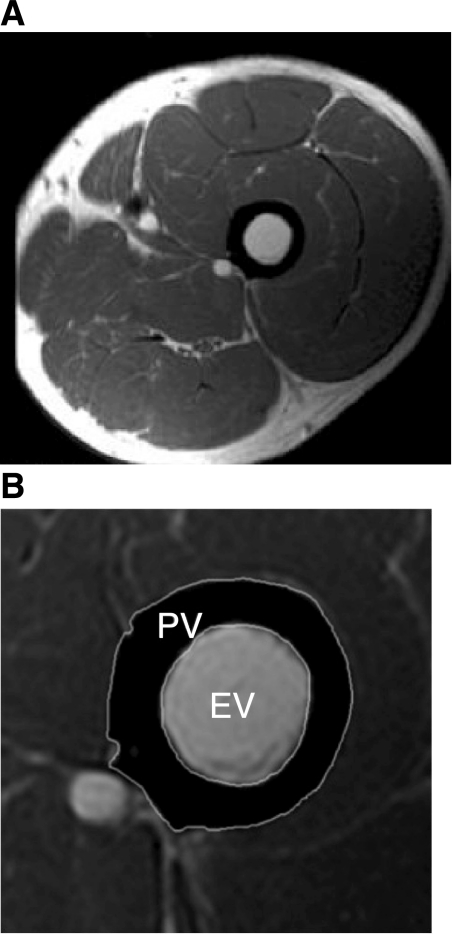
The skeletal response to short-term exercise training remains poorly described. We thus studied the lower limb skeletal response of 723 Caucasian male army recruits to a 12-wk training regime. Femoral bone volume was assessed using magnetic resonance imaging, bone ultrastructure by quantitative ultrasound (QUS), and bone mineral density (BMD) using dual-energy X-ray absorptiometry (DXA) of the hip. Left hip BMD increased with training (mean ± SD: 0.85 ± 3.24, 2.93 ± 4.85, and 1.89 ± 2.85% for femoral neck, Ward's area, and total hip, respectively; all P < 0.001). Left calcaneal broadband ultrasound attenuation rose 3.57 ± 0.5% (P < 0.001), and left and right femoral cortical volume by 1.09 ± 4.05 and 0.71 ± 4.05%, respectively (P = 0.0001 and 0.003), largely through the rise in periosteal volume (0.78 ± 3.14 and 0.59 ± 2.58% for right and left, respectively, P < 0.001) with endosteal volumes unchanged. Before training, DXA and QUS measures were independent of limb dominance. However, the dominant femur had higher periosteal (25,991.49 vs. 2,5572 mm(3), P < 0.001), endosteal (6,063.33 vs. 5,983.12 mm(3), P = 0.001), and cortical volumes (19,928 vs. 19,589.56 mm(3), P = 0.001). Changes in DXA, QUS, and magnetic resonance imaging measures were independent of limb dominance. We show, for the first time, that short-term exercise training in young men is associated not only with a rise in human femoral BMD, but also in femoral bone volume, the latter largely through a periosteal response.
Figures
References
-
- Alfredson H, Nordstrom P, Pietila T, Lorentzon R. Long-term loading and regional bone mass of the arm in female volleyball players. Calcif Tissue Int 62: 303–308, 1998 - PubMed
-
- Ammann P, Rizzoli R. Bone strength and its determinants. Osteoporos Int 3: S13–S18, 2003 - PubMed
-
- Ashizawa N, Nonaka K, Michikami S, Mizuki T, Amagai H, Tokuyama K, Suzuki M. Tomographical description of tennis-loaded radius: reciprocal relation between bone size and volumetric BMD. J Appl Physiol 86: 1347–1351, 1999 - PubMed
-
- Ay A, Yurtkuran M. Influence of aquatic and weight-bearing exercises on quantitative ultrasound variables in postmenopausal women. Am J Phys Med Rehabil 84: 52–61, 2005 - PubMed
-
- Babaroutsi E, Magkos F, Manios Y, Sidossis LS. Body mass index, calcium intake, and physical activity affect calcaneal ultrasound in healthy Greek males in an age-dependent and parameter-specific manner. J Bone Miner Metab 23: 157–166, 2005 - PubMed
Publication types
MeSH terms
Grants and funding
LinkOut - more resources
Full Text Sources
Medical
