


Sleep-dependent facilitation of episodic memory details
- PMID: 22114672
- PMCID: PMC3219667
- DOI: 10.1371/journal.pone.0027421
Sleep-dependent facilitation of episodic memory details
Abstract
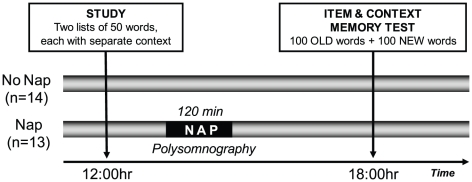
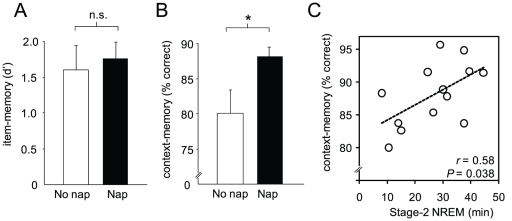
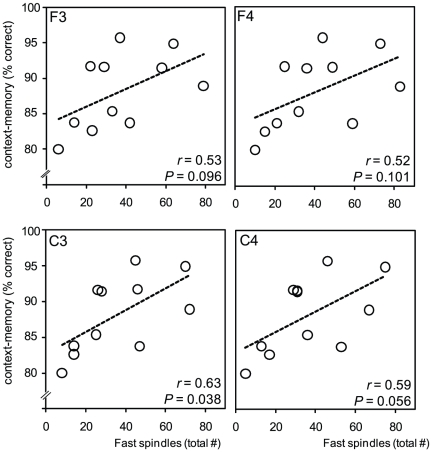
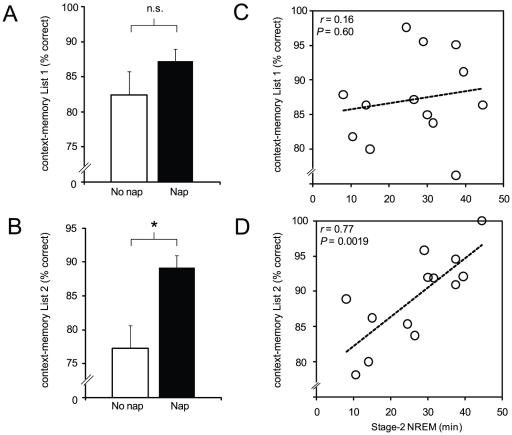
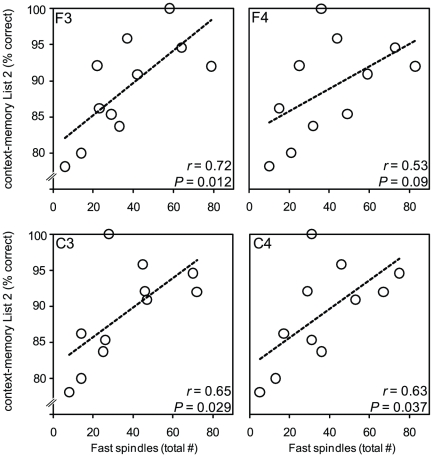
While a role for sleep in declarative memory processing is established, the qualitative nature of this consolidation benefit, and the physiological mechanisms mediating it, remain debated. Here, we investigate the impact of sleep physiology on characteristics of episodic memory using an item- (memory elements) and context- (contextual details associated with those elements) learning paradigm; the latter being especially dependent on the hippocampus. Following back-to-back encoding of two word lists, each associated with a different context, participants were assigned to either a Nap-group, who obtained a 120-min nap, or a No Nap-group. Six hours post-encoding, participants performed a recognition test involving item-memory and context-memory judgments. In contrast to item-memory, which demonstrated no between-group differences, a significant benefit in context-memory developed in the Nap-group, the extent of which correlated both with the amount of stage-2 NREM sleep and frontal fast sleep-spindles. Furthermore, a difference was observed on the basis of word-list order, with the sleep benefit and associated physiological correlations being selective for the second word-list, learned last (most proximal to sleep). These findings suggest that sleep may preferentially benefit contextual (hippocampal-dependent) aspects of memory, supported by sleep-spindle oscillations, and that the temporal order of initial learning differentially determines subsequent offline consolidation.
Conflict of interest statement
Figures
References
-
- Diekelmann S, Born J. The memory function of sleep. Nat Rev Neurosci. 2010;11:114–126. - PubMed
-
- Miller G. Neuroscience. Hunting for meaning after midnight. Science. 2007;315:1360–1363. - PubMed
-
- Diekelmann S, Wilhelm I, Born J. The whats and whens of sleep-dependent memory consolidation. Sleep Med Rev. 2009;13:309–321. - PubMed
-
- Ellenbogen JM, Hulbert JC, Stickgold R, Dinges DF, Thompson-Schill SL. Interfering with theories of sleep and memory: sleep, declarative memory, and associative interference. Curr Biol. 2006;16:1290–1294. - PubMed
Publication types
MeSH terms
Grants and funding
LinkOut - more resources
Full Text Sources
Research Materials
