


Chronic constipation: current treatment options
- PMID: 22114754
- PMCID: PMC3206558
Chronic constipation: current treatment options
Abstract
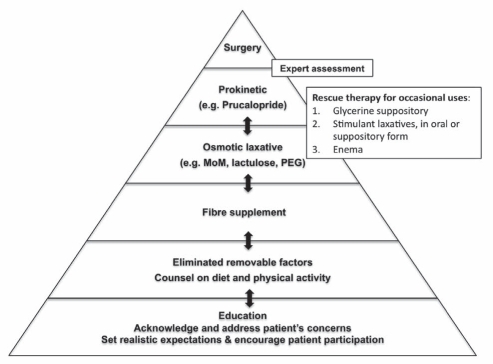
Constipation is a common functional gastrointestinal disorder that affects patients of all ages. In 2007, a consensus group of 10 Canadian gastroenterologists developed a set of recommendations pertaining to the management of chronic constipation and constipation dominant irritable bowel syndrome. Since then, tegaserod has been withdrawn from the Canadian market. A new, highly selective serotonin receptor subtype 4 agonist, prucalopride, has been examined in several large, randomized, placebo-controlled trials demonstrating its efficacy and safety in the management of patients with chronic constipation. Additional studies evaluating the use of stimulant laxatives, polyethylene glycol and probiotics in the management of chronic constipation have also been published. The present review summarizes the previous recommendations and new evidence supporting different treatment modalities - namely, diet and lifestyle, bulking agents, stool softeners, osmotic and stimulant laxatives, prucalopride and probiotics in the management of chronic constipation. A brief summary of lubiprostone and linaclotide is also presented. The quality of evidence is presented by adopting the Grading of Recommendations, Assessment, Development and Evaluation system. Finally, a management pyramid for patients with chronic constipation is proposed based on the quality of evidence, impact of each modality on constipation and on general health, and their availabilities in Canada.
La constipation chronique est un trouble gastro-intestinal fonctionnel commun qui touche des patients de tout âge. En 2007, un groupe consensuel de dix gastroentérologues canadiens a élaboré une série de recommandations portant sur la prise en charge de la constipation chronique et du syndrome du côlon irritable dominé par la constipation. Depuis, le tégasérod a été retiré du marché canadien. Le prucalopride, un nouvel agoniste hautement sélectif des récepteurs de la sérotonine de sous-type 4, a fait l’objet de plusieurs grands essais aléatoires et contrôlés contre placebo qui en démontrent l’efficacité et l’innocuité dans la prise en charge des patients atteints de constipation chronique. D’autres études publiées portent également sur l’utilisation des laxatifs stimulants, du polyéthylène glycol et des probiotiques dans la prise en charge de la constipation chronique. La présente analyse contient le résumé des recommandations antérieures et des nouvelles données probantes étayant diverses modalités thérapeutiques, notamment le régime et le mode de vie, les agents gonflants, les laxatifs émollients, les osmotiques et les laxatifs stimulants, le prucalopride et les probiotiques dans la prise en charge de la constipation. Un court résumé de la lubiprostone et du linaclotide est également présenté. La qualité des données probantes est présentée conformément au système de qualité, d’élaboration et d’évaluation des recommandations. Enfin, une pyramide de prise en charge des patients atteints de constipation chronique est présentée d’après la qualité des données probantes, les effets de chaque modalité sur la constipation et sur la santé générale ainsi que sur leur disponibilité au Canada.
Figures
References
-
- Higgins PD, Johanson JF. Epidemiology of constipation in North America: A systematic review. Am J Gastroenterol. 2004;99:750–9. - PubMed
-
- Wald A, Scarpignato C, Mueller-Lissner S, et al. A multinational survey of prevalence and patterns of laxative use among adults with self-defined constipation. Aliment Pharmacol Ther. 2008;28:917–30. - PubMed
-
- Tack J, Muller-Lissner S. Treatment of chronic constipation: Current pharmacologic approaches and future directions. Clin Gastroenterol Hepatol. 2009;7:502–8. 496. quiz. - PubMed
-
- Irvine EJ, Ferrazzi S, Pare P, Thompson WG, Rance L. Health-related quality of life in functional GI disorders: Focus on constipation and resource utilization. Am J Gastroenterol. 2002;97:1986–3. - PubMed
-
- Longstreth GF, Thompson WG, Chey WD, Houghton LA, Mearin F, Spiller RC. Functional bowel disorders. Gastroenterology. 2006;130:1480–91. - PubMed
Publication types
MeSH terms
Substances
LinkOut - more resources
Full Text Sources
Other Literature Sources
Medical