Review
. 2011 Dec;45(6):355-67.
doi: 10.1016/j.pediatrneurol.2011.08.010.

Genetic and biologic classification of infantile spasms

Affiliations
Review

Genetic and biologic classification of infantile spasms

Alex R Paciorkowski et al. Pediatr Neurol. 2011 Dec.

Abstract

Infantile spasms constitute an age-dependent epilepsy, highly associated with cognitive impairment, autism, and movement disorders. Previous classification systems focused on a distinction between symptomatic and cryptogenic etiologies, and have not kept pace with recent discoveries of mutations in genes in key pathways of central nervous system development in patients with infantile spasms. Children with certain genetic syndromes are much likelier to manifest infantile spasms, and we review the literature to propose a genetic classification of these disorders. Children demonstrating genetic associations with infantile spasms also manifest phenotypes beyond epilepsy that may be explained by recent advances in the understanding of underlying biological mechanisms. Therefore we propose a biologic classification of genes highly associated with infantile spasms, and articulate models for infantile spasms pathogenesis based on those data. The two best described pathways of pathogenesis involve abnormalities in the gene regulatory network of gamma-aminobutyric acidergic forebrain development and abnormalities in molecules expressed at the synapse. These genetic and biologic classifications are flexible, and they should encourage much needed progress in syndrome recognition, clinical genetic testing, and the development of new therapies targeting specific pathways of pathogenesis.


Figures

Figure 1
Figure 1
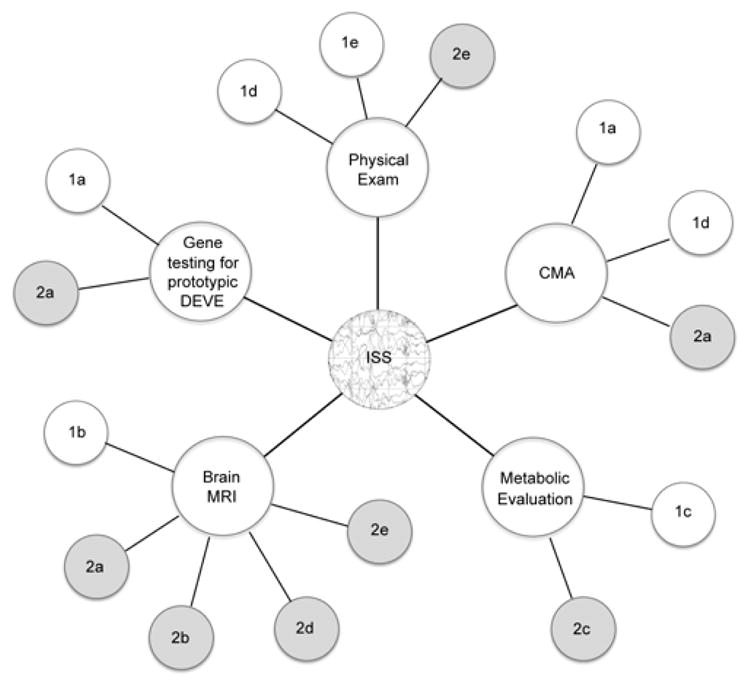
Evaluation of infantile spasms (ISS) using the classification system in Table 1. Diagnosis of ISS centers upon epileptic spasms associated with ictal electrodecrement. Evaluations may be carried out concurrently, depending upon the clinical scenario. Physical exam findings may lead to recognition of syndromes of genomic imbalance (Group 1d) such as Down syndrome, Williams syndrome, or Miller-Dieker syndrome; or may suggest other syndromes putatively associated with ISS (Group 1e); or recognizable genotype-unknown syndromes (Group 2e). Gene testing for the prototypic developmental epilepsies (DEVE) may find mutations in known associated genes (Group 1a); or if negative may suggest a genotype-unknown prototypic DEVE (Group 2a). Brain MRI may find specific structural brain malformations (Group 1b) and lead to specific follow-up genetic testing; or may reveal non-specific abnormalities associated with genotype-unknown prototypic DEVE (Group 2a), findings associated with genotype-unknown syndromes (Group 2b), extrinsic injury patterns (Group 2d), or recognizable abnormalities putatively associated with ISS (Group 2e). Metabolic evaluation may lead to identification of specific inborn errors of metabolism associated with ISS, leading to genetic testing for those disorders (Group 1c); or may reveal metabolic abnormalities associated with genotype-unknown conditions (Group 2c). Chromosomal microarray (CMA) may identify prototypic DEVE such as duplication of FOXG1 or deletion of CDKL5 or MEF2C (Group 1a); diagnose known syndromes of genomic imbalance associated with ISS (Group 1d); or may be negative suggesting a genotype-unknown prototypic DEVE (Group 2a).
Figure 2
Figure 2
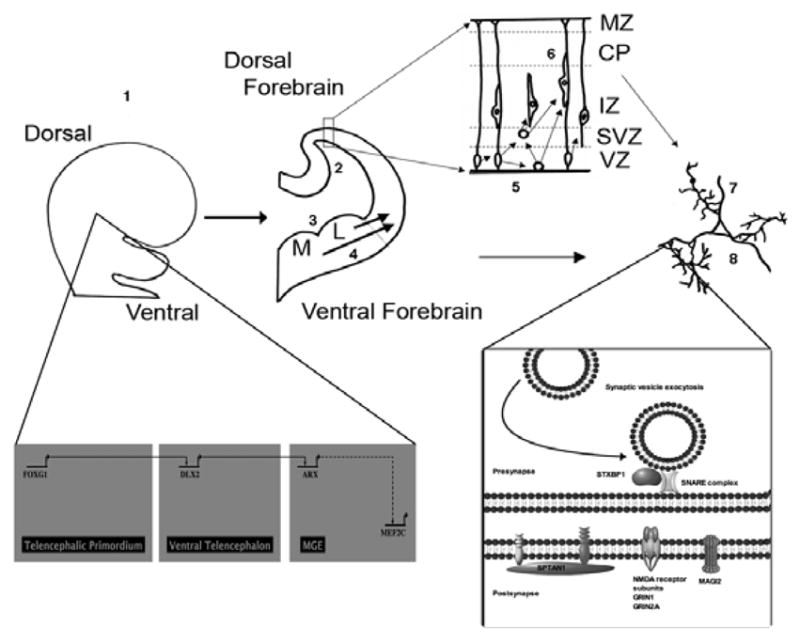
The two best characterized subgroups of ISS-associated genes illustrated with the stages of central nervous system (CNS) development. Group A includes transcription factors essential to CNS dorsal-ventral differentiation (FOXG1), affecting neuroprogenitor cells broadly, with downstream effects on synapse function, as well as ARX, which is involved in ventral GABAergic interneuron differentiation, migration, and synaptogenesis. MEF2C is probably involved in this process as well. Group D genes (GRIN1, GRIN2A, MAGI2, SPTAN1, STXBP1) encode binding proteins or receptors with direct roles in presynaptic and/or postsynaptic development and function. 1 = Dorsal-ventral differentiation; 2 = Dorsal neuroprogenitor cell proliferation; 3 = Ventral neuroprogenitor cell proliferation; 4 = GABAergic interneuron migration; 5 = Intermediate progenitor cell proliferation; 6 = Glutaminergic neuron migration; 7 = Axonogenesis; 8 = Synaptogenesis; Red = primary role in developmental stage; Pink = Secondary effect on developmental stage; L = lateral ganglionic eminence; M/MGE = medial ganglionic eminence; MZ = marginal zone; CP = cortical plate; IZ = intermediate zone; SVZ = subventricular zone; VZ = ventricular zone

References

    1. Lux AL, Osborne JP. A proposal for case definitions and outcome measures in studies of infantile spasms and West syndrome: consensus statement of the West Delphi group. Epilepsia. 2004;45:1416–1428. - PubMed
    1. Trevathan E, Murphy CC, Yeargin-Allsopp M. The descriptive epidemiology of infantile spasms among Atlanta children. Epilepsia. 1999;40:748–751. - PubMed
    1. Saemundsen E, Ludvigsson P, Rafnsson V. Risk of autism spectrum disorders after infantile spasms: a population-based study nested in a cohort with seizures in the first year of life. Epilepsia. 2008;49:1865–1870. - PubMed
    1. Philippi H, Wohlrab G, Bettendorf U, Borusiak P, Kluger G, Strobl K, Bast T. Electroencephalographic evolution of hypsarrhythmia: toward an early treatment option. Epilepsia. 2008;49:1859–1864. - PubMed
    1. Watanabe K, Negoro T, Aso K, Matsumoto A. Reappraisal of interictal electroencephalograms in infantile spasms. Epilepsia. 1993;34:679–685. - PubMed