


Differential patterns of abnormal activity and connectivity in the amygdala-prefrontal circuitry in bipolar-I and bipolar-NOS youth
- PMID: 22115148
- PMCID: PMC3268077
- DOI: 10.1016/j.jaac.2011.09.023
Differential patterns of abnormal activity and connectivity in the amygdala-prefrontal circuitry in bipolar-I and bipolar-NOS youth
Abstract
Objective: The functioning of neural systems supporting emotion processing and regulation in youth with bipolar disorder not otherwise specified (BP-NOS) remains poorly understood. We sought to examine patterns of activity and connectivity in youth with BP-NOS relative to youth with bipolar disorder type I (BP-I) and healthy controls (HC).
Method: Participants (18 BP-I youth, 16 BP-NOS youth, and 18 HC) underwent functional magnetic resonance imaging while performing two emotional-face gender labeling tasks (happy/neutral, fearful/neutral). Analyses focused on a priori neural regions supporting emotion processing (amygdala) and emotion regulation (ventromedial prefrontal cortex (VMPFC), dorsolateral prefrontal cortex (DLPFC). Connectivity analyses used VMPFC as a seed region.
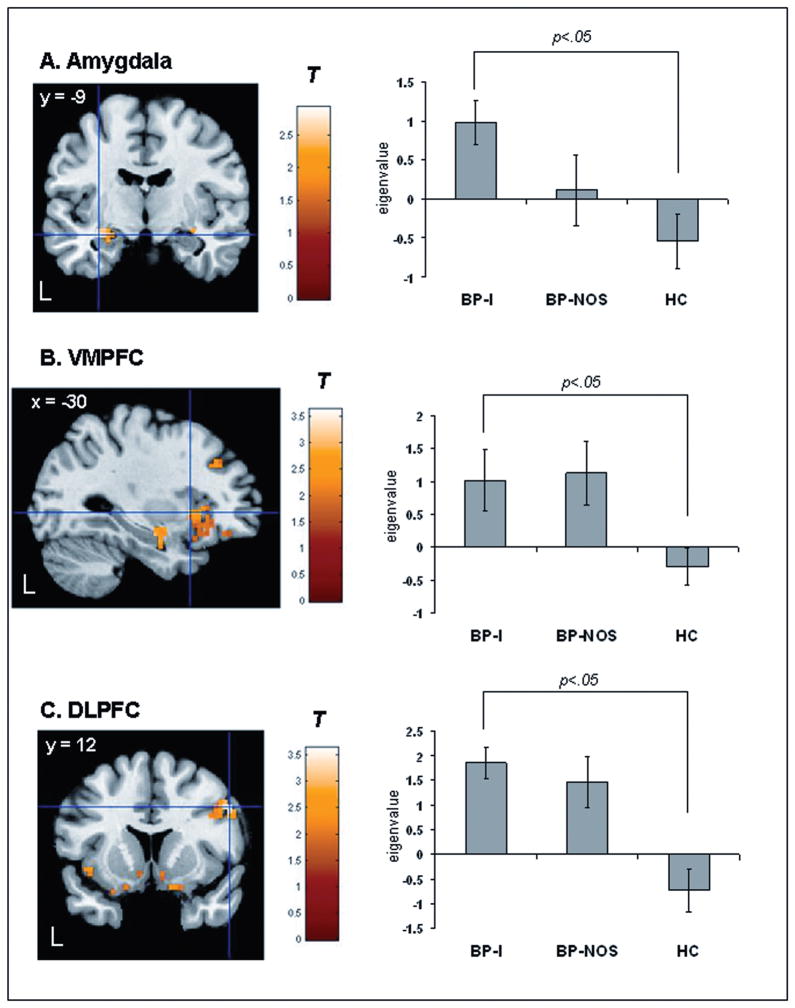
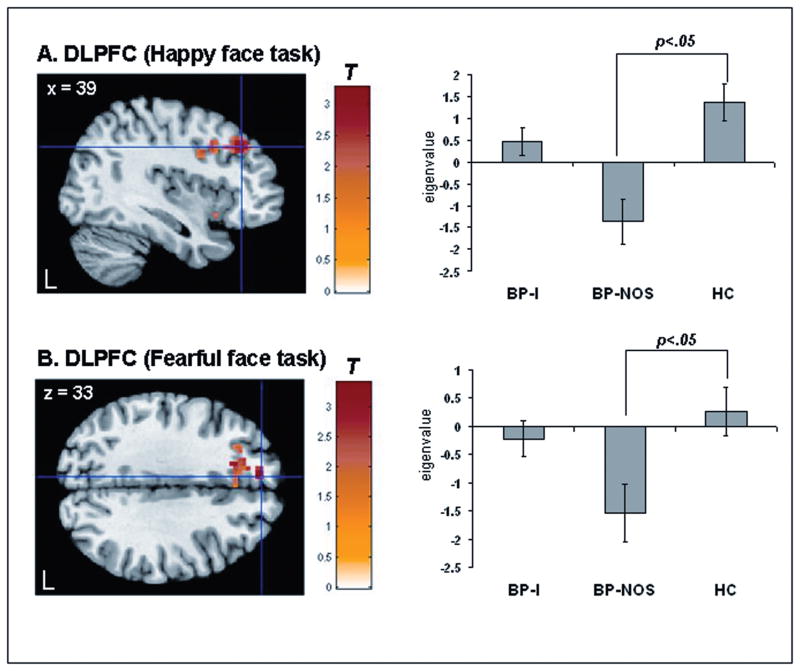
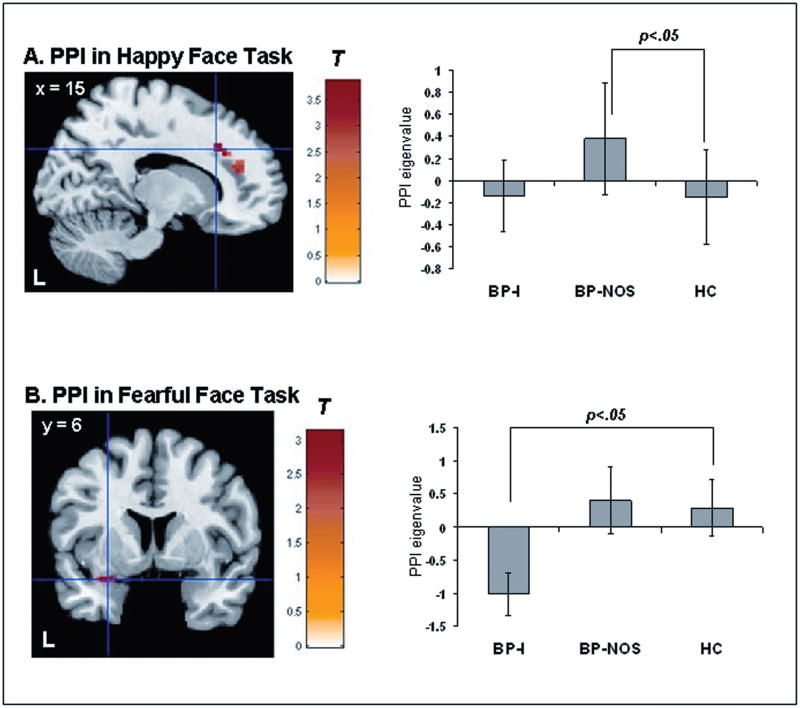
Results: During the happy-face task, BP-I youth had greater amygdala, VMPFC, and DLPFC activity to happy faces whereas BP-NOS youth had reduced VMPFC and DLPFC activity to neutral faces relative to HC, and reduced amygdala, VMPFC, and DLPFC activity to neutral faces versus BP-I. During the fearful-face task, BP-I youth had reduced DLPFC activity to fearful faces whereas BP-NOS youth had reduced DLPFC activity to neutral faces relative to HC. BP-NOS youth showed greater VMPFC-DLPFC connectivity to happy faces relative to HC and BP-I youth. BP-I youth showed reduced VMPFC-amygdala connectivity to fearful faces relative to HC and BP-NOS youth.
Conclusions: This is the first study to document differential patterns of abnormal neural activity in, and connectivity between, neural regions supporting emotion processing and regulation in BP-NOS versus BP-I youth. Findings suggest that despite similarities in symptom presentation, there are differential patterns of abnormal neural functioning in BP-NOS and BP-I relative to HC, which might reflect an "intermediate state" in the course of BP-I illness. Future longitudinal studies are needed to relate these findings with future conversion to BP-I/II.
Copyright © 2011 American Academy of Child and Adolescent Psychiatry. Published by Elsevier Inc. All rights reserved.
Figures
References
-
- Phillips ML, Drevets WC, Rauch SL, Lane R. Neurobiology of emotion perception II: Implications for major psychiatric disorders. Biol Psychiatry. 2003;54:515–528. - PubMed
-
- Charney DS, Babich KS. Foundation for the NIMH strategic plan for mood disorders research. Biol Psychiatry. 2002;52(6):455–456. - PubMed
-
- Phillips ML, Frank E. Redefining Bipolar Disorder: Toward DSM-V. Am J Psychiatry. 2006;163:1135–1136. - PubMed
