


Invasive Acer negundo outperforms native species in non-limiting resource environments due to its higher phenotypic plasticity
- PMID: 22115342
- PMCID: PMC3275484
- DOI: 10.1186/1472-6785-11-28
Invasive Acer negundo outperforms native species in non-limiting resource environments due to its higher phenotypic plasticity
Abstract
Background: To identify the determinants of invasiveness, comparisons of traits of invasive and native species are commonly performed. Invasiveness is generally linked to higher values of reproductive, physiological and growth-related traits of the invasives relative to the natives in the introduced range. Phenotypic plasticity of these traits has also been cited to increase the success of invasive species but has been little studied in invasive tree species. In a greenhouse experiment, we compared ecophysiological traits between an invasive species to Europe, Acer negundo, and early- and late-successional co-occurring native species, under different light, nutrient availability and disturbance regimes. We also compared species of the same species groups in situ, in riparian forests.
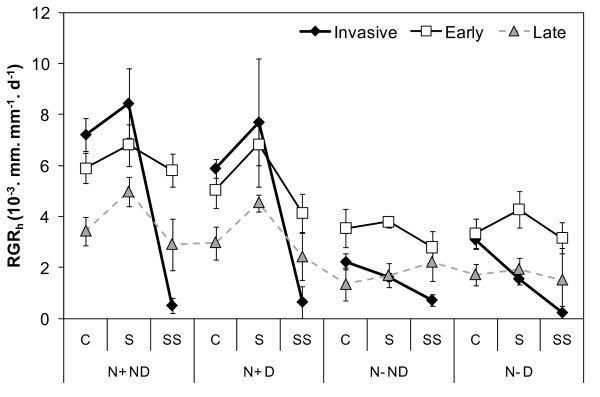
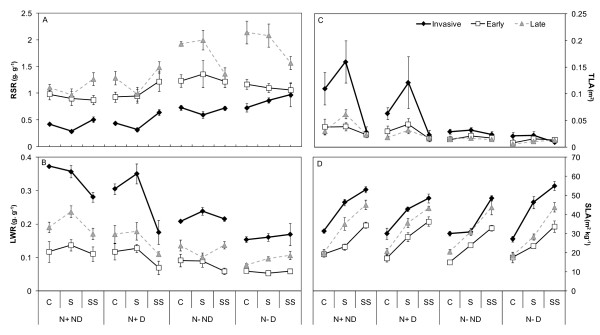
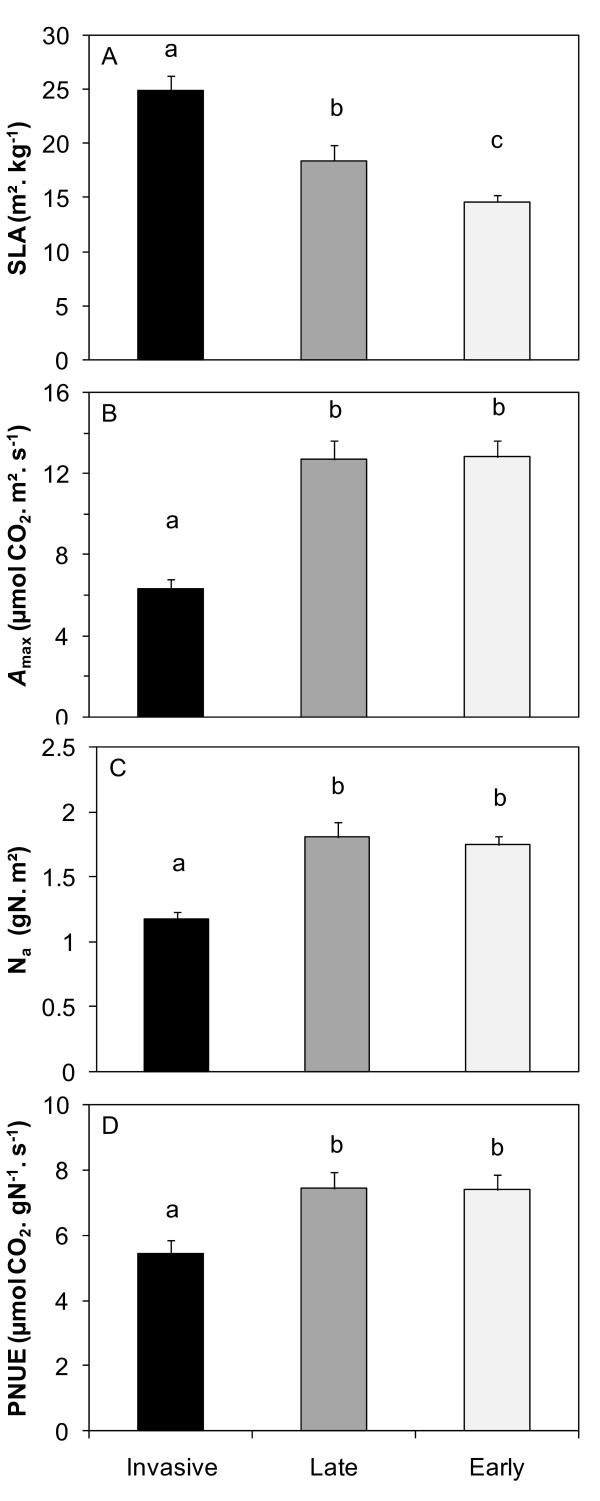
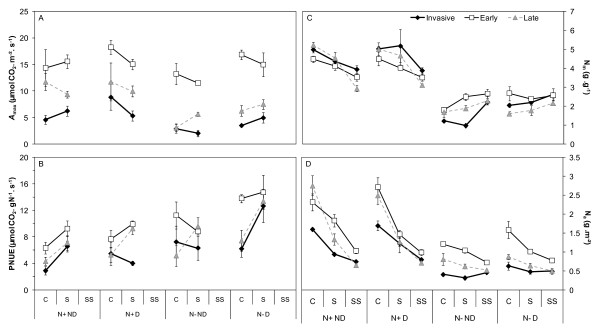
Results: Under non-limiting resources, A. negundo seedlings showed higher growth rates than the native species. However, A. negundo displayed equivalent or lower photosynthetic capacities and nitrogen content per unit leaf area compared to the native species; these findings were observed both on the seedlings in the greenhouse experiment and on adult trees in situ. These physiological traits were mostly conservative along the different light, nutrient and disturbance environments. Overall, under non-limiting light and nutrient conditions, specific leaf area and total leaf area of A. negundo were substantially larger. The invasive species presented a higher plasticity in allocation to foliage and therefore in growth with increasing nutrient and light availability relative to the native species.
Conclusions: The higher level of plasticity of the invasive species in foliage allocation in response to light and nutrient availability induced a better growth in non-limiting resource environments. These results give us more elements on the invasiveness of A. negundo and suggest that such behaviour could explain the ability of A. negundo to outperform native tree species, contributes to its spread in European resource-rich riparian forests and impedes its establishment under closed-canopy hardwood forests.
Figures
References
-
- Mack RN, Simberloff D, Lonsdale WM, Evans H, Clout M, Bazzaz FA. Biotic invasions: Causes, epidemiology, global consequences, and control. Ecol Applic. 2000;10:689–710.
-
- Pimentel D, Zuniga R, Morrison D. Update on the environmental and economic costs associated with alien-invasive species in the United States. Ecol Econ. 2005;52:273–288.
-
- Vitousek PM, Dantonio CM, Loope LL, Rejmanek M, Westbrooks R. Introduced species: A significant component of human-caused global change. New Zeal J Ecol. 1997;21:1–16.
-
- Richardson DM, Pysek P. Plant invasions: merging the concepts of species invasiveness and community invasibility. Prog Phys Geog. 2006;30:409–431.
-
- Sakai AK, Allendorf FW, Holt JS, Lodge DM, Molofsky J, With KA, Baughman S, Cabin RJ, Cohen JE, Ellstrand NC. et al. The population biology of invasive species. Ann Rev Ecol Syst. 2001;32:305–332.
Publication types
MeSH terms
LinkOut - more resources
Full Text Sources
