Review
. 2012 Feb;26(2):194-201.
doi: 10.1038/eye.2011.299. Epub 2011 Nov 25.

Diagnostic dilemmas in retinitis and endophthalmitis

Affiliations
Review

Diagnostic dilemmas in retinitis and endophthalmitis

J L Davis. Eye (Lond). 2012 Feb.

Abstract

Visual loss in infectious posterior uveitis or panuveitis can occur if proper therapy is delayed because of diagnostic uncertainty. Some disorders, such as acute retinal necrosis and bacterial endophthalmitis, can be rapidly progressive, and therefore require prompt and accurate diagnosis to guide initial therapy. Other more slowly evolving infections, such as toxoplasmic chorioretinitis or fungal endophthalmitis, can be worsened by empiric use of corticosteroids without specific antimicrobial coverage. Key ocular diagnostic features are helpful but highly variable with overlap with both non-infectious uveitis and neoplastic masquerades, even for key signs such as hypopyon. Close examination of the fundus with attention to color, location, size, border, and opacity of lesions and associated arteriolitis or frosted branch angiitis is helpful in the diagnosis of chorioretinitis. Ultrasonography is an important tool in the evaluation of eyes with suspected endophthalmitis, especially those with intracapsular infection or focal infected deposits. Testing of intraocular fluid can be extremely useful but suffers from inaccessibility, poor sensitivity, and test selections dependent on a presumptive diagnosis, which may be wrong. The dilemma for clinician is to make the correct diagnosis of a rare, blinding, variegated disease quickly enough to intercede with specific therapy or to apply empiric therapy in a sufficiently skilled manner to avert disaster and confirm the diagnosis by response to treatment. When non-infectious uveitis is in the differential, empiric corticosteroids must sometimes be used, at great risk, if clinical examination, ancillary testing, and any available intraocular diagnostic tests have failed to confirm a diagnosis.


Figures
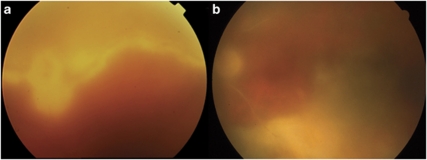
Figure 1
Figure 1
Diffuse toxoplasmosis. The chorioretinitis was initially misdiagnosed as acute retinal necrosis. (a) This elderly man may have acquired toxoplasmosis while he gardened at his new home; he was IgM and IgG antibody positive for toxoplasmosis. Note the focal lesion on the left that appears to have spread diffusely into a smooth-bordered chorioretinitis. There is vitreous haze. PCR from the vitreous was positive for toxoplasmosis. (b) This elderly woman developed what appeared to be a classic focal reactivation of toxoplasmic chorioretinitis after cataract extraction. She was treated with multiple courses of doxycycline, recurring each time the medication was stopped. The infection spread inferiorly and temporally. Vision was hand motions only.
Figure 2
Figure 2
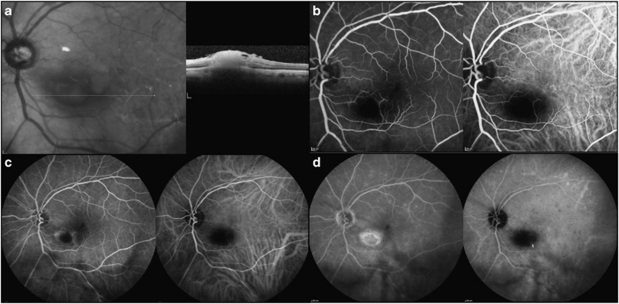
Imaging studies of toxoplasmic focal chorioretinitis. (a) OCT image through lesion showing inner retinal hyperreflectivity with shadowing of the outer retina and choroid. (b) Early angiogram, 50 s. There is hypofluorescence of the lesion in both the fluorescein (left) and the indocyanine angiogram (right). (c) Mid-phase of the angiogram, 2.33 min. Hyperfluorescence begins at the edge of the focal lesion. The ICG remains hypofluorescent. (d) Late angiogram, 15.11 min. The lesion is almost fully stained with fluorescein. In the ICG the lesion is hypofluorescent and surrounded by dark dots most visible in the temporal macula.
Figure 3
Figure 3
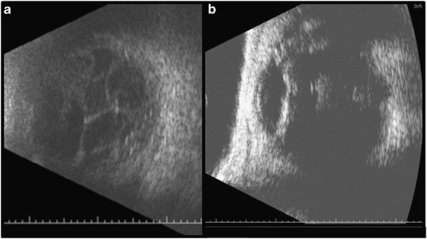
Ultrasonography in the diagnosis of postoperative endophthalmitis. (a) Classic appearance of vitreous stands and membranes on B-scan ultrasound. Variations in gain can alter the appearance of the vitreous opacities. (b) Capsular hyperreflectivity in a case of delayed onset endophthalmitis with dense intracapsular deposits. The vitreous contains some dense deposits but is not diffusely infiltrated. Absence of vitreous inflammation or opacities is suggestive that endophthalmitis is not present, except for limited anterior forms.
Figure 4
Figure 4
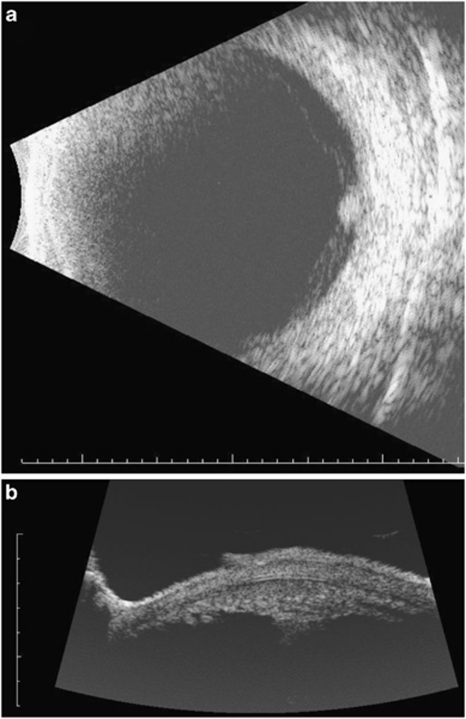
Persistent fungal endophthalmitis following pars plana vitrectomy and removal of infected capsular bag. During a second surgery the entire bag and lens implant were removed, but inflammation persisted. Ultrasound confirmed focal deposits in the ciliary body region in the meridian where the infected capsular plaques had been noted. (a) Anterior to the equator at 3:00 (3EA) there is a focal deposit in the ciliary body region. (b) Anterior segment B scan confirms a ciliary body deposit at the 3:00 position (3T). Notice the ciliary processes to the left of the deposit. At surgery, a focal white deposit was found between 3 and 4:00 adherent to the ciliary processes. Removal of it with the vitreous cutter and picks followed by repeated injections of amphotericin enabled the infection to be cured.

References

    1. Deschenes J, Murray PI, Rao NA, Nussenblatt RB, International Uveitis Study Group International Uveitis Study Group (IUSG): clinical classification of uveitis. Ocul Immunol Inflamm. 2008;16:1–2. - PubMed
    1. Chiquet C, Cornut PL, Benito Y, Thuret G, Maurin M, Lafontaine PO, French Institutional Endophthalmitis Study Group et al. Eubacterial PCR for bacterial detection and identification in 100 acute postcataract surgery endophthalmitis. Invest Ophthalmol Vis Sci. 2008;49:1971–1978. - PubMed
    1. Balansard B, Bodaghi B, Cassoux N, Fardeau C, Romand S, Rozenberg F, et al. Necrotising retinopathies simulating acute retinal necrosis syndrome. Br J Ophthalmol. 2005;89:96–101. - PMC - PubMed
    1. McKelvie PA, Francis IC, Watson S, Nuovo G. Multifocal chorioretinal atrophy associated with herpes zoster ophthalmicus. Clin Exp Ophthalmol. 2001;29:429–432. - PubMed
    1. Gupta A, Bansal R, Gupta V, Sharma A, Bambery P. Ocular signs predictive of tubercular uveitis. Am J Ophthalmol. 2010;149:562–570. - PubMed

Publication types

MeSH terms