. 2012 Feb;43(2):514-23.
doi: 10.1161/STROKEAHA.111.627562. Epub 2011 Nov 23.

Amyloid-β contributes to blood-brain barrier leakage in transgenic human amyloid precursor protein mice and in humans with cerebral amyloid angiopathy

Affiliations

Amyloid-β contributes to blood-brain barrier leakage in transgenic human amyloid precursor protein mice and in humans with cerebral amyloid angiopathy

Anika M S Hartz et al. Stroke. 2012 Feb.

Abstract

Background and purpose: Cerebral amyloid angiopathy (CAA) is a degenerative disorder characterized by amyloid-β (Aβ) deposition in the blood-brain barrier (BBB). CAA contributes to injuries of the neurovasculature including lobar hemorrhages, cortical microbleeds, ischemia, and superficial hemosiderosis. We postulate that CAA pathology is partially due to Aβ compromising the BBB.

Methods: We characterized 19 patients with acute stroke with "probable CAA" for neurovascular pathology based on MRI and clinical findings. Also, we studied the effect of Aβ on the expression of tight junction proteins and matrix metalloproteases (MMPs) in isolated rat brain microvessels.

Results: Two of 19 patients with CAA had asymptomatic BBB leakage and posterior reversible encephalopathic syndrome indicating increased BBB permeability. In addition to white matter changes, diffusion abnormality suggesting lacunar ischemia was found in 4 of 19 patients with CAA; superficial hemosiderosis was observed in 7 of 9 patients. Aβ(40) decreased expression of the tight junction proteins claudin-1 and claudin-5 and increased expression of MMP-2 and MMP-9. Analysis of brain microvessels from transgenic mice overexpressing human amyloid precursor protein revealed the same expression pattern for tight junction and MMP proteins. Consistent with reduced tight junction and increased MMP expression and activity, permeability was increased in brain microvessels from human amyloid precursor protein mice compared with microvessels from wild-type controls.

Conclusions: Our findings indicate that Aβ contributes to changes in brain microvessel tight junction and MMP expression, which compromises BBB integrity. We conclude that Aβ causes BBB leakage and that assessing BBB permeability could potentially help characterize CAA progression and be a surrogate marker for treatment response.


Figures
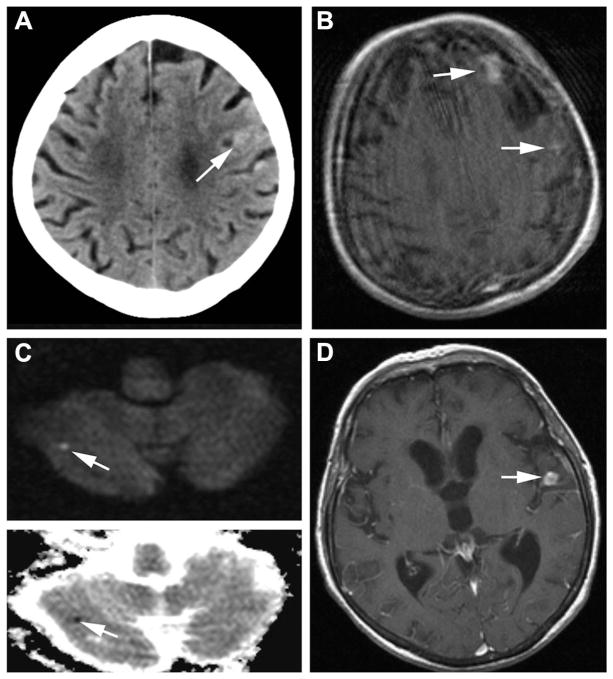
Figure 1
Figure 1
Imaging data of Patient 1. A, Day 19 after initial presentation: cranial CT showing left frontal small subarachnoid hemorrhage. B, Day 22: postcontrast T1-MRI showing left frontal and small left parietal area of contrast enhancement. C, Day 28: diffusion-weighted imaging (upper) and apparent diffusion coefficient (lower) showing small right cerebellar infarct. D, Day 28: postcontrast T1-MRI showing new area of contrast enhancement, whereas left frontal lesion disappeared.
Figure 2
Figure 2
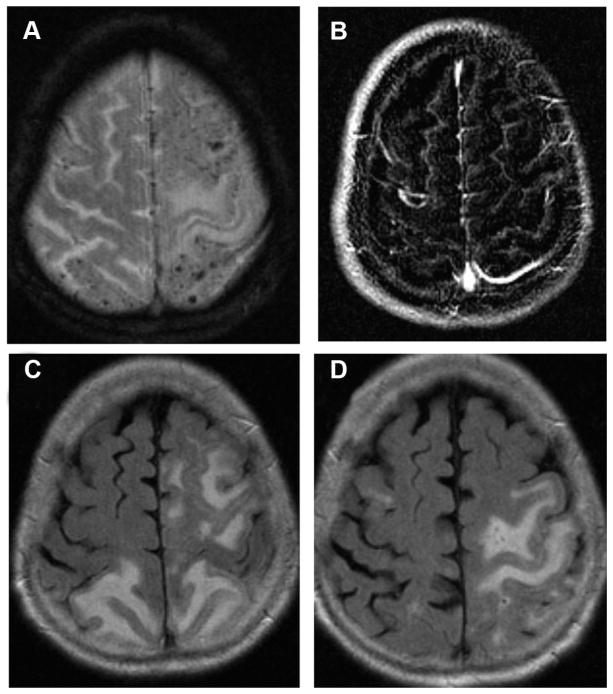
Imaging data for Patient 6 with CAA and PRES. A, MRI with T2* FLASH sequences showing multiple microhemorrhages. B, Subtraction image demonstrating BBB leakage around a small micro-hemorrhage. C, FLAIR image with occipital edema. D, FLAIR image 2 months later with new left parietal and no occipital edema. CAA indicates cerebral amyloid angiopathy; PRES, posterior reversible encephalopathic syndrome; FLASH, fast low-angle shot; BBB, blood–brain barrier; FLAIR, fluid-attenuated inversion recovery.
Figure 3
Figure 3
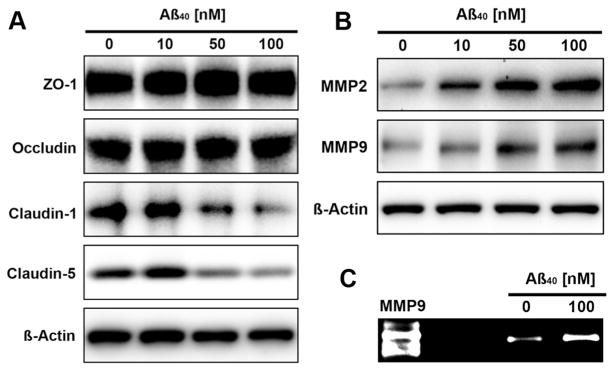
Aβ effects on tight junction (TJ) proteins and MMPs in brain microvessels. Western blots showing concentration-dependent (A) reduction of the TJ proteins claudin-1 and claudin-5 and (B) increase of the matrix metalloproteases MMP-2 and MMP-9 in rat brain microvessels exposed to human Aβ40 for 6 hours. Expression of the TJ proteins ZO-1 and occludin remained unchanged. C, Zymogram showing increased MMP-9 activity in isolated brain microvessels that were exposed to 100 nmol/L Aβ40 for 6 hours. Aβ indicates amyloid-β.
Figure 4
Figure 4
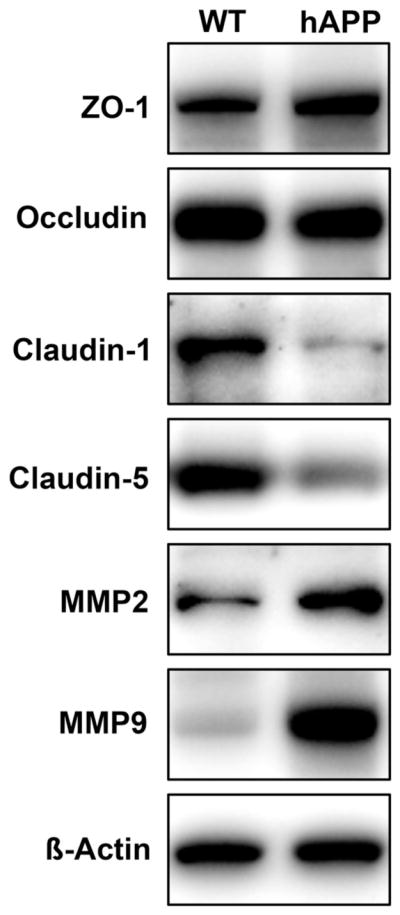
TJ proteins and MMPs in brain microvessels from hAPP mice. Western blots showing reduction of claudin-1 and claudin-5 and increase of MMP-2 and MMP-9 in brain microvessels from hAPP mice. Expression of ZO-1 and occludin remained unchanged. TJ indicates tight junction; MMP, matrix metalloprotease; hAPP, human amyloid precursor protein.
Figure 5
Figure 5
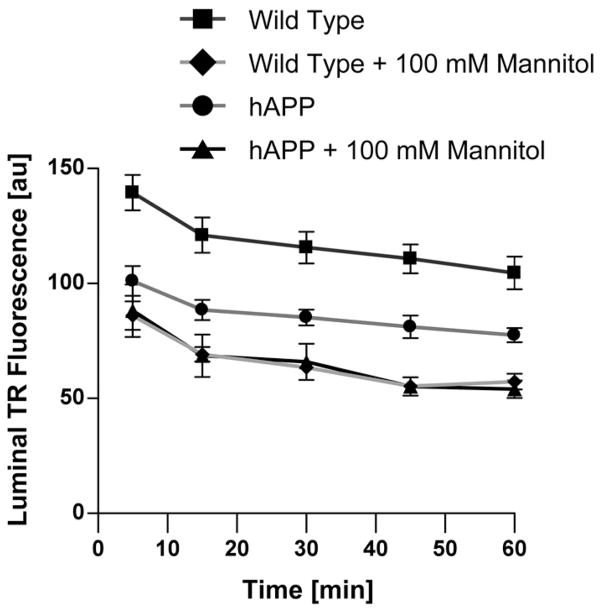
Permeability of brain microvessels from hAPP mice. Efflux of the fluorescence dye Texas red (TR) was monitored over 60 minutes in microvessels from wild-type and hAPP mice with/without mannitol used as positive control for barrier opening. Data are mean±SEM for 7 brain microvessels per time point from 1 microvessel isolation from 20 mice; SEM are in the range 3.1 to 11.4. Shown are arbitrary units (0–255). First-order efflux rates were calculated using nonlinear regression. hAPP indicates human amyloid precursor protein.

References

    1. Love S, Miners S, Palmer J, Chalmers K, Kehoe P. Insights into the pathogenesis and pathogenicity of cerebral amyloid angiopathy. Front Biosci. 2009;14:4778–4792. - PubMed
    1. Maia LF, Mackenzie IR, Feldman HH. Clinical phenotypes of cerebral amyloid angiopathy. J Neurol Sci. 2007;257:23–30. - PubMed
    1. Nitta T, Hata M, Gotoh S, Seo Y, Sasaki H, Hashimoto N, et al. Size-selective loosening of the blood–brain barrier in claudin-5-deficient mice. J Cell Biol. 2003;161:653–660. - PMC - PubMed
    1. Chow N, Bell RD, Deane R, Streb JW, Chen J, Brooks A, et al. Serum response factor and myocardin mediate arterial hypercontractility and cerebral blood flow dysregulation in Alzheimer’s phenotype. Proc Natl Acad Sci U S A. 2007;104:823–828. - PMC - PubMed
    1. Knudsen KA, Rosand J, Karluk D, Greenberg SM. Clinical diagnosis of cerebral amyloid angiopathy: validation of the Boston criteria. Neurology. 2001;56:537–539. - PubMed

Publication types

MeSH terms