


Effects of lifestyle intervention in persons at risk for type 2 diabetes mellitus - results from a randomised, controlled trial
- PMID: 22117618
- PMCID: PMC3247299
- DOI: 10.1186/1471-2458-11-893
Effects of lifestyle intervention in persons at risk for type 2 diabetes mellitus - results from a randomised, controlled trial
Abstract
Background: Lifestyle change is probably the most important single action to prevent type 2 diabetes mellitus. The purpose of this study was to assess the effects of a low-intensity individual lifestyle intervention by a physician and compare this to the same physician intervention combined with an interdisciplinary, group-based approach in a real-life setting.
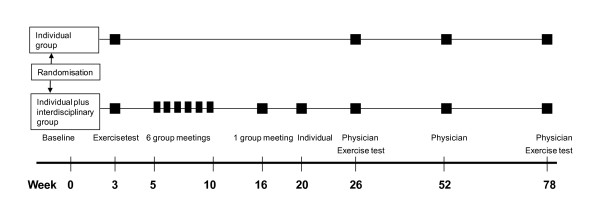
Methods: The "Finnish Diabetes Risk score" (FINDRISC) was used by GPs to identify individuals at high risk. A randomised, controlled design and an 18 month follow-up was used to assess the effect of individual lifestyle counselling by a physician (individual physician group, (IG)) every six months, with emphasis on diet and exercise, and compare this to the same individual lifestyle counselling combined with a group-based interdisciplinary program (individual and interdisciplinary group, (IIG)) provided over 16 weeks. Primary outcomes were changes in lifestyle indicated by weight reduction ≥ 5%, improvement in exercise capacity as assessed by VO2 max and diet improvements according to the Smart Diet Score (SDS).
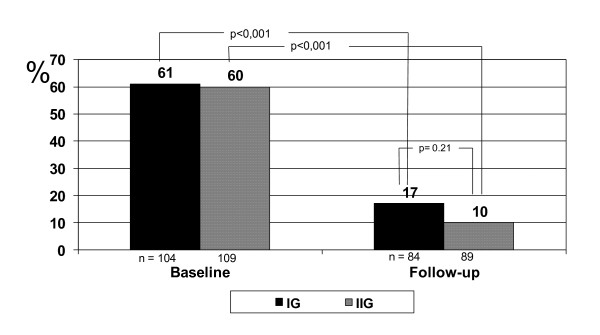
Results: 213 participants (104 in the IG and 109 in the IIG group, 50% women), with a mean age of 46 and mean body mass index 37, were included (inclusion rate > 91%) of whom 182 returned at follow-up (drop-out rate 15%). There were no significant differences in changes in lifestyle behaviours between the two groups. At baseline 57% (IG) and 53% (IIG) of participants had poor aerobic capacity and after intervention 35% and 33%, respectively, improved their aerobic capacity at least one metabolic equivalent. Unhealthy diets according to SDS were common in both groups at baseline, 61% (IG) and 60% (IIG), but uncommon at follow-up, 17% and 10%, respectively. At least 5% weight loss was achieved by 35% (IG) and 28% (IIG). In the combined IG and IIG group, at least one primary outcome was achieved by 93% while all primary outcomes were achieved by 6%. Most successful was the 78% reduction in the proportion of participants with unhealthy diet (almost 50% absolute reduction).
Conclusion: It is possible to achieve important lifestyle changes in persons at risk for type 2 diabetes with modest clinical efforts. Group intervention yields no additional effects. The design of the study, with high inclusion and low dropout rates, should make the results applicable to ordinary clinical settings.
Trial registration: ClinicalTrials.gov: NCT00202748.
Figures

References
-
- van Dam RM. The epidemiology of lifestyle and risk for type 2 diabetes. Eur J Epidemiol. 2003;18(12):1115–25. - PubMed
Publication types
MeSH terms
Associated data
LinkOut - more resources
Full Text Sources
Medical
