


Review
doi: 10.1016/j.coi.2011.10.007.
Epub 2011 Nov 24.
B cells and autoimmunity
Affiliations
- PMID: 22119110
- PMCID: PMC3268048
- DOI: 10.1016/j.coi.2011.10.007
Item in Clipboard
Review
B cells and autoimmunity
Curr Opin Immunol.
2011 Dec.
Abstract
There is a growing appreciation for the role for B cells in autoimmune disorders in which inflammation is driven by T cells, in addition to the well-established role for B cells in autoimmune disorders characterized by pathogenic auto-antibodies. Current information on tolerance checkpoints in B cells, B cell depletion, BAFF blockade, regulatory B cells and clonal ignorance mediated by the SIAE/Siglec pathway will be reviewed.
Copyright © 2011. Published by Elsevier Ltd.
Figures
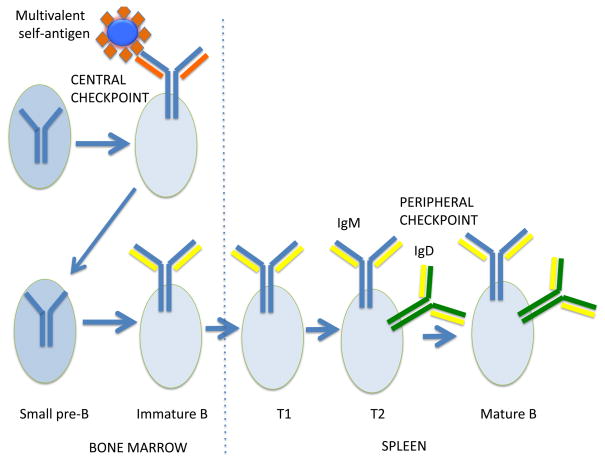
Immature B cells in the bone marrow that encounter multivalent self antigens revert to the small pre-B stage, continue to rearrange κ and if necessary λ light chain genes and generate newly generated B cells that have a novel light chain that is no longer self-reactive. Immature B cells with novel light chains that are no longer part of a self-reactive B cell receptor, then migrate to the periphery as T1 B cells where they mature into newly generated IgM and IgD expressing recirculating T2 B cells and then into mature recirculating B cells.
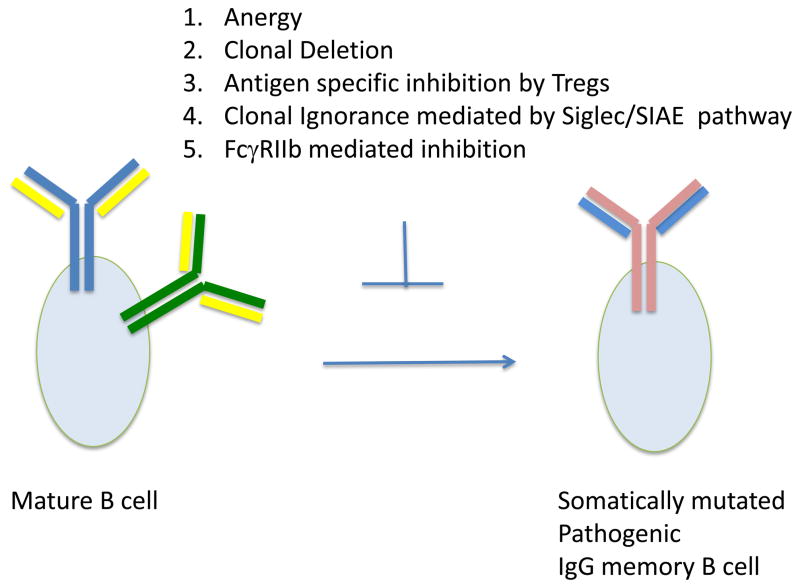
These mechanisms include anergy, clonal deletion, specific inhibition of naïve B cells by Tregs in an MHC class II and CD40L dependent manner, clonal inhibition by the Siglec/SIAE pathway, and inhibition by FcγRIIb.
References
-
- Shlomchik MJ, Marshak-Rothstein A, Wolfowicz CB, Rothstein TL, Weigert MG. The role of clonal selection and somatic mutation in autoimmunity. Nature. 1987;328:805–811. - PubMed
-
- Pelanda R, Schwers S, Sonoda E, Torres RM, Nemazee D, Rajewsky K. Receptor editing in a transgenic mouse model: site, efficiency, and role in B cell tolerance and antibody diversification. Immunity. 1997;7:765–775. This was the first study using BCR knockin mice to explore the phenomenon of receptor editing, established in conventional BCR transgenic mice in the studies in references 2 and 3. - PubMed
-
- Halverson R, Torres RM, Pelanda R. Receptor editing is the main mechanism of B cell tolerance toward membrane antigens. Nature immunology. 2004;5:645–650. - PubMed
Publication types
MeSH terms
Substances
Grants and funding
LinkOut - more resources
Full Text Sources
