


Selective molecular recognition in amyloid growth and transmission and cross-species barriers
- PMID: 22119878
- PMCID: PMC6407624
- DOI: 10.1016/j.jmb.2011.11.023
Selective molecular recognition in amyloid growth and transmission and cross-species barriers
Abstract
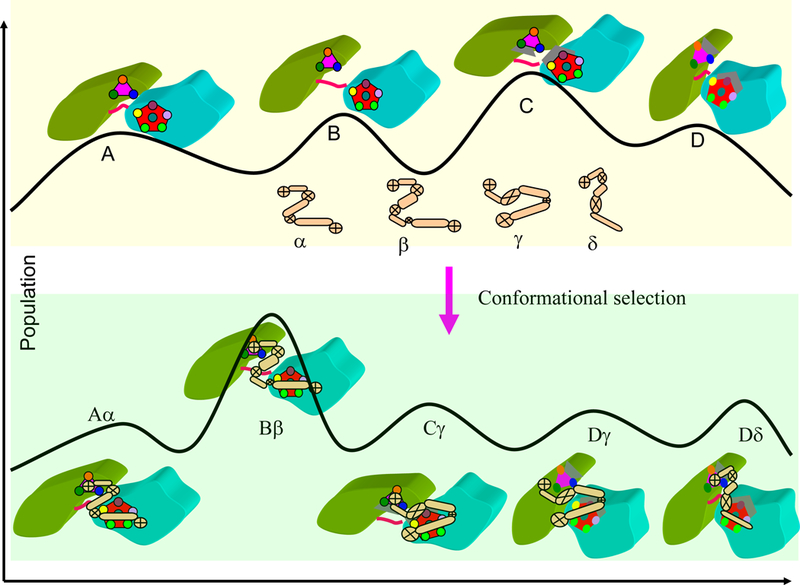
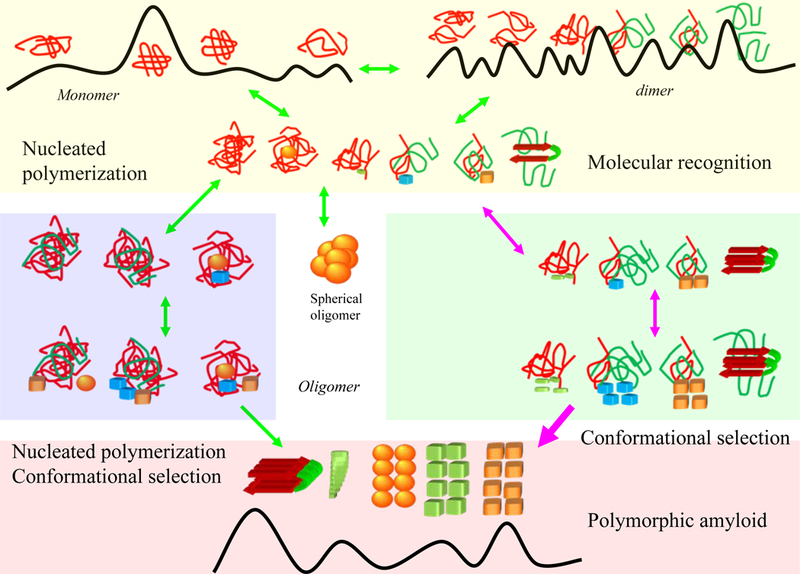
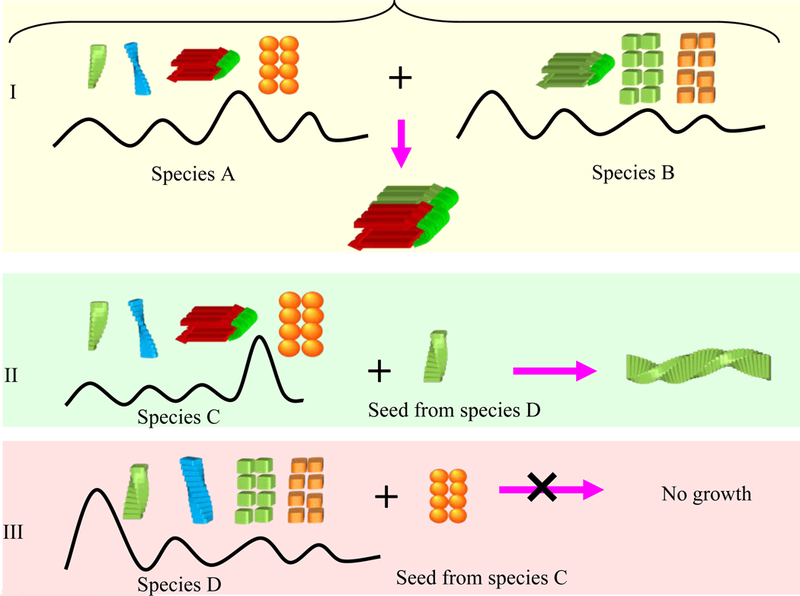
Mutual conformational selection and population shift followed by minor induced-fit optimization is the key mechanism in biomolecular recognition, and monomers and small oligomers binding to amyloid seeds in fibril growth is a molecular recognition event. Here, we describe amyloid aggregation, preferred species, cross-species barriers and transmission within the broad framework of molecular recognition. Cross-seeding of amyloid species is governed by conformational selection of compatible (complementary) states. If the dominant conformations of two species are similar, they can cross-seed each other; on the other hand, if they are sufficiently different, they will grow into different fibrils, reflecting species barriers. Such a scenario has recently been observed for the tau protein, which has four repeats. While a construct consisting of repeats 1, 3 and 4 can serve as a seed for the entire four-repeat tau segment, the inverse does not hold. On the other hand, the tau protein repeats with the characteristic U-turn shape can cross-seed Alzheimer's amyloid β and, similarly, the islet amyloid polypeptide. Within this framework, we suggest that the so-called "central dogma" of amyloid formation, where aggregation takes place through nonspecific backbone hydrogen bonding interactions, which are common to all peptides and proteins, is a simple reflection of the heterogeneous, polymorphic free-energy landscape of amyloid species. Here, we review available data and make some propositions addressing this key problem. In particular, we argue that recent theoretical and experimental observations support the key role of selective molecular recognition in amyloidosis and in determining cross-species barriers and transmission.
Copyright © 2011 Elsevier Ltd. All rights reserved.
Figures
References
-
- Carrell RW & Lomas DA (1997). Conformational disease. Lancet 350, 134–8. - PubMed
-
- Kirkitadze MD, Bitan G & Teplow DB (2002). Paradigm shifts in Alzheimer’s disease and other neuro degenerative disorders: The emerging role of oligomeric assemblies. Journal of Neuroscience Research 69, 567–577. - PubMed
-
- Walsh DM & Selkoe DJ (2004). Oligomers on the brain: the emerging role of soluble protein aggregates in neurodegeneration. Protein Pept Lett 11, 213–28. - PubMed
-
- Hardy J & Selkoe DJ (2002). Medicine - The amyloid hypothesis of Alzheimer’s disease: Progress and problems on the road to therapeutics. Science 297, 353–356. - PubMed
-
- Kayed R, Head E, Thompson JL, McIntire TM, Milton SC, Cotman CW & Glabe CG (2003). Common structure of soluble amyloid oligomers implies common mechanism of pathogenesis. Science 300, 486–489. - PubMed
Publication types
MeSH terms
Substances
Grants and funding
LinkOut - more resources
Full Text Sources
