


doi: 10.2217/ahe.11.56.
The aging immune system and its relationship with cancer
Affiliations
- PMID: 22121388
- PMCID: PMC3222953
- DOI: 10.2217/ahe.11.56
Item in Clipboard
The aging immune system and its relationship with cancer
Aging health.
.
Abstract
The incidence of most common cancers increases with age. This occurs in association with, and is possibly caused by a decline in immune function, termed immune senescence. Although the size of the T-cell compartment is quantitatively maintained into older age, several deleterious changes (including significant changes to T-cell subsets) occur over time that significantly impair immunity. This article highlights some of the recent findings regarding the aging immune system, with an emphasis on the T-cell compartment and its role in cancer.
Figures
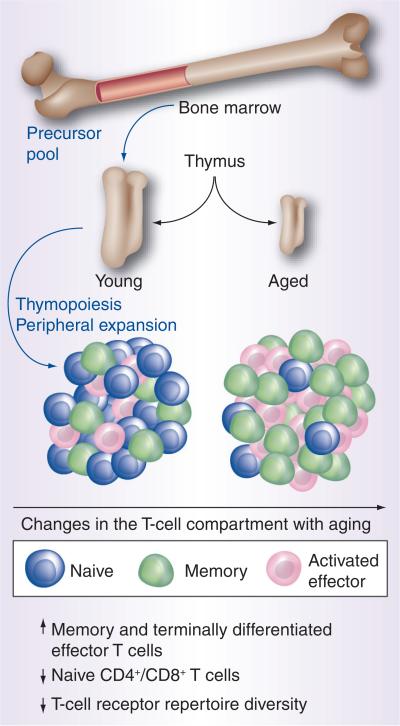
The young thymus supports more robust thymopoiesis with naive cells, which have the greatest T-cell receptor repertoire diversity and comprise the largest proportion of T cells. With aging, thymus involution occurs and there is progressive loss of T-cell receptor repertoire diversity with the decreased population of naive T cells and there is an enlarged memory component that secretes most type 1 and 2 cytokines. With repeated stimulation, the memory cells give rise to activated effector T cells, which are oligoclonal and have the most restricted T-cell receptor repertoire.
References
-
- Fulop T, Kotb R, Fortin CF, Pawelec G, De Angelis F, Larbi A. Potential role of immunosenescence in cancer development. Ann. NY Acad. Sci. 2010;1197:158–165. - PubMed
-
- Hakim FT, Flomerfelt FA, Boyiadzis M, Gress RE. Aging, immunity and cancer. Curr. Opin. Immunol. 2004;16(2):151–156. - PubMed
-
- Hakim FT, Gress RE. Immunosenescence: deficits in adaptive immunity in the elderly. Tissue Antigens. 2007;70(3):179–189. - PubMed
-
- Sportès C, Hakim FT. Aging, immunity and cancer. In: Fulop T, Franceschi C, Hirokawa K, Pawelec G, editors. Handbook on Immunosenescence: Basic Understanding and Clinical Applications. Springer; Berlin, Germany: 2009.
Grants and funding
LinkOut - more resources
Full Text Sources