


The routine utilization of procedural pain management for pediatric lumbar punctures: are we there yet?
- PMID: 22121399
- PMCID: PMC3194011
- DOI: 10.4021/jocmr584w
The routine utilization of procedural pain management for pediatric lumbar punctures: are we there yet?
Abstract
Background: The objective of this study was to assess the utilization of local anesthetics by emergency physicians (EP) and pediatric physicians (PP) who performed a lumbar puncture (LP) in pediatric patients from birth to 24 months of age.
Methods: We conducted a prospective study of children that received an LP at a university tertiary referring hospital. A convenience sample included children from birth to 24 months that received an LP for suspected meningitis in the ED or pediatric units during a one-year period. Physicians performing the LP were blinded to the objectives of the study. Data was collected using a standardized procedure form developed for this study.
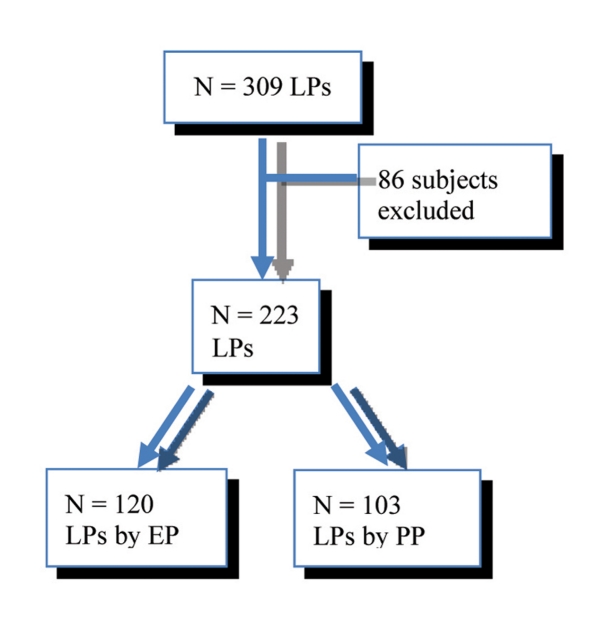
Results: Three hundred nine LPs were performed during the study period. Excluded patients consisted of 29 subjects who underwent moderate procedural sedation and 57 subjects that had incomplete procedural data forms. From our sample population of 223 subjects, 146 subjects received a local anesthetic prior to the LP. One hundred twenty six subjects received 1% lidocaine, 20 subjects received EMLA cream (with one subject that received both 1% lidocaine and EMLA), while 77 received no pre-procedural local anesthetic. The use of local anesthetics differed greatly with the age of the patient. Pre-procedural local anesthetics were administered in 65 of 120 subjects less than 12 months of age and in 81 of 82 patients 12 to 24 months of age. Interestingly, the neonatal subject population did not receive any procedural anesthetic by EP or PP. PP and EP differed in the type of local anesthetic utilized prior to performing a LP. EP exclusively used 1% lidocaine while PP preferentially administered EMLA. A subset analysis demonstrated that only PP utilized moderate sedation (Midazolam and Fentanyl) in 41/309 (13%) of the study population.
Conclusions: This is the first study to demonstrate that EPs and PPs differ in their preference in the use of local anesthetics prior to LP and that procedural anesthetic is not universal within this pediatric age group and that utilization of a local anesthetic varies by patient age, with younger children less likely to receive a local anesthetic.
Keywords: Local anesthetic; Lumbar puncture; Emergency physician; Pediatric physician.
Figures
References
-
- The use of pediatric sedation and analgesia. American College of Emergency Physicians. Ann Emerg Med. 2001 - PubMed
-
- The assessment and management of acute pain in infants, children, and adolescents. Pediatrics. 2001;108(3):793–797. - PubMed
-
- Pinheiro JM, Furdon S, Ochoa LF. Role of local anesthesia during lumbar puncture in neonates. Pediatrics. 1993;91(2):379–382. - PubMed
-
- Franck LS, Greenberg CS, Stevens B. Pain assessment in infants and children. Pediatr Clin North Am. 2000;47(3):487–512. - PubMed
LinkOut - more resources
Full Text Sources
Miscellaneous