


Proteolytic processing of Alzheimer's β-amyloid precursor protein
- PMID: 22122372
- PMCID: PMC3254787
- DOI: 10.1111/j.1471-4159.2011.07519.x
Proteolytic processing of Alzheimer's β-amyloid precursor protein
Abstract
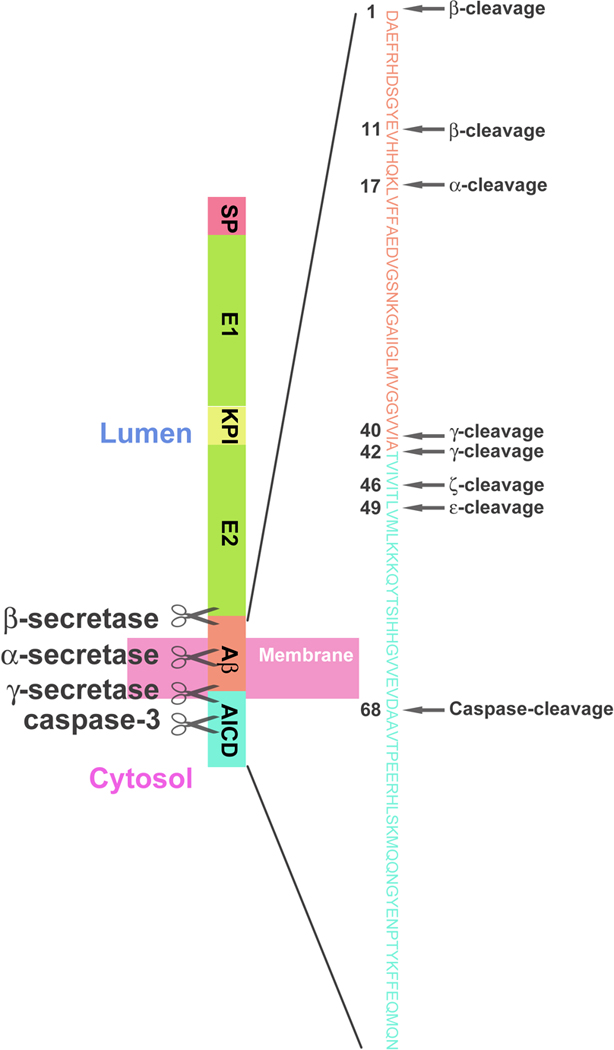
β-Amyloid precursor protein (APP) is a critical factor in the pathogenesis of Alzheimer's disease (AD). APP undergoes post-translational proteolysis/processing to generate the hydrophobic β-amyloid (Aβ) peptides. Deposition of Aβ in the brain, forming oligomeric Aβ and plaques, is identified as one of the key pathological hallmarks of AD. The processing of APP to generate Aβ is executed by β- and γ-secretase and is highly regulated. Aβ toxicity can lead to synaptic dysfunction, neuronal cell death, impaired learning/memory and abnormal behaviors in AD models in vitro and in vivo. Aside from Aβ, proteolytic cleavages of APP can also give rise to the APP intracellular domain, reportedly involved in multiple types of cellular events such as gene transcription and apoptotic cell death. In addition to amyloidogenic processing, APP can also be cleaved by α-secretase to form a soluble or secreted APP ectodomain (sAPP-α) that has been shown to be mostly neuro-protective. In this review, we describe the mechanisms involved in APP metabolism and the likely functions of its various proteolytic products to give a better understanding of the patho/physiological functions of APP.
© 2011 The Authors. Journal of Neurochemistry © 2011 International Society for Neurochemistry.
Conflict of interest statement
The authors declare no conflict of interest with respect to the research reported herein.
References
-
- Acquati F, Accarino M, Nucci C, Fumagalli P, Jovine L, Ottolenghi S, Taramelli R. The gene encoding DRAP (BACE2), a glycosylated transmembrane protein of the aspartic protease family, maps to the down critical region. FEBS Lett. 2000;468:59–64. - PubMed
-
- Ag CB. Generation of an Apoptotic Intracellular Peptide by gamma-Secretase Cleavage of Alzheimer's Amyloid Protein Precursor. J. Alzheimer's Dis. 2000;2:289–301. - PubMed
-
- Altmeppen HC, Prox J, Puig B, Kluth MA, Bernreuther C, Thurm D, Jorissen E, Petrowitz B, Bartsch U, De Strooper B, Saftig P, Glatzel M. Lack of a-disintegrin-and-metalloproteinase ADAM10 leads to intracellular accumulation and loss of shedding of the cellular prion protein in vivo. Mol. Neurodegener. 2011;6:36. - PMC - PubMed
Publication types
MeSH terms
Substances
Grants and funding
LinkOut - more resources
Full Text Sources
Medical
