


Relational and Item-Specific Encoding (RISE): task development and psychometric characteristics
- PMID: 22124089
- PMCID: PMC3245591
- DOI: 10.1093/schbul/sbr146
Relational and Item-Specific Encoding (RISE): task development and psychometric characteristics
Abstract
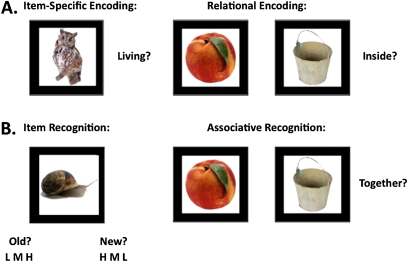
Objectives: The Relational and Item-Specific Encoding task (RISE) was designed to assess contributions of specific encoding and retrieval processes to episodic memory in schizophrenia. This manuscript describes how a cognitive neuroscience functional imaging paradigm was translated for clinical research.
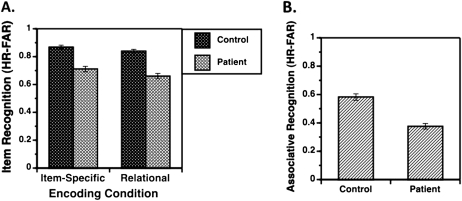
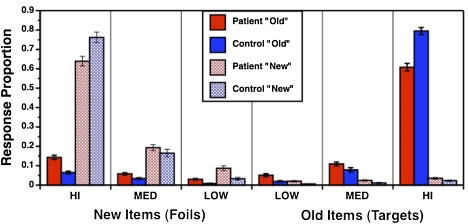
Methods: The RISE manipulates encoding by requiring participants to decide whether stimuli are "living/nonliving" (item-specific) or whether one stimulus fits inside the other (relational) and estimates familiarity (F) and recollection (R) by examining receiver operator characteristics (ROC) and assessing item and associative recognition. Two studies examined psychometric characteristics and tested the hypothesis that patients have differential deficits in relational vs item-specific encoding and disproportionate impairments in recollection vs familiarity.
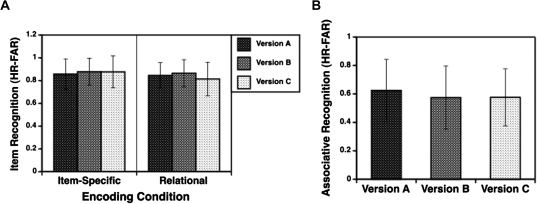
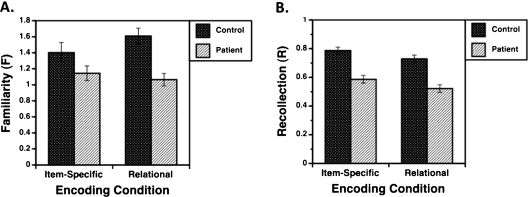
Results: Study 1, using visual objects, provided support for the encoding hypotheses and revealed good internal consistency and alternate forms reliability, with small differences between test forms. ROC analysis revealed R and F deficits, with F deficits most prominent following relational encoding. Study 2 used word stimuli, which lowered item recognition, but patients had difficulty understanding task demands, and words were less desirable for non-English speaking clinical trials, leading to the decision to proceed with the original task.
Conclusions: The RISE is a valid and reliable measure of item-specific and relational memory that is well tolerated, with good psychometric characteristics and equivalent forms to facilitate treatment studies. Results indicate that episodic memory in schizophrenia is most preserved under conditions promoting item-specific encoding that is supported by familiarity-based recognition and is most impaired under relational encoding and recollection-based retrieval conditions.
Figures
References
-
- Tulving E. Episodic memory: from mind to brain. Annu Rev Psychol. 2002;53:1–25. - PubMed
-
- Aleman A, Hijman R, de Haan EHF, Kahn RS. Memory impairment in schizophrenia: a meta-analysis. Am J Psychiatry. 1999;156:1358–1366. - PubMed
-
- Hunt RR, Einstein GO. Relational and item-specific information in memory. J Verbal Learn Verbal Behav. 1981;20:497–514.
