


The promise of neuroprotective agents in Parkinson's disease
- PMID: 22125548
- PMCID: PMC3221408
- DOI: 10.3389/fneur.2011.00068
The promise of neuroprotective agents in Parkinson's disease
Erratum in
- Front Neurol. 2013;7:69
Abstract
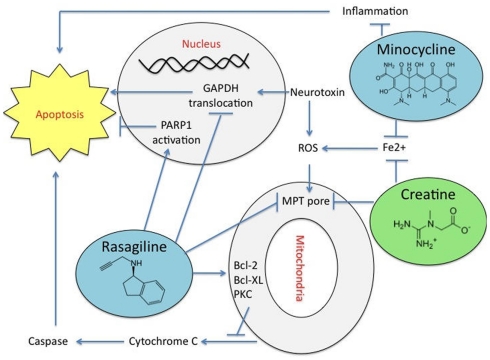
Parkinson's disease (PD) is characterized by loss of dopamine neurons in the substantia nigra of the brain. Since there are limited treatment options for PD, neuroprotective agents are currently being tested as a means to slow disease progression. Agents targeting oxidative stress, mitochondrial dysfunction, and inflammation are prime candidates for neuroprotection. This review identifies Rasagiline, Minocycline, and creatine, as the most promising neuroprotective agents for PD, and they are all currently in phase III trials. Other agents possessing protective characteristics in delaying PD include stimulants, vitamins, supplements, and other drugs. Additionally, combination therapies also show benefits in slowing PD progression. The identification of neuroprotective agents for PD provides us with therapeutic opportunities for modifying the course of disease progression and, perhaps, reducing the risk of onset when preclinical biomarkers become available.
Keywords: Parkinson’s disease; neurodegeneration; neuroprotection.
Figures
References
-
- Aguiar L. M., Nobre H. V., Jr., Macedo D. S., Oliveira A. A., Freitas R. M., Vasconcelos S. M., Cunha G. M., Sousa F. C., Viana G. S. (2006). Neuroprotective effects of caffeine in the model of 6-hydroxydopamine lesion in rats. Pharmacol. Biochem. Behav. 84, 415–419 10.1016/j.pbb.2006.05.027 - DOI - PubMed
-
- Akao Y., Maruyama W., Shimizu S., Yi H., Nakagawa Y., Shamoto-Nagai M., Youdim M. B., Tsujimoto Y., Naoi M. (2002a). Mitochondrial permeability transition mediates apoptosis induced by N-methyl(R)salsolinol, an endogenous neurotoxin, and is inhibited by Bcl-2 and rasagiline, N-propargyl-1(R)-aminoindan. J. Neurochem. 82, 913–923 10.1046/j.1471-4159.2002.01047.x - DOI - PubMed
LinkOut - more resources
Full Text Sources
