. 2011;6(11):e27895.
doi: 10.1371/journal.pone.0027895. Epub 2011 Nov 18.

Emergence and transmission pathways of rapidly evolving evolutionary branch C4a strains of human enterovirus 71 in the Central Plain of China

Affiliations

Emergence and transmission pathways of rapidly evolving evolutionary branch C4a strains of human enterovirus 71 in the Central Plain of China

Yong Zhang et al. PLoS One. 2011.

Abstract

Background: Large-scale outbreaks of hand, foot, and mouth disease (HFMD) occurred repeatedly in the Central Plain of China (Shandong, Anhui, and Henan provinces) from 2007 until now. These epidemics have increased in size and severity each year and are a major public health concern in mainland China.

Principal findings: Phylogenetic analysis was performed and a Bayesian Markov chain Monte Carlo tree was constructed based on the complete VP1 sequences of HEV71 isolates. These analyses showed that the HFMD epidemic in the Central Plain of China was caused by at least 5 chains of HEV71 transmission and that the virus continued to circulate and evolve over the winter seasons between outbreaks. Between 1998 and 2010, there were 2 stages of HEV71 circulation in mainland China, with a shift from evolutionary branch C4b to C4a in 2003-2004. The evolution rate of C4a HEV71 was 4.99×10(-3) substitutions per site per year, faster than the mean of all HEV71 genotypes. The most recent common ancestor estimates for the Chinese clusters dated to October 1994 and November 1993 for the C4a and C4b evolutionary branches, respectively. Compared with all C4a HEV71 strains, a nucleotide substitution in all C4b HEV71 genome (A to C reversion at nt2503 in the VP1 coding region, which caused amino acid substitution of VP1-10: Gln to His) had reverted.

Conclusions: The data suggest that C4a HEV71 strains introduced into the Central Plain of China are responsible for the recent outbreaks. The relationships among HEV71 isolates determined from the combined sequence and epidemiological data reveal the underlying seasonal dynamics of HEV71 circulation. At least 5 HEV71 lineages circulated in the Central Plain of China from 2007 to 2009, and the Shandong and Anhui lineages were found to have passed through a genetic bottleneck during the low-transmission winter season.


Conflict of interest statement

Competing Interests: The authors have declared that no competing interests exist.

Figures

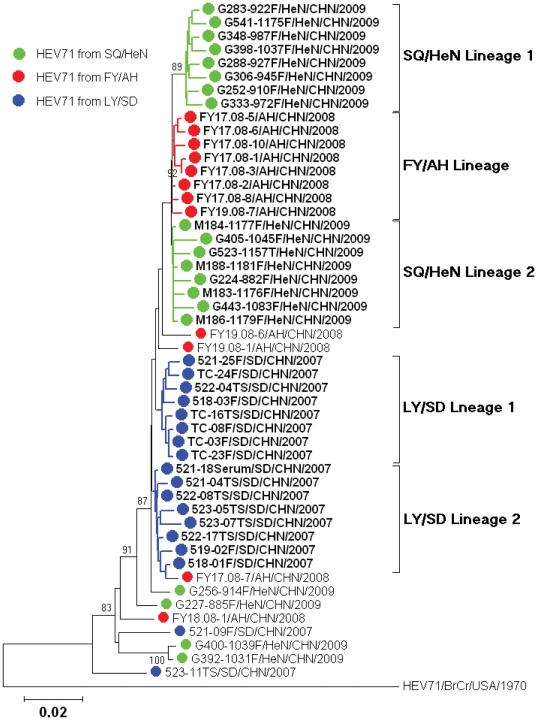
Figure 1
Figure 1. Five lineages of HEV71 circulated in the Central Plain of China.
Abbreviations of Chinese cities/provinces: LY/SD, Linyi/Shandong; FY/AH, Fuyang/Anhui; SQ/HeN, Shangqiu/Henan.
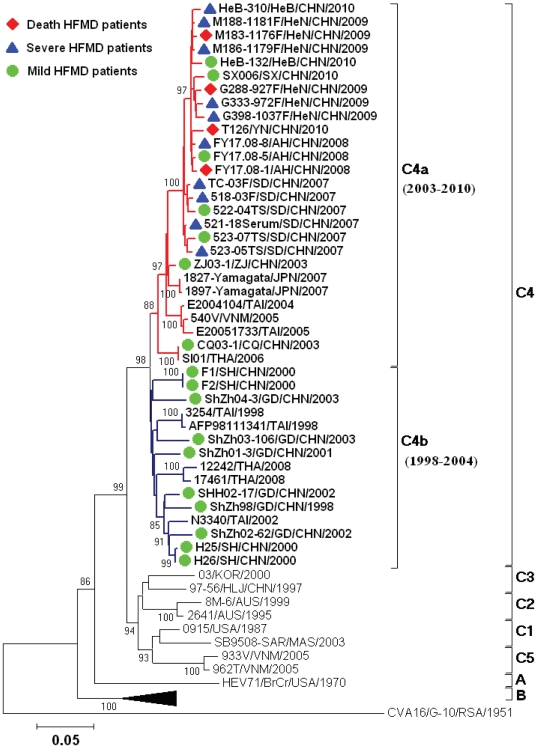
Figure 2
Figure 2. Sustained transmission of the C4a evolutionary branch in the Central Plain of China.
Abbreviations of Chinese provinces: SD, Shandong; AH, Anhui; HeN, Henan; YN, Yunnan; SX, Shanxi; HeB, Hebei; ZJ, Zhejiang; CQ, Chongqing, SH, Shanghai; GD, Guangdong.
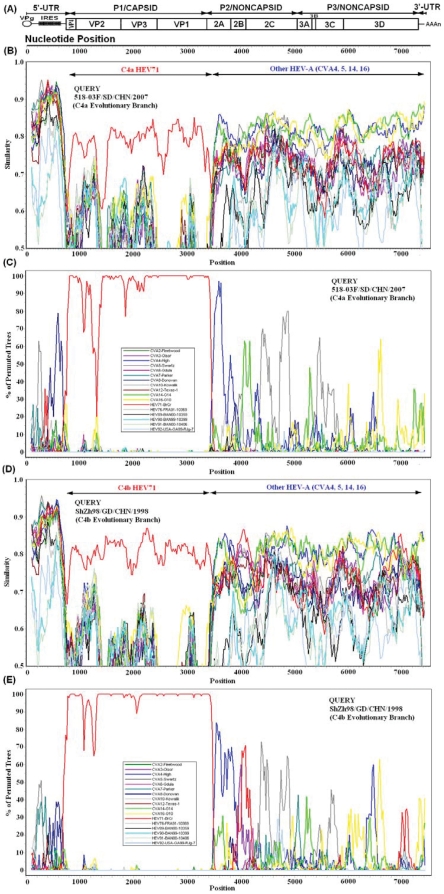
Figure 3
Figure 3. Similarity plot and bootscan analysis of whole genomes of C4b HEV71 strains.
Similarity plot and bootscan analysis of complete genomes of C4a and C4b HEV71 strains using a sliding window of 200 nt moving in 20-nt steps. For each plot, the names of viruses of the query sequence were indicated in the upper left corner, and for each bootscan analysis, the names of viruses of the query sequence were indicated in the upper right corner.
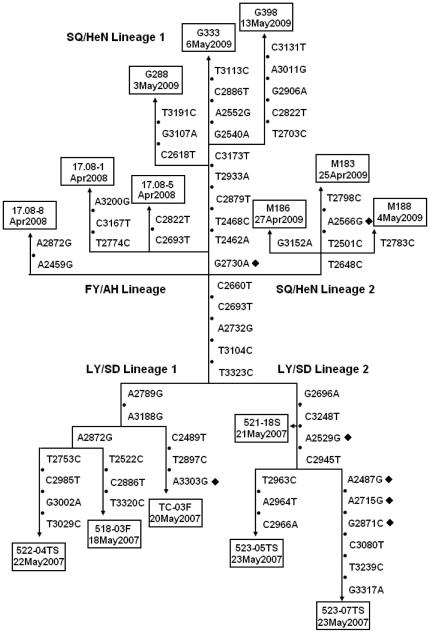
Figure 4
Figure 4. Tree summarizing evolutionary relationships among outbreak isolates based upon differences in VP1 nucleotide sequences.
The branch structure of the tree was constructed under the assumption that each substitution occurred only once, and the tree was rooted to the 2007 Shandong outbreak isolates. Vertical branches are scaled to the number of nucleotide differences between VP1 sequences. The VP1 nucleotide substitutions that encode amino acid changes are indicated by symbol“⧫” The dates shown are those on which the clinical samples were taken. Abbreviations of Chinese cities/provinces: LY/SD, Linyi/Shandong; FY/AH, Fuyang/Anhui; SQ/HeN, Shangqiu/Henan.
Figure 5
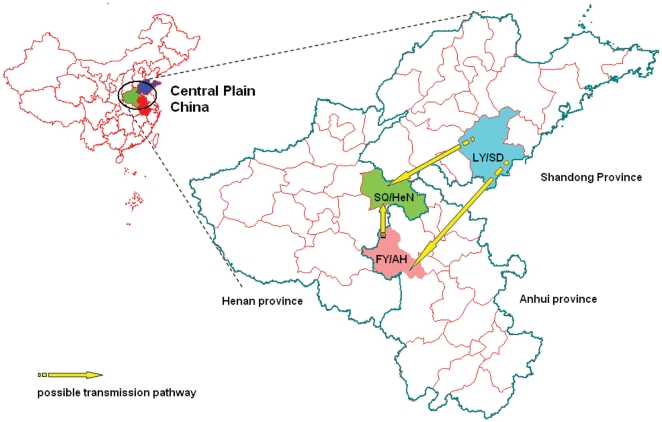
Figure 5. The locations and possible HEV71 transmission pathways of the HFMD outbreaks in the Central Plain of China during 2007–2009.
HFMD outbreaks with high morbidity and mortality occurred in 2007, 2008, and 2009 and began in Linyi City in Shandong province (blue), Fuyang City in Anhui province (green), and Shangqiu City in Henan province (red), respectively. The possible transmission pathways of HEV71 are indicated by yellow arrows. Abbreviations of Chinese cities/provinces: LY/SD, Linyi/Shandong; FY/AH, Fuyang/Anhui; SQ/HeN, Shangqiu/Henan.
Figure 6
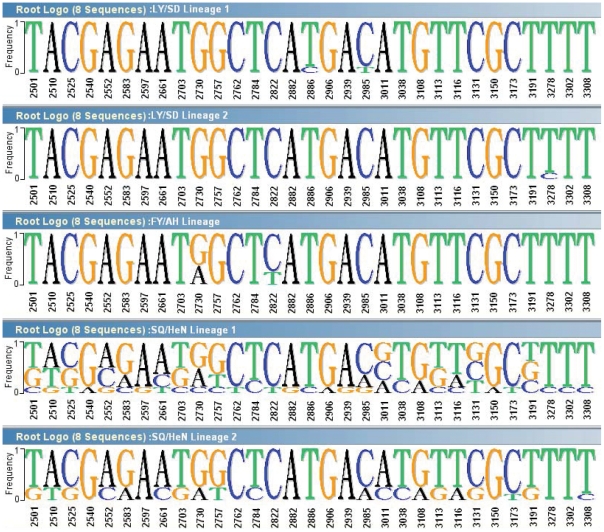
Figure 6. Sequence logo showing nucleotide acid diversity in the VP1 region sequences among these 5 lineages of HEV71.
Only mutated positions were shown. More mutated positions occurred in the SQ/HeN lineages than FY Lineage and LY/SD Lineages. Sequence logo was constructed using Phylo-mLogo .
Figure 7
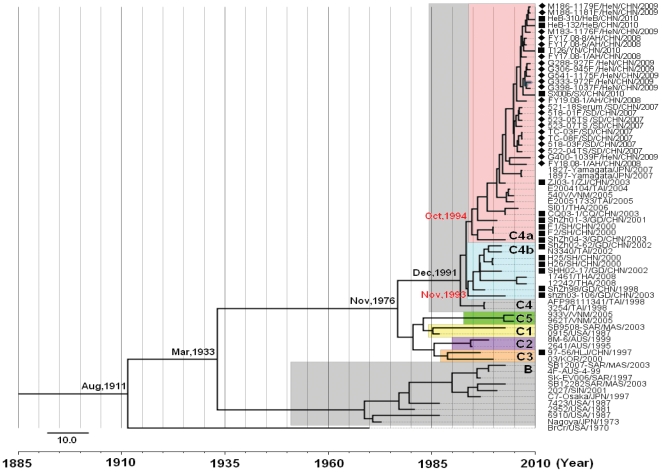
Figure 7. MCMC tree of the complete VP1 region sequence of HEV71 strains found worldwide visualized using FigTree.
The width of a branch reflects the evolutionary rate of the individual sequences and their reconstructed ancestors. HEV71 isolates collected in mainland China from 1998 to 2010 segregated into 2 clusters (C4a and C4b evolutionary branches). The most recent common ancestor (t MRCA) estimates for the Chinese clusters were dated to Oct, 1994 (95% HPD, Mar, 1992–Dec, 1996) and Nov, 1993 (95% HPD, May, 1991–Jun, 1996) for the C4a and C4b evolutionary branches, respectively. Diamonds indicate HEV71 isolates from the Central Plain of China, and solid squares indicate HEV71 isolates from other parts of mainland China.

References

    1. Stanway G, Brown F, Christian P, Hovi T, Hyypiä T, et al. Family Picornaviridae. "Virus Taxonomy Eighth Report of the International Committee on Taxonomy of Viruses". 2005. pp. 757–778. Eds. Fauquet, C.M., Mayo, M.A., Maniloff, J., Desselberger, U. and Ball, L.A. Elsevier/Academic Press, London.
    1. Oberste MS, Maher K, Michele SM, Belliot G, Uddin M, et al. Enteroviruses 76, 89, 90 and 91 represent a novel group within the species Human enterovirus A. J Gen Virol. J Gen Virol. 2005;86:445–451. - PubMed
    1. Oberste MS, Penaranda S, Maher K, Pallansch MA. Complete genome sequences of all members of the species Human enterovirus A. J Gen Virol. J Gen Virol. 2004;85:1597–1607. - PubMed
    1. Zhu Z, Zhu S, Guo X, Wang J, Wang D, et al. Retrospective seroepidemiology indicated that human enterovirus 71 and coxsackievirus A16 circulated wildly in central and southern China before large-scale outbreaks from 2008. Virol J. 2010;7:300. - PMC - PubMed
    1. Li L, He Y, Yang H, Zhu J, Xu X, et al. Genetic characteristics of human enterovirus 71 and coxsackievirus A16 circulating from 1999 to 2004 in Shenzhen, People's Republic of China. J Clin Microbiol. 2005;43:3835–3839. - PMC - PubMed

Publication types

MeSH terms

Substances

Associated data