


Pattern of presentation and survival of breast cancer in a teaching hospital in north Western Nigeria
- PMID: 22125710
- PMCID: PMC3215495
- DOI: 10.5001/omj.2010.29
Pattern of presentation and survival of breast cancer in a teaching hospital in north Western Nigeria
Abstract
Objectives: Developing countries are experiencing demographic and epidemiologic transition and the prevalence of non-communicable diseases especially cancers which is on the increase. Breast cancer is the most common and lethal malignancy in developing countries with varying presentation. This study aims to determine the pattern of presentation and survival of breast cancer patients in North Western Nigeria.
Methods: A five-year retrospective review of breast cancer records from 2001-2005 was conducted. Relevant information was retrieved and analyzed using statistical package for social science software. Manchester stage III and IV were classified as advance disease. Survival analysis was carried out with survival defined as the time between the date of commencement of treatment and the date of last follow-up or death.
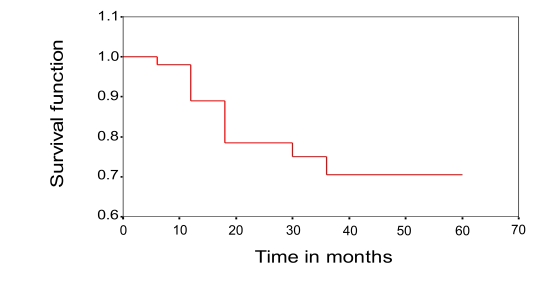
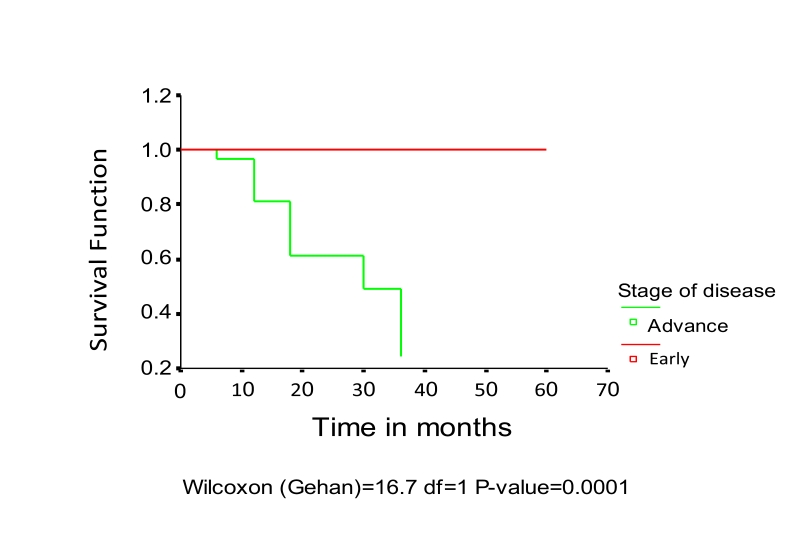
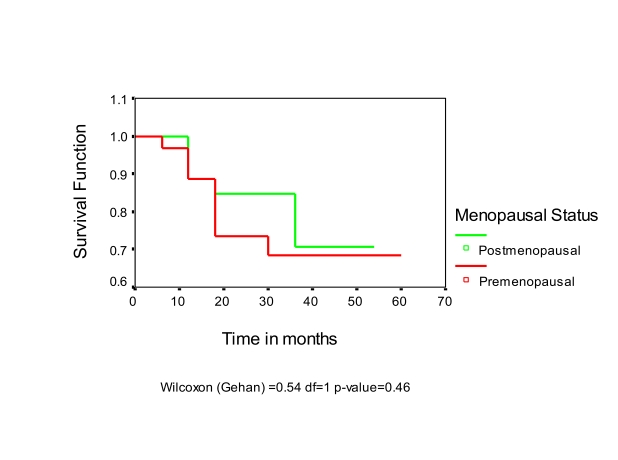
Results: Most of the patients were in the 4th and 5th decades 58 (57.4%) with a mean age of 44.5±13 years. Majority of the patients were females 99 (96.1%). One of the four males had invasive lobular carcinoma while the others presented with invasive ductal carcinoma 3 (75.0%). Most of the patients were premenopausal 62 (62.6%) and were presented late with advanced breast cancer disease 64 (62.1%). The left breast was more affected 64 (62.1%), and the upper outer quadrant was mostly involved 48 (60.7%), followed by the areola, 43(41.7%) either singly or in combination. Invasive ductal carcinoma was detected in 85 (82.5%) cases and was the predominant histological finding. Survival rate beyond 30 months was observed in 24.5% of cases and 100% for advanced and early breast cancer respectively, (p=0.0001). The overall survival rate beyond 36 months was 70.4% and postmenopausal patients (70.6%) had better survival beyond 36 months than premenopausal (68.5%) patients (p=0.05).
Conclusion: The overall survival rate was low and patients with early breast cancer had better survival than those with advanced disease. Majority of the patients were young premenopausal women with advanced breast cancer.
Figures
References
-
- Lucas AO, Gilles HM. Non-Communicable Disease: Health in Transition. In Short Textbook of Public Health Medicine for the Tropics. International Students Edition. Arnold publishers 2003; 237-259.
-
- Smigal C, Jemal A, Ward E, et al. Trend in breast cancer by race and ethnicity: Update 2006. Cancer J clin. 2006; 56:168-183. - PubMed
-
- Badoe EA, Archampong EO, da Rocha-Afodu JT. The Breast. In Principles and Practice of Surgery including Pathology in the tropics. Third Ed. Ghana Publishing Corporation 2000; 457-477.
-
- Afolayan EA. Five years of cancer registration at Zaria (1992-1996). Niger Postgrad Med J 2004. Sep;11(3):225-229 - PubMed
LinkOut - more resources
Full Text Sources