Circadian regulation of cortisol release in behaviorally split golden hamsters
- PMID: 22128030
- PMCID: PMC3275398
- DOI: 10.1210/en.2011-1624
Circadian regulation of cortisol release in behaviorally split golden hamsters
Abstract
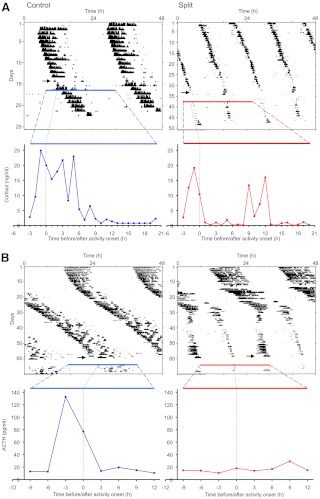
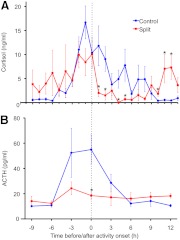
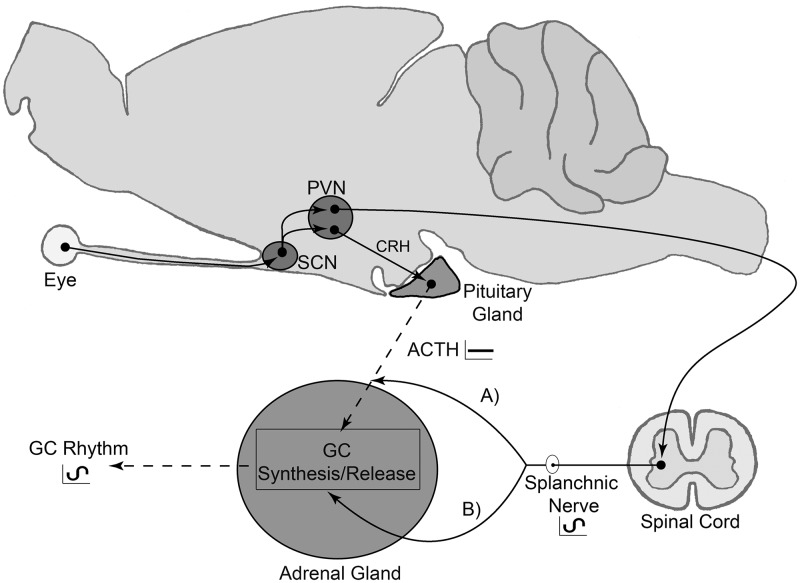
The master circadian clock located within the hypothalamic suprachiasmatic nucleus (SCN) is necessary for the circadian rhythm of glucocorticoid (GC) release. The pathways by which the SCN sustains rhythmic GC release remain unclear. We studied the circadian regulation of cortisol release in the behaviorally split golden hamster, in which the single bout of circadian locomotor activity splits into two bouts approximately 12 h apart after exposing the animals to constant light conditions. We show that unsplit control hamsters present a single peak of cortisol release that is concomitant with a single peak of ACTH release. In contrast, split hamsters show two peaks of cortisol release that are approximately 12 h appart and are appropriately phased to each locomotor activity bout but surprisingly do not rely on rhythmic release of ACTH. Our results are consistent with a model in which the circadian pacemaker within the SCN regulates the circadian release of GC via input to the hypothalamo-pituitary-adrenal axis and via a second regulatory pathway, which likely involves sympathetic innervation of the adrenal and can operate even in the absence of ACTH circadian rhythmic release. Furthermore, we show that although the overall 24-h cortisol output in split hamsters is lower than in unsplit controls, split hamsters release constant low levels of ACTH. This result suggests that the timing, rather than the absolute amount, of cortisol release is more critical for the induction of negative feedback effects that regulate the hypothalamo-pituitary-adrenal axis.
Figures
Comment in
-
The suprachiasmatic nucleus gets split: why does cortisol respond but not ACTH?Endocrinology. 2012 Feb;153(2):546-8. doi: 10.1210/en.2011-2082. Endocrinology. 2012. PMID: 22267683 No abstract available.
References
-
- Hastings MH, Reddy AB, Maywood ES. 2003. A clockwork web: circadian timing in brain and periphery, in health and disease. Nat Rev Neurosci 4:649–661 - PubMed
-
- Moore RY, Eichler VB. 1972. Loss of a circadian adrenal corticosterone rhythm following suprachiasmatic lesions in the rat. Brain Res 42:201–206 - PubMed
-
- de la Iglesia HO, Meyer J, Carpino A, Jr, Schwartz WJ. 2000. Antiphase oscillation of the left and right suprachiasmatic nuclei. Science 290:799–801 - PubMed
-
- Swann JM, Turek FW. 1985. Multiple circadian oscillators regulate the timing of behavioral and endocrine rhythms in female golden hamsters. Science 228:898–900 - PubMed
Publication types
MeSH terms
Substances
Grants and funding
LinkOut - more resources
Full Text Sources
Miscellaneous