


doi: 10.1186/1742-2094-8-168.
Neuro-inflammation, blood-brain barrier, seizures and autism
Affiliations
- PMID: 22129087
- PMCID: PMC3293070
- DOI: 10.1186/1742-2094-8-168
Item in Clipboard
Neuro-inflammation, blood-brain barrier, seizures and autism
J Neuroinflammation.
.
Abstract
Many children with Autism Spectrum Diseases (ASD) present with seizure activity, but the pathogenesis is not understood. Recent evidence indicates that neuro-inflammation could contribute to seizures. We hypothesize that brain mast cell activation due to allergic, environmental and/or stress triggers could lead to focal disruption of the blood-brain barrier and neuro-inflammation, thus contributing to the development of seizures. Treating neuro-inflammation may be useful when anti-seizure medications are ineffective.
Figures
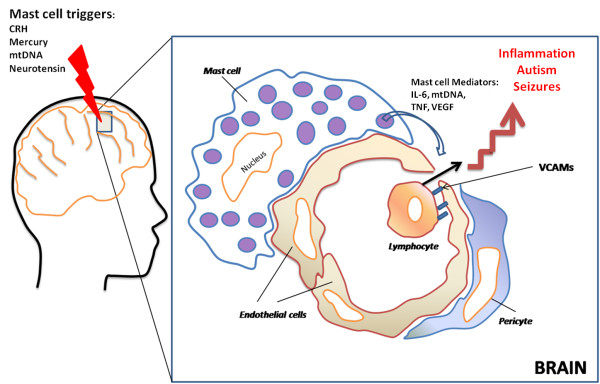
Mast cells are located perivascularly close to nerve endings and regulate blood-brain barrier permeability. Upon stimulation by allergic and non-immune triggers (e.g, CRH, neurotensin, mercury, mitochondrial (mt) DNA), mast cells release vasodilatory and inflammatory molecules (IL-6, mtDNA, TNF and VEGF), some of which increase the expression of vascular endothelial cell adhesion molecules (VCAMs) and permit exit of circulating lymphocytes in the brain. Focal brain inflammation could then contribute to or exacerbate seizures.
References
-
- Kogan MD, Blumberg SJ, Schieve LA, Boyle CA, Perrin JM, Ghandour RM, Singh GK, Strickland BB, Trevathan E, van Dyck PC. Prevalence of parent-reported diagnosis of autism spectrum disorder among children in the US, 2007. Pediatrics. 2009;5:1395–1403. - PubMed
-
- Trevathan E. Seizures and epilepsy among children with language regression and autistic spectrum disorders. J Child Neurol. 2004;19(Suppl 1):S49–S57. - PubMed
Publication types
MeSH terms
Grants and funding
LinkOut - more resources
Full Text Sources
Medical
