


Review
doi: 10.1038/clpt.2011.281.
Epub 2011 Nov 30.
Vaccines against drug abuse
Affiliations
- PMID: 22130115
- PMCID: PMC3345810
- DOI: 10.1038/clpt.2011.281
Item in Clipboard
Review
Vaccines against drug abuse
Clin Pharmacol Ther.
2012 Jan.
Abstract
The currently available medications for the treatment of drug abuse have had only limited success. Anti-addiction vaccines, aimed at eliciting antibodies that block the pharmacological effects of drugs, have great potential for treating drug abuse. We review the status of two vaccines that are undergoing clinical trials (for cocaine and nicotine addiction) and two that are still in preclinical development (for methamphetamine and heroin addiction). We also outline the challenges and ethical concerns associated with the development of anti-addiction vaccines and their use as future therapeutics.
Figures
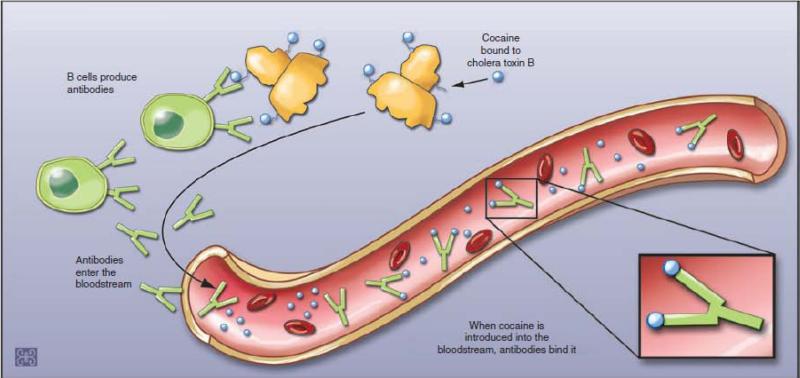
The cocaine vaccine is comprised of succinylnorcocaine molecules covalently linked to a carrier protein derived from the cholera B toxin (rCTB), which is suspended in an aluminum adjuvant. This vaccine can stimulate B-cell to produce antibodies to cocaine as well as rCTB. When cocaine later enters the bloodstream, cocaine antibody can bind the drug, and form the antibody-drug compound molecules in circulation that are too large to cross the blood brain barrier.
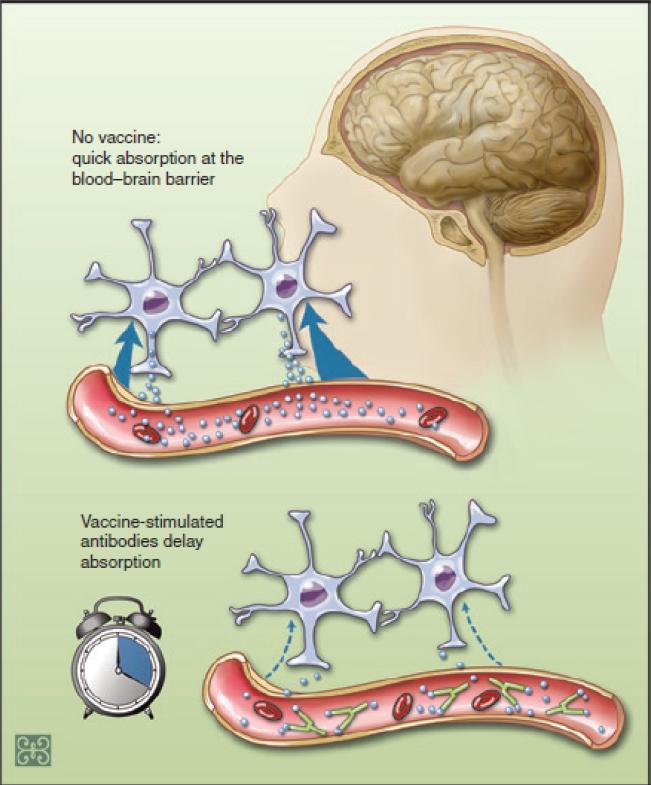
In the absence of cocaine vaccine, drug readily absorbs at the brain blood barrier and enters brain. This causes reinforcement effects, or “high” of cocaine. Vaccine stimulates antibody production, sequesters drug in the blood circulation. This antibody-drug binding prevents the cocaine from rapidly leaving the blood vessels and entering the brain, reducing the drug's euphoric effects.
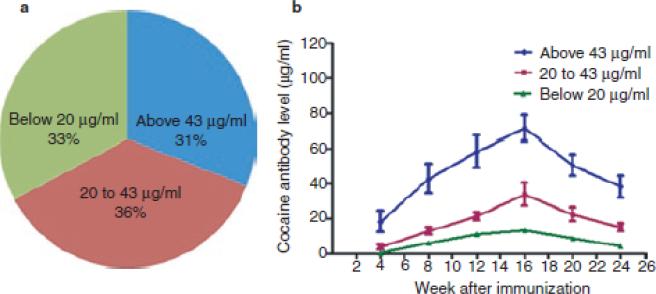
Figure 3a (left). Among the patients in our cocaine vaccine study, cocaine antibody levels attained high (over 43 μg/ml), medium (20 to 43 μg/ml) or low (below 20μg/ml) levels at 16 weeks after vaccination in 31%, 36% and 33% of the total patients who participated the phase IIb trial of cocaine vaccine. Figure 3b (right). Cocaine antibody levels were first detectable at the 4 weeks after the initial vaccination, and reached their peak at 16 weeks, and remained relatively high until 24 weeks after vaccination in patients who attained peak cocaine antibody levels of at least 20 μg/ml.
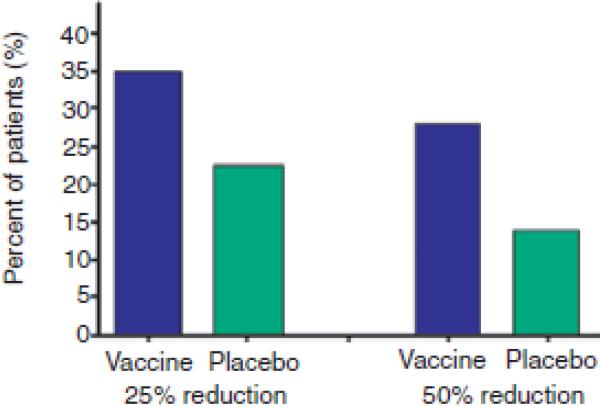
A higher percentage of vaccinated than placebo patients achieved both a 25% and 50% reduction in cocaine use between weeks 16 through 20.
References
-
- World drug report 2010. http://www.unodc.org/documents/wdr/WDR_2010/World_Drug_Report_2010_lo-re....
-
- Maxwell S, Shinderman MS. Optimizing long-term response to methadone maintenance treatment: a 152-week follow-up using higher-dose methadone. J Addict Dis. 2002;21(3):1–12. - PubMed
Publication types
MeSH terms
Substances
Grants and funding
LinkOut - more resources
Full Text Sources
Other Literature Sources
Medical
Molecular Biology Databases
