


Resistance to BRAF inhibitors: unraveling mechanisms and future treatment options
- PMID: 22131348
- PMCID: PMC3588168
- DOI: 10.1158/0008-5472.CAN-11-1243
Resistance to BRAF inhibitors: unraveling mechanisms and future treatment options
Abstract
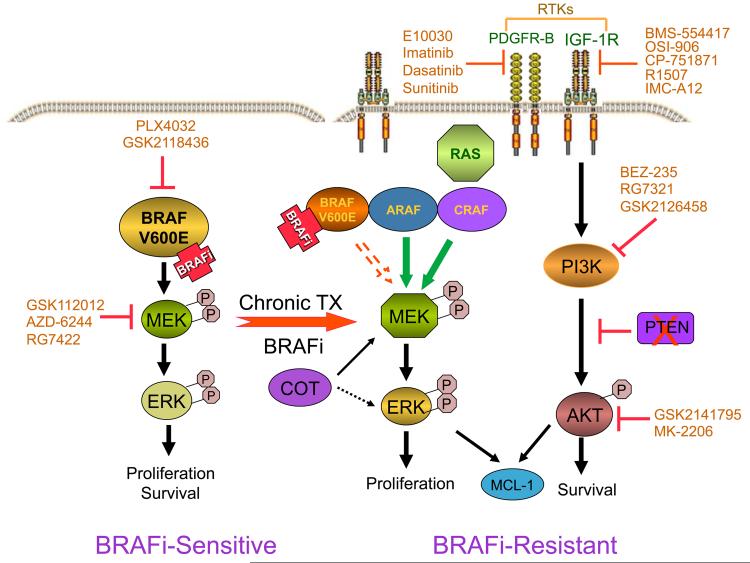
The mitogen-activated protein kinase (MAPK) pathway has emerged as a central target for melanoma therapy due to its persistent activation in the majority of tumors. Several BRAF inhibitors aimed at curbing MAPK pathway activity are currently in advanced stages of clinical investigation. However, their therapeutic success is limited by the emergence of drug resistance, as responses are transient and tumors eventually recur. To develop effective and long-lasting therapies for melanoma patients, it is essential to understand the mechanisms underlying resistance to BRAF inhibitors. Here, we briefly review recent preclinical studies that have provided insight into the molecular mechanisms of resistance to BRAF inhibitors and discuss potential strategies to treat drug-resistant melanomas.
Figures
References
-
- Sun W, Schuchter LM. Metastatic melanoma. Curr Treat Options Oncol. 2001;2:193–202. - PubMed
-
- Easty DJ, Gray SG, O’Byrne KJ, O’Donnell D, Bennett DC. Receptor tyrosine kinases and their activation in melanoma. Pigment Cell Melanoma Res. 2011;24:446–61. - PubMed
-
- Davies H, Bignell GR, Cox C, Stephens P, Edkins S, Clegg S, et al. Mutations of the BRAF gene in human cancer. Nature. 2002;417:949–54. - PubMed
Publication types
MeSH terms
Substances
Grants and funding
LinkOut - more resources
Full Text Sources
Other Literature Sources
Medical
Research Materials
