


Lower birth weight indicates higher risk of autistic traits in discordant twin pairs
- PMID: 22132806
- PMCID: PMC3658607
- DOI: 10.1017/S0033291711002339
Lower birth weight indicates higher risk of autistic traits in discordant twin pairs
Abstract
Background: Autism spectrum disorder (ASD) is a neurodevelopmental disorder of complex etiology. Although strong evidence supports the causal role of genetic factors, environmental risk factors have also been implicated. This study used a co-twin-control design to investigate low birth weight as a risk factor for ASD.
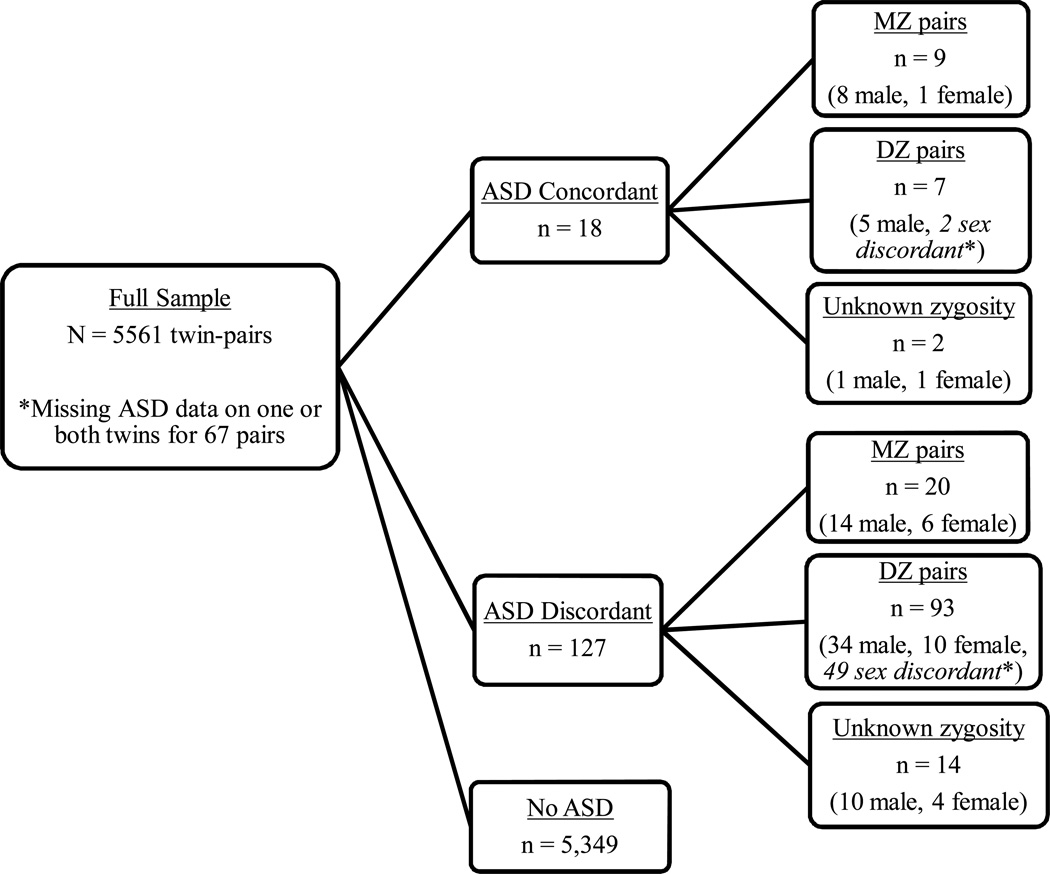
Method: We studied a population-based sample of 3715 same-sex twin pairs participating in the Child and Adolescent Twin Study of Sweden (CATSS). ASD was assessed using a structured parent interview for screening of ASD and related developmental disorders, based on DSM-IV criteria. Birth weight was obtained from medical birth records maintained by the Swedish Medical Birth Registry.
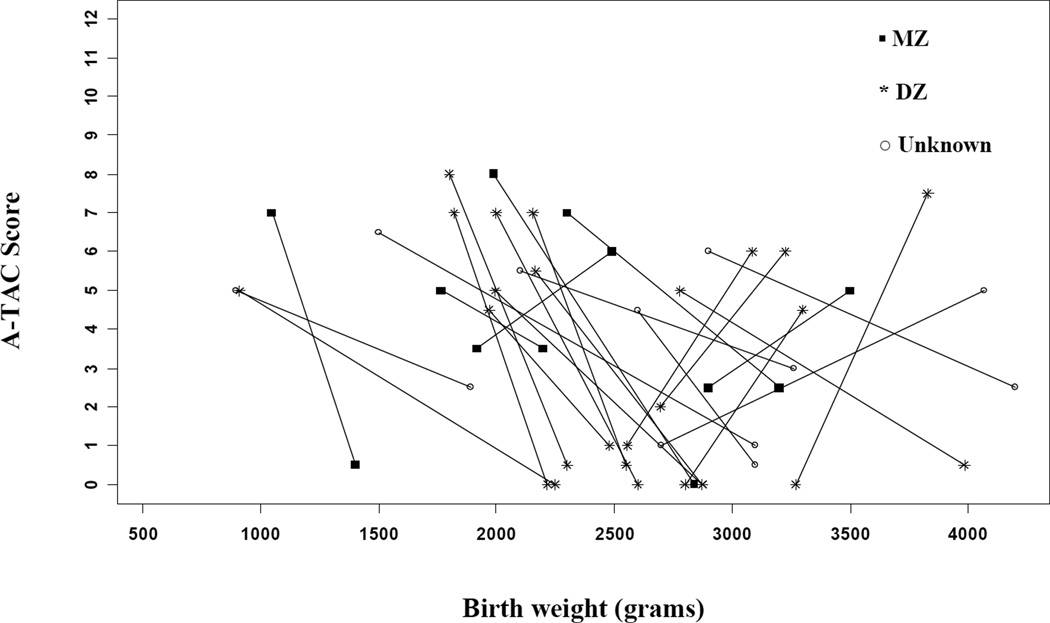
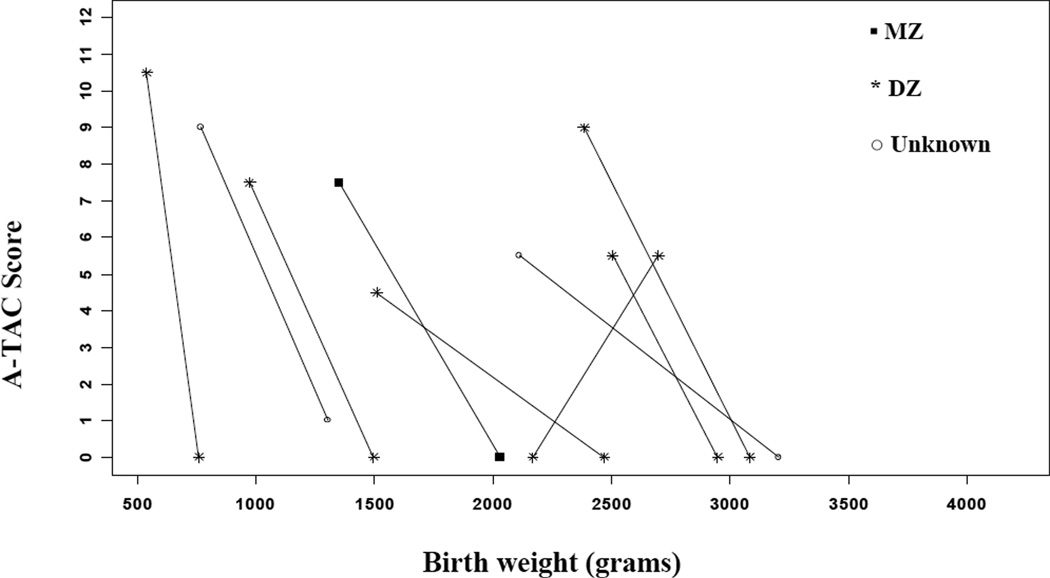
Results: Twins lower in birth weight in ASD-discordant twin pairs (n=34) were more than three times more likely to meet criteria for ASD than heavier twins [odds ratio (OR) 3.25]. Analyses of birth weight as a continuous risk factor showed a 13% reduction in risk of ASD for every 100 g increase in birth weight (n=78). Analysis of the effect of birth weight on ASD symptoms in the entire population (most of whom did not have ASD) showed a modest association. That is, for every 100 g increase in birth weight, a 2% decrease in severity of ASD indexed by scores on the Autism - Tics, attention-deficit hyperactivity disorder (AD/HD), and other Comorbidities (A-TAC) inventory would be expected in the sample as a whole.
Conclusions: The data were consistent with the hypothesis that low birth weight confers risk to ASD. Thus, although genetic effects are of major importance, a non-genetic influence associated with birth weight may contribute to the development of ASD.
Conflict of interest statement
The authors have no conflicts of interest to declare.
Figures
References
-
- Anckarsäter H, Larson T, Hansson SL, Carlström E, Ståhlberg O, Gillberg C, Råstam R, Gillberg C, Lichtenstein P. Child neurodevelopmental and behavioral problems at intercorrelated and dimensionally distributed in the general population. The Open Psychiatry Journal. 2008;2:5–11.
-
- Anckarsäter H, Lichtenstein P, Carlstedt E, Ståhlberg O, Gillberg C. Psychometric development of The Autism - Tics, AD/HD and other comorbidities (A-TAC) inventory. Full version with gate structure; based on clinic and general population data. 2007
-
- Bailey A, Le Couteur A, Gottesman I, Bolton P, Simonoff E, Yuzda E, Rutter M. Autism as a strongly genetic disorder: evidence from a British twin study. Psychological Medicine. 1995;25(1):63–77. - PubMed
-
- Beversdorf DQ, Manning SE, Hillier A, Anderson SL, Nordgren RE, Walters SE, Nagaraja HN, Cooley WC, Gaelic SE, Bauman ML. Timing of prenatal stressors and autism. Journal of Autism and Developmental Disorders. 2005;35(4):471–478. - PubMed
-
- Blickstein I. The definition, diagnosis, and management of growth-discordant twins: An international census survey. Acta Geneticae Medicae et Gemellologiae. 1991;40(3–4):345–351. - PubMed
Publication types
MeSH terms
Grants and funding
LinkOut - more resources
Full Text Sources
