Review
. 2012 Jan 21;4(2):330-42.
doi: 10.1039/c1nr11277e. Epub 2011 Dec 1.

Theranostic nanoplatforms for simultaneous cancer imaging and therapy: current approaches and future perspectives

Affiliations
Review

Theranostic nanoplatforms for simultaneous cancer imaging and therapy: current approaches and future perspectives

Ki Young Choi et al. Nanoscale. .

Abstract

Theranostics is a concept which refers to the integration of imaging and therapy. As an evolving new field, it is related to but different from traditional imaging and therapeutics. It embraces multiple techniques to arrive at a comprehensive diagnostic, in vivo molecular images and an individualized treatment regimen. More recently, there is a trend of tangling these efforts with emerging materials and nanotechnologies, in an attempt to develop novel platforms and methodologies to tackle practical issues in clinics. In this article, topics of rationally designed nanoparticles for the simultaneous imaging and therapy of cancer will be discussed. Several exemplary nanoparticle platforms such as polymeric nanoparticles, gold nanomaterials, carbon nanotubes, magnetic nanoparticles and silica nanoparticles will be elaborated on and future challenges of nanoparticle-based systems will be discussed.


Figures

Fig. 1
Fig. 1
A. Schematic illustration and TEM image of the formation of D-HINPs. B. MR images taken before, and 1 and 4 h after the injection of D-HINPs. C. Tumor growth curves for treatment with D-HINPs, free DOX, Doxil, HINPs and PBS. Adapted with permission from Quan et al. Copyright 2011, American Chemical Society.
Fig. 2
Fig. 2
Multifunctional IONPs for in vivo dual-modality imaging and therapy. A. Schematic illustration of the multifunctional nanoparticles consisting of a magnetic nanoparticle labeled with Cy5.5, membrane translocation peptides (MPAP), and short-interfering ribose nucleic acid (siRNA) molecules. B. In vivo magnetic resonance imaging (MRI) of mice bearing subcutaneous tumors before and after treatment. High-intensity optical signal in the tumor confirmed the delivery of the nanoparticle. Adapted with permission from Medarova et al. Copyright 2007, Nature Publishing Group.
Fig. 3
Fig. 3
NIR fluorescence imaging guided photothermal therapy with SWNTs. A digital photo (A) and a NIR photoluminescence image (B) of a BALB/c mouse with two 4T1 tumors (indicated by arrows) taken after intravenous injection of SWNTs. IR thermal images of tumor-bearing mice (C) with and (D) without injection of SWNTs under 808 nm laser irradiation and the corresponding photos of mice before the NIR irradiation (E,F). Adapted with permission from Robinson et al. Copyright 2010, Springer Science&Business Media and Tsinghua Press.
Fig. 4
Fig. 4
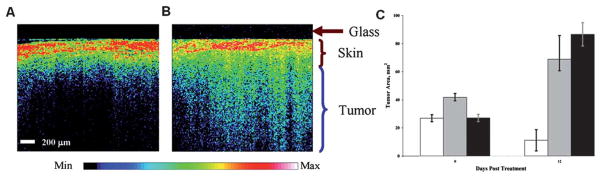
Representative OCT images from tumors of mice systemically injected with PBS (A) or with nanoshells (B). Representative OCT images from tumors of mice systemically injected with nanoshells. C. Tumor size before irradiation and 12 days post-irradiation of mice treated with nanoshell + NIR laser irradiation (white bar); PBS sham + NIR laser treatment (gray bar) or untreated control (black bar); values are average ± SEM. Adapted with permission from Gobin et al. Copyright 2007, American Chemical Society.
Fig. 5
Fig. 5
A. Schematic illustration and TEM images of the magnetic gold nanoshells (Mag-GNS) B. T2-weighted MR images of control SKBR3 cells, HER2/neu-negative H520 cells incubated with Mag-GNS-AbHER2/neu, and HER2/neu-positive SKBR3 cells incubated with Mag-GNS-AbHER2/neu. D. Optical microscope images of (a) control SKBR3 cells, (b) HER2/neu-negative H520 cells incubated with Mag-GNS-AbHER2/neu, and (c) HER2/neu-positive SKBR3 cells incubated with Mag-GNSAbHER2/neu after irradiation for 10 s with a femtosecond-pulse laser (with a wavelength of 800 nm and a beam diameter of 1 mm) and subsequent staining with trypan blue. Adapted with permission from Kim et al. Copyright 2006, John Wiley & Sons, Inc.
Fig. 6
Fig. 6
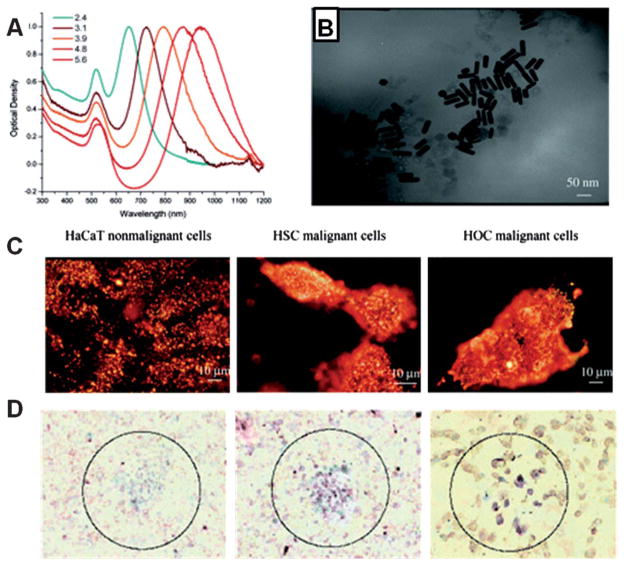
A. Surface plasmon absorption spectra of gold nanorods of different aspect ratios, showing the sensitivity of the strong longitudinal band to the aspect ratios of the nanorods. B. TEM image of nanorods of aspect ratio of 3.9, the absorption spectrum of which is shown as the orange curve in panel A. C. Light scattering images of anti-EGFR/Au nanorods after incubation with cells for 30 min at room temperature. D. Selective photothermal therapy of cancer cells with anti-EGFR/Au nanorods incubated. The circles show the laser spots on the samples. Adapted with permission from Huang et al. Copyright 2006, American Chemical Society.
Fig. 7
Fig. 7
A. Schematic diagram and TEM image of chitosan-based nanoparticles (CNPs). B. In vivo images of tumor specificity. The black arrow indicates intravenous injection of Cy5.5-labeled PTX-CNPs. C. Representative images of excised tumors treated with saline and PTX-CNPs for 18 days. Adapted with permission from Kim et al. Copyright 2010 Elsevier Ltd.
Fig. 8
Fig. 8
A. B-mode ultrasound image of MDA MB231 human breast cancer tumor in a nude mouse after intravenous injection of PEG-PLLA/perfluoropentane microbubble formulation. Image taken 4.5 h after injection. B. Trans-torso image of the same mouse showing the tumor (designated as “mass”), kidneys, and spine. C. Tumor growth curves for control mice (filled diamonds); mice treated by four tail vein injections of DOX-loaded microbubbles administered twice weekly without ultrasound (open squares); and mice treated by the same regimen combined with tumor sonication (open triangles). n = 3–5. Adapted with permission from Rapoport et al. Copyright 2007 Oxford University Press.
Fig. 9
Fig. 9
Schematic illustration of the nanoporous particle-supported lipid bilayer, depicting the disparate types of therapeutic and diagnostic agent that can be loaded within the nanoporous silica core. Adapted with permission from Ashley et al. Copyright 2011, Nature Publishing Group.

References

    1. American Cancer Society. Cancer Facts & Figures 2011. American Cancer Society; Atlanta: 2011.
    1. Etzioni R, Urban N, Ramsey S, McIntosh M, Schwartz S, Reid B, Radich J, Anderson G, Hartwell L. Nat Rev Cancer. 2003;3:243–252. - PubMed
    1. Koo H, Huh MS, Sun IC, Yuk SH, Choi K, Kim K, Kwon IC. Acc Chem Res. 2011;44:1018–1028. - PubMed
    1. Al-Jamal WT, Kostarelos K. Acc Chem Res. 2011;44:1094–1104. - PubMed
    1. Ambrogio MW, Thomas CR, Zhao YL, Zink JI, Stoddart JF. Acc Chem Res. 2011;44:903–913. - PMC - PubMed

Publication types

MeSH terms