


Predictive utility of atrial, N-terminal pro-atrial, and N-terminal pro-B-type natriuretic peptides for mortality and cardiovascular events in the general community: a 9-year follow-up study
- PMID: 22134933
- PMCID: PMC3228614
- DOI: 10.4065/mcp.2011.0437
Predictive utility of atrial, N-terminal pro-atrial, and N-terminal pro-B-type natriuretic peptides for mortality and cardiovascular events in the general community: a 9-year follow-up study
Abstract
Objective: To determine the predictive value of atrial natriuretic peptide (ANP), N-terminal pro-ANP (NT-proANP), and N-terminal pro-B-type natriuretic peptide (NT-proBNP) for mortality and cardiovascular events in the general population in the absence of overt heart failure (HF).
Participants and methods: We identified a community-based cohort of 2042 individuals. Those with stage C or D HF (n=45) and renal insufficiency (n=6) were excluded from the current study. Of the remaining individuals, 1769 (89%) underwent echocardiography and measurement of plasma ANP, NT-proANP, and NT-proBNP. Participants were followed up from January 1, 1997, to May 1, 2009, for mortality, HF, myocardial infarction (MI), and cerebrovascular accident; median follow-up was 9 years.
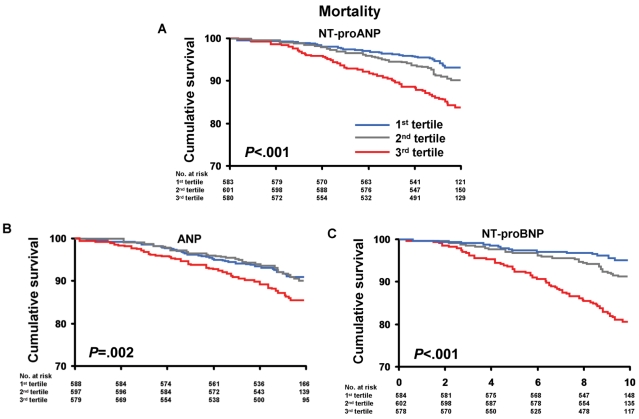
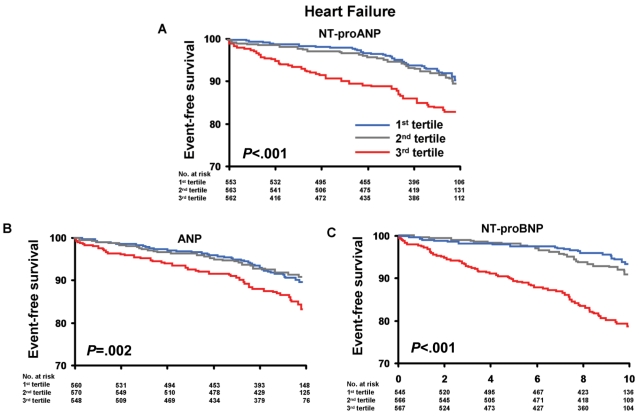
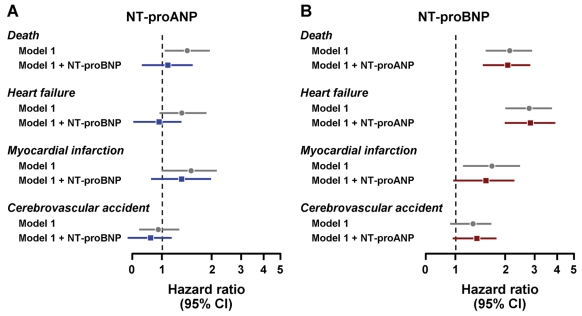
Results: After adjustment for conventional clinical risk factors, NT-proANP had significant predictive value for mortality but not for HF, MI, or cerebrovascular accident, whereas ANP lacked any predictive value. The predictive value of NT-proANP for mortality was attenuated after adjustment for structural and functional cardiac abnormalities. In contrast, NT-proBNP had predictive value for mortality, HF, and MI after adjustment for conventional risk factors and retained significance for mortality and HF after adjustment for structural and functional cardiac abnormalities.
Conclusion: Our results suggest that NT-proBNP is a more robust cardiac biomarker compared with ANP or NT-proANP and is independently predictive of mortality and HF in the general population free of overt HF.
Figures
Comment in
-
Natriuretic peptides as markers of cardiovascular risk: the story continues.Mayo Clin Proc. 2011 Dec;86(12):1143-5. doi: 10.4065/mcp.2011.0725. Mayo Clin Proc. 2011. PMID: 22134932 Free PMC article. No abstract available.
References
-
- McCullough PA, Nowak RM, McCord J, et al. B-type natriuretic peptide and clinical judgment in emergency diagnosis of heart failure: analysis from Breathing Not Properly (BNP) Multinational Study. Circulation. 2002;106(4):416–422 - PubMed
-
- Maisel AS, Krishnaswamy P, Nowak RM, et al. Rapid measurement of B-type natriuretic peptide in the emergency diagnosis of heart failure. N Engl J Med. 2002;347(3):161–167 - PubMed
-
- Heidenreich PA, Gubens MA, Fonarow GC, Konstam MA, Stevenson LW, Shekelle PG. Cost-effectiveness of screening with B-type natriuretic peptide to identify patients with reduced left ventricular ejection fraction. J Am Coll Cardiol. 2004;43(6):1019–1026 - PubMed
-
- Burnett JC, Jr, Kao PC, Hu DC, et al. Atrial natriuretic peptide elevation in congestive heart failure in the human. Science. 1986;231(4742):1145–1147 - PubMed
Publication types
MeSH terms
Substances
Grants and funding
LinkOut - more resources
Full Text Sources
Other Literature Sources
Research Materials
Miscellaneous
