


Preventing HIV Transmission in Nigeria: Role of the Dentists
- PMID: 22135532
- PMCID: PMC3216151
Preventing HIV Transmission in Nigeria: Role of the Dentists
Abstract
Background: As healthcare providers, dentists are in a unique position to foster behavioural changes that are needed to stem the spread of HIV infection. This study was conducted to assess the role of dentists in the prevention of HIV transmission in Nigeria.
Methods: This descriptive cross-sectional survey was conducted from June 2006 to January 2007. A multi-stage sampling technique was used to select 300 practising dentists from all parts of Nigeria. Data were collected through a self-administered questionnaire that focused on dentist demographic details, attitudes towards treating HIV-infected persons, involvement in public or clinic-based patient education on HIV and infection control.
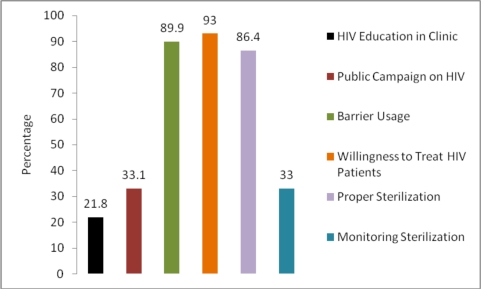
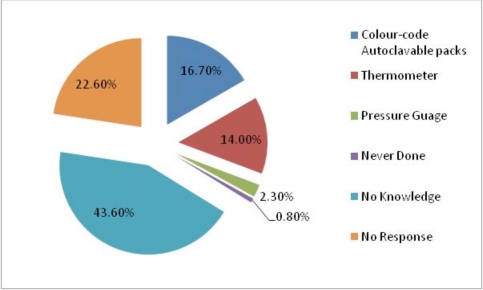
Results: Two hundred and fifty-seven questionnaires were returned completed, constituting an 86% response rate. The majority of respondents (77.8%) had their dental practice in the southern part of Nigeria, and 89% were in the age bracket of 21-40 years. HIV education by dentists was ranked as poor, as less than a quarter of respondents routinely educated patients on HIV in the clinic. Only a few dentists (33.3%) were involved in public enlightenment programme on HIV in the previous 12 months. Most of the respondents (93%) reported a willingness to treat HIV-infected patients while observing universal precautions. Good infection barrier practices were adopted by 89.9% of dentists, and disposable cartridges for local anaesthetic agents and dental needles were not reused by 93.4% of the respondents. Autoclaving was the most widely used sterilization method (73.2%), but less than half of the respondents knew how to ascertain whether sterilization was effective.
Conclusion: This study revealed that efforts by Nigerian dentists to prevent HIV transmission are presently less than optimal. Therefore, there is a need for sensitisation and motivation through seminars, workshops and lectures.
Keywords: HIV; Nigeria; dental sciences; dentists practice patterns; infection transmission; prevention and control.
Figures
Similar articles
-
Dentists and cross-infection.J Dent Assoc S Afr. 1997 Mar;52(3):165-7. J Dent Assoc S Afr. 1997. PMID: 9461908
-
Infection control knowledge and practices related to HIV among Nigerian dentists.J Infect Dev Ctries. 2009 Sep 15;3(8):604-10. doi: 10.3855/jidc.552. J Infect Dev Ctries. 2009. PMID: 19801803
-
HIV/AIDS: the knowledge, attitudes and behaviour of dentists in Nairobi, Kenya.SADJ. 2001 Dec;56(12):587-91. SADJ. 2001. PMID: 11887443
-
Nigerian dental students' willingness to treat HIV-positive patients.J Dent Educ. 2010 Apr;74(4):446-52. J Dent Educ. 2010. PMID: 20388818
-
Survey on attitudes toward HIV-infected individuals and infection control practices among dentists in Mexico City.Am J Infect Control. 2000 Feb;28(1):21-4. doi: 10.1016/s0196-6553(00)90007-5. Am J Infect Control. 2000. PMID: 10679133
Cited by
-
Prevalence of occupational infectious diseases among primary oral health care teams and prevention measures.Rev Bras Med Trab. 2020 Dec 11;18(2):149-157. doi: 10.47626/1679-4435-2020-546. Rev Bras Med Trab. 2020. PMID: 33324456 Free PMC article.
-
Dentition status and treatment needs of human immunodeficiency virus-positive patients on anti retro viral therapy in Raichur taluk, Karnataka, India: A cross sectional study.Eur J Dent. 2017 Apr-Jun;11(2):238-241. doi: 10.4103/ejd.ejd_290_16. Eur J Dent. 2017. PMID: 28729800 Free PMC article.
-
HIV/AIDS-related attitudes and oral impacts on daily performances: a cross-sectional study of Sudanese adult dental patients.BMC Health Serv Res. 2013 Aug 26;13:335. doi: 10.1186/1472-6963-13-335. BMC Health Serv Res. 2013. PMID: 23971974 Free PMC article.
-
Factors related to the willingness of Palestinian dentists to treat patients with blood-borne diseases.Int Dent J. 2015 Apr;65(2):103-9. doi: 10.1111/idj.12138. Epub 2014 Oct 24. Int Dent J. 2015. PMID: 25345747 Free PMC article.
-
Nigerian dental technology students and human immunodeficiency virus infection: knowledge, misconceptions and willingness to care.Ann Med Health Sci Res. 2014 May;4(3):330-5. doi: 10.4103/2141-9248.133454. Ann Med Health Sci Res. 2014. PMID: 24971203 Free PMC article.
References
-
- Setel PW, Unwin N, Hemed Y. Cause-Specific Adult Mortality: Evidence from Community-Based Surveillance—Selected Sites, Tanzania, 1992–1998. Morb Mortal Wkly Reo. 2000;49(19):416–419. - PubMed
-
- Ogunbodede EO. HIV/AIDS Situation in Africa. Int Dent J. 2004;54:352–360. - PubMed
-
- UNAIDS . 2004 Report on the Global AIDS Epidemic. Geneva: UNAIDS; Jul, 2004.
-
- US Department of Health and Human Services, Public Health Services National Center for Health Statistics Plans and Operations of the Third National Health and Nutrition Examination Survey 1988–1994. Vital Health Stat 1. 1994;1(32):1–407.
-
- Oginni AO. Dental care needs and demands in patients attending the dental hospital of the Obafemi Awolowo University Teaching Hospital’s Complex Ile-Ife, Nigeria. Niger J Med. 2004;13(4):339–344. - PubMed
LinkOut - more resources
Full Text Sources
Research Materials