. 2012 Jan 25;134(3):1673-9.
doi: 10.1021/ja2087147. Epub 2012 Jan 10.

Broad substrate specificity of the amide synthase in S. hygroscopicus--new 20-membered macrolactones derived from geldanamycin

Affiliations

Broad substrate specificity of the amide synthase in S. hygroscopicus--new 20-membered macrolactones derived from geldanamycin

Simone Eichner et al. J Am Chem Soc. .

Abstract

The amide synthase of the geldanamycin producer, Streptomyces hygroscopicus, shows a broader chemoselectivity than the corresponding amide synthase present in Actinosynnema pretiosum, the producer of the highly cytotoxic ansamycin antibiotics, the ansamitocins. This was demonstrated when blocked mutants of both strains incapable of biosynthesizing 3-amino-5-hydroxybenzoic acid (AHBA), the polyketide synthase starter unit of both natural products, were supplemented with 3-amino-5-hydroxymethylbenzoic acid instead. Unlike the ansamitocin producer A. pretiosum, S. hygroscopicus processed this modified starter unit not only to the expected 19-membered macrolactams but also to ring enlarged 20-membered macrolactones. The former mutaproducts revealed the sequence of transformations catalyzed by the post-PKS tailoring enzymes in geldanamycin biosynthesis. The unprecedented formation of the macrolactones together with molecular modeling studies shed light on the mode of action of the amide synthase responsible for macrocyclization. Obviously, the 3-hydroxymethyl substituent shows similar reactivity and accessibility toward C-1 of the seco-acid as the arylamino group, while phenolic hydroxyl groups lack this propensity to act as nucleophiles in the macrocyclization. The promiscuity of the amide synthase of S. hygroscopicus was further demonstrated by successful feeding of four other m-hydroxymethylbenzoic acids, leading to formation of the expected 20-membered macrocycles. Good to moderate antiproliferative activities were encountered for three of the five new geldanamycin derivatives, which matched well with a competition assay for Hsp90α.


Figures

Figure 1
Figure 1
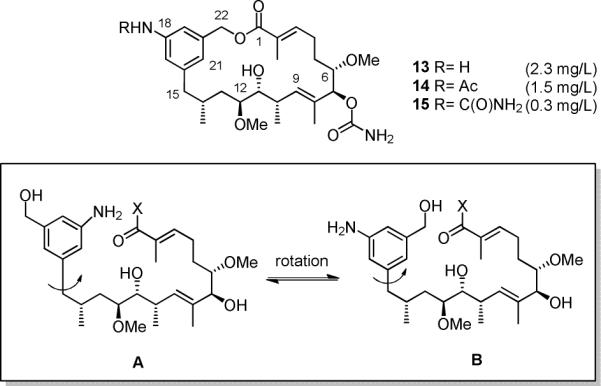
New 20-membered macrolactones 1315 and precursors A/B responsible for macrolactamization and macrolactonization, respectively (X; The nature of the leaving group at C-1 is unknown, so that X principally could be -OH, -SCoA or –SPKS, the latter two being the more likely cases).
Figure 2
Figure 2
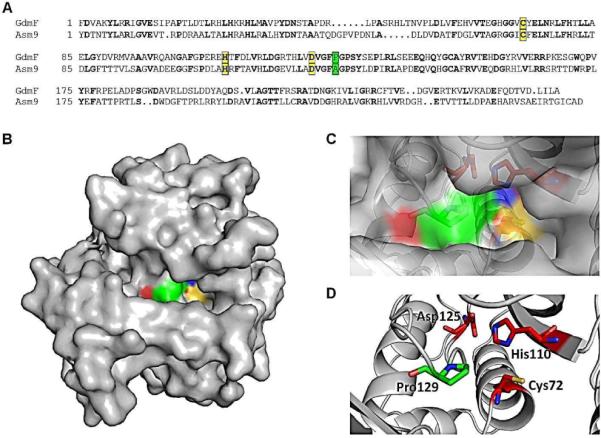
(A) Sequence alignment of GdmF and Asm9 using web-based resources (http://blast.ncbi.nlm.nih.gov). Amino acids in bold indicate a perfect match. Yellow ground displays the catalytic triad: Cys72, His110 and Asp125; Green ground, Pro/Ala129 (for GdmF and Asm9, respectively); (B) Surface representations of the homology model of GdmF using SWISS-MODEL. Note the tight channel leading to the catalytic triad (Cys72, His110 and Asp125 are colored, compare to C and D); (C, D) Zoom-in of Figure 2B showing the catalytic triad and Pro129.
Figure 3
Figure 3
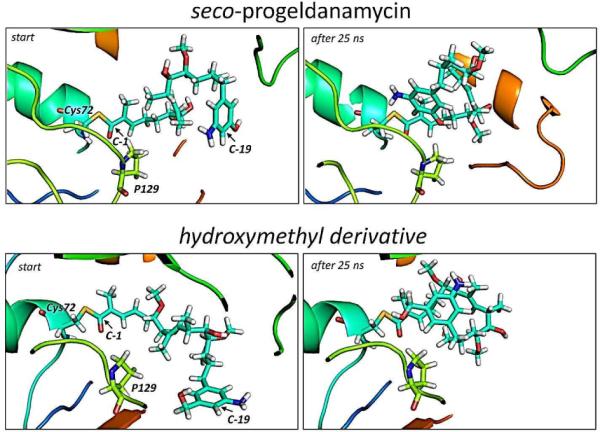
Starting and end trajectory after 25 nanoseconds of the restrained MD simulations of GdmF covalently linked to seco-progeldanamycin (top panel) and its hydroxymethyl derivative (bottom panel). The distance restraint (5 Å) between C-1 and C-19 contained a linearly increasing energy penalty during the simulation. Note, that for the hydroxymethyl derivative the aromatic ring moves out of plane in order to avoid clashes with P129.
Figure 4
Figure 4
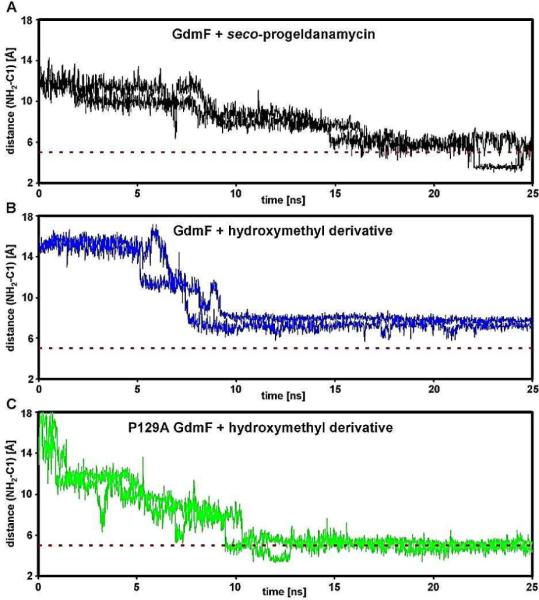
Restrained MD simulations of the aromatic ring whilst penetrating the catalytic site of GdmF (and its variant P129A) using a distance restraint (5 Å) with linearly increasing energy penalty between C-1 and C-19, the latter being located halfway between the nucleophilic groups (–NH2, –OH or –CH2OH) decorating the aromatic ring (Figure 3). Using this approach we were able to qualitatively probe the conformational space available to the aromatic ring and thus the distance of the nucleophilic groups to C-1. The dashed red line indicates close proximity of the NH2 nucleophile to C-1 after penetration as observed for the natural ligand seco-progeldanmycin (in black). In contrast, the approach of the NH2 nucleophile of the hydroxymethyl derivative of seco-geldanamycin towards C-1 appears hindered (in blue) which might explain observed slower lactam cyclization rates for this non-natural substrate. In fact, detailed analyses of the dynamic trajectories imply that the naturally occurring compound is still mobile within the catalytic pocket of GdmF, while the hydroxymethyl derivative shows static properties (compare Figure 4A and 4B and data not shown). The static ligand properties can be overcome once proline 129 is mutated to an alanine (P129A, in green) rationalizing the observed turnover specificity for Asm9 (compare Figure 4B and 4C). Note that P129A mimics the catalytic pocket of Asm9 (see Figures 2,3)).
Figure 5
Figure 5
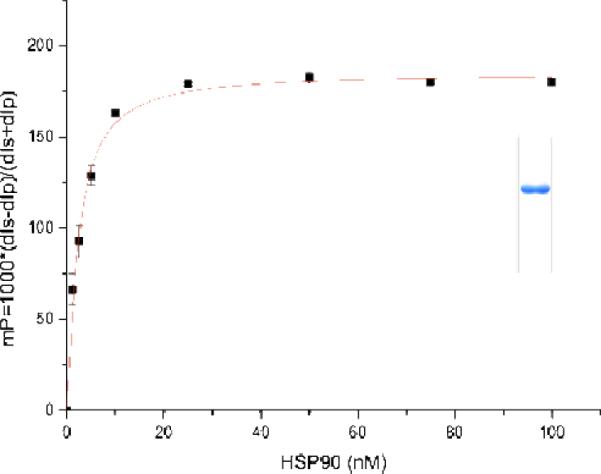
Dose-response curve for the binding of 10 nM geldanamycin-FITC conjugate to human Hsp90α. Different amounts of purified protein were incubated with geldanamycin-FITC at 4° C and fluorescence polarization was measured after 16 h. Data were imported into Origin 6.0 to determine the dissociation constant from a dose-response curve as a function of the Hsp90α concentration. The tracer had a Kd of 11 nM for HSP90α. The assay was performed under conditions at or above 130 mP (inset: purified full length Hsp90α).
Scheme 1
Scheme 1
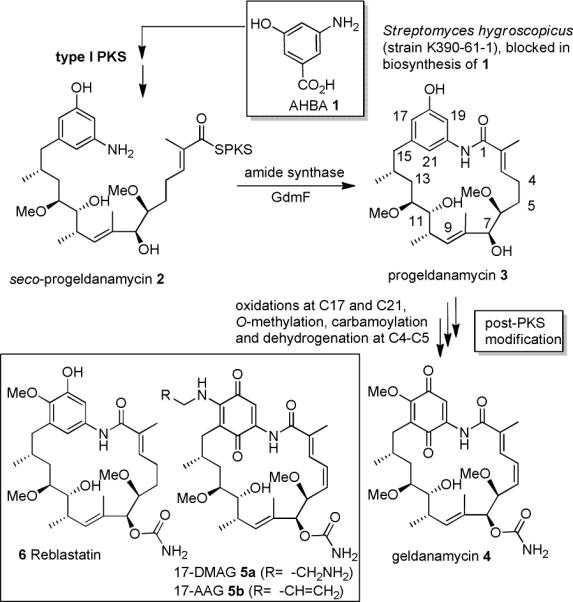
Biosynthesis starting from 3-amino-5-hydroxybenzoic acid (AHBA 1) of geldanamycin (4) via seco-(2) and progeldanamycin (3).
Scheme 2
Scheme 2
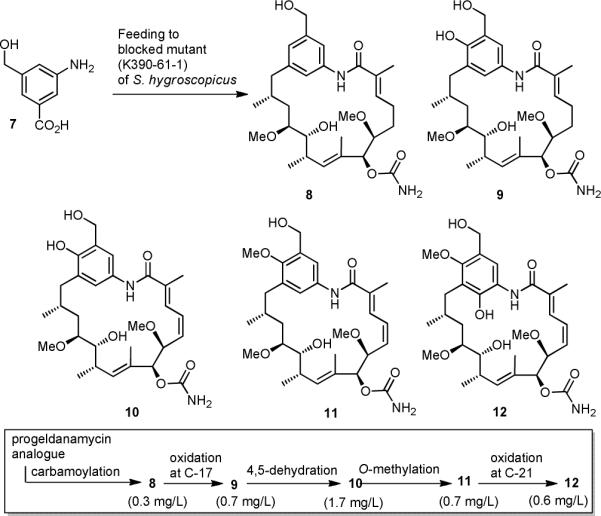
Mutasynthesis with S. hygroscopicus K390-61-1 using 3-aminobenzoic acid (7) and our proposed sequence of postketide transformations.
Scheme 3
Scheme 3
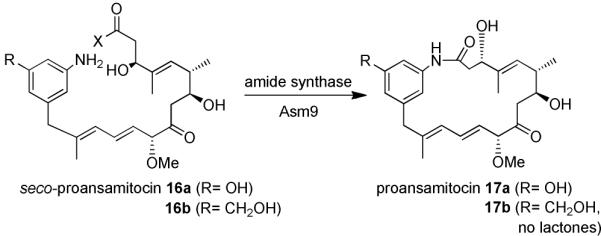
Macrolactamization of seco-proansamitocin 16a and derivative 16b to proansamitocin 17a and derivative 17b, respectively, by the amide synthase (Asm9) from Actinosynnema pretiosum (for X refer to legend of figure 1).
Scheme 4
Scheme 4
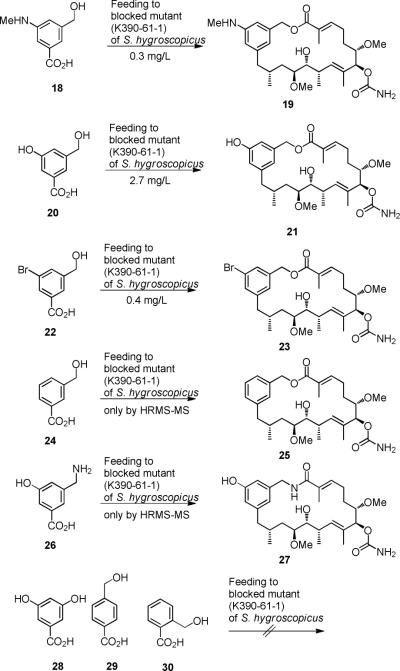
New 20-membered geldanamycin-derived macrolactones 19, 21, 23 and 25 (isolated yields) and 20-membered macrolactam 30.

References

    1. Workman P. Curr. Cancer Drug Targets. 2003;3:297–300. - PubMed
    2. Neckers L, Neckers K. Expert Opin. Emerg. Drugs. 2005;10:137–149. - PubMed
    3. Whitesell L, Lindquist SL. Nat. Rev. Cancer. 2005;5:761–772. - PubMed
    4. Prodromou C, Roe SM, O'Brien R, Ladbury JE, Piper PW, Pearl LH. Cell. 1997;90:65–75. - PubMed
    1. Review: Biamonte MA, van de Water R, Arndt JW, Scannevin RH, Perret D, Lee W-C. J. Med. Chem. 2010;53:3–17..

    1. Blagosklonny MV, Toretsky J, Neckers L. Oncogene. 1995;11:933–939. - PubMed
    1. Janin L. J. Med. Chem. 2005;48:7503–7512. - PubMed
    1. Stead P, Latif S, Blackaby AP, Sidebottom PJ, Deakin A, Taylor NL, Life P, Spaull J, Burrell F, Jones R, Lewis J, Davidson I, Mander T. J. Antibiot. 2000;53:657–663. - PubMed
    2. Takatsu T, Ohtsuki M, Muramatsu A, Enokita R, Kurakata SI. J. Antibiot. 2000;53:1310–1312. - PubMed

Publication types