. 2012 Feb;180(2):636-49.
doi: 10.1016/j.ajpath.2011.10.026. Epub 2011 Dec 2.

Constitutive TL1A expression under colitogenic conditions modulates the severity and location of gut mucosal inflammation and induces fibrostenosis

Affiliations

Constitutive TL1A expression under colitogenic conditions modulates the severity and location of gut mucosal inflammation and induces fibrostenosis

Robert Barrett et al. Am J Pathol. 2012 Feb.

Abstract

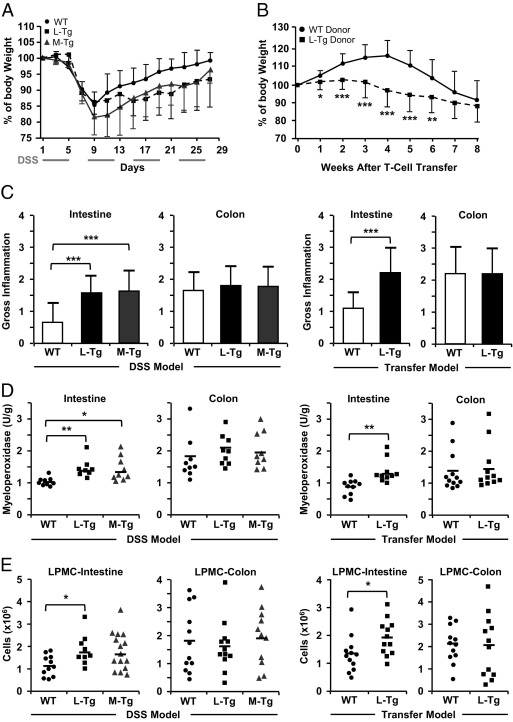
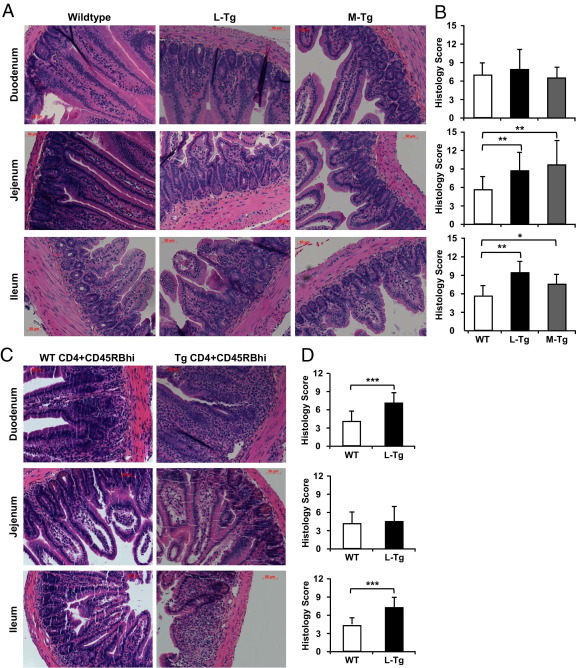
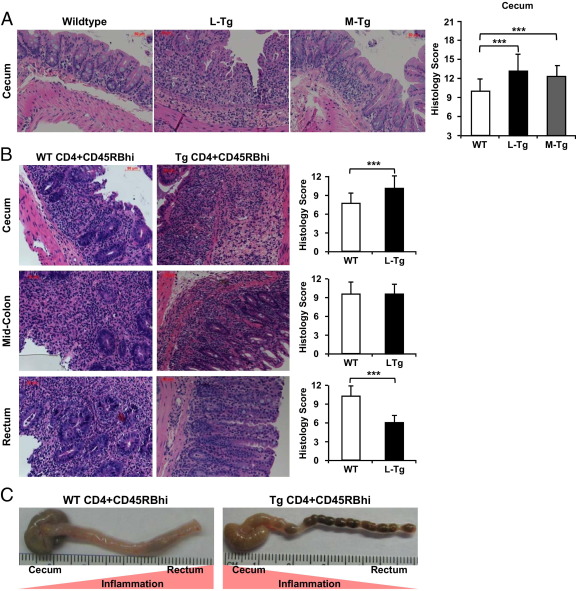
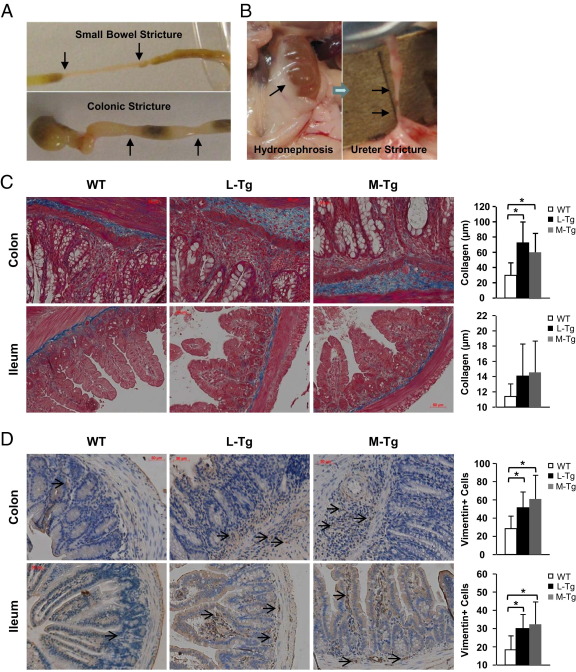
Intestinal fibrostenosis is a hallmark of severe Crohn's disease and can lead to multiple surgeries. Patients with certain TNFSF15 variants overexpress TL1A. The aim of this study was to determine the effect of TL1A overexpression on intestinal inflammation and the development of fibrostenosis. We assessed the in vivo consequences of constitutive TL1A expression on gut mucosal inflammation and fibrostenosis using two murine models of chronic colitis. In the dextran sodium sulfate (DSS) and adoptive T-cell transfer models, there was proximal migration of colonic inflammation, worsened patchy intestinal inflammation, and long gross intestinal strictures in Tl1a transgenic compared to wild-type littermates. In the DSS model, myeloid- and T-cell-expressing Tl1a transgenic mice had increased T-cell activation markers and interleukin-17 expression compared to wild-type mice. In the T-cell transfer model, Rag1(-/-) mice receiving Tl1a transgenic T cells had increased interferon-γ expression but reduced T-helper 17 cells and IL-17 production. Narrowed ureters with hydronephrosis were found only in the Tl1a transgenic mice in all chronic colitis models. In human translational studies, Crohn's disease patients with higher peripheral TL1A expression also exhibited intestinal fibrostenosis and worsened ileocecal inflammation with relative sparing of rectosigmoid inflammation. These data show that TL1A is an important cytokine that not only modulates the location and severity of mucosal inflammation, but also induces fibrostenosis.


Figures

Figure 1
Figure 1
Intestinal and colonic disease features in WT, L-Tg, and M-Tg mice. Percentage of body weight change is shown for DSS-induced colitis (n = 15 for WT, M-Tg, and L-Tg) (A) and adoptive T-cell transfer model (n = 12 for WT donor and L-Tg donor) (B). Data are expressed as mean ± SD. C: Gross appearance of intestine and colon were measured using a standard scoring system.D: Myeloperoxidase activity was measured, and data are expressed as arbitrary unit (U) per gram (g) of protein. E: Total numbers of mononuclear cells were isolated from the distal 10 cm of intestine or colon. For D, each symbol represents independent mice. Each symbol in E represents the mean of triplicates. *P < 0.05, **P < 0.01, and ***P < 0.001.
Figure 2
Figure 2
Tl1a-Tg mice have patchy intestinal inflammation. Representative H&E stained DSS (A) and adoptive-transfer (C) intestinal sections are shown. Quantitative histology scores for DSS (B) and adoptive transfer (D) were determined. Data are expressed as mean ± SD. Fields were scored at ×200 magnification. *P < 0.05, **P < 0.01, ***P < 0.001.
Figure 3
Figure 3
Tl1a-Tg mice have proximal migration of colonic inflammation. Representative H&E-stained DSS (A) and adoptive-transfer (B) colonic sections are shown with corresponding quantitative histology scores. C: Representative colonic specimen showing proximal migration of gross inflammation in the mice receiving L-Tg T cells compared to WT T cells. Data are expressed as mean ± SD. Fields were scored at ×200 magnification. ***P < 0.001.
Figure 4
Figure 4
Tl1a-Tg mice have fibrostenotic disease. A: Representative pictures of intestinal and colonic stricture (arrows) are shown. B: Representative pictures of hydronephrosis due to ureteral stricture (arrows) are shown. C: Masson-Trichrome staining of collagen deposition in nonstrictured tissue sections of mouse at mid-colon and distal 3 cm of ilea is shown for the DSS model. Thickness of collagen deposition (stained blue) was quantitated and represented as mean ± SD. D: Vimentin stain of fibroblasts in nonstrictured tissue sections were performed for the DSS model. Fibroblasts were stained brown (arrows). Vimentin-positive cells were quantitated and represented as mean ± SD. Fields were scored at ×200 magnification. *P < 0.05.
Figure 5
Figure 5
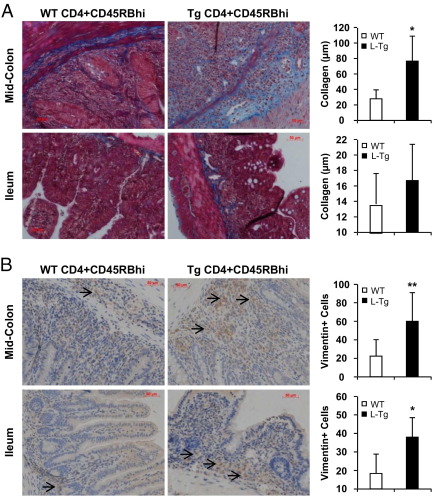
Adoptive transfer of L-Tg mice can lead to fibrostenotic disease. A: Masson-Trichrome staining of collagen deposition in nonstrictured tissue sections of mouse at mid-colon and distal 3 cm of ilea is shown for the adoptive-transfer model. Thickness of collagen deposition was quantitated and represented as mean ± SD. B: Vimentin stain of fibroblasts in nonstrictured tissue sections was performed for the adoptive-transfer model. Fibroblasts were stained brown (arrows). Vimentin-positive cells were quantitated and represented as mean ± SD. Fields were scored at ×200 magnification for A and B. *P < 0.05, **P < 0.01.
Figure 6
Figure 6
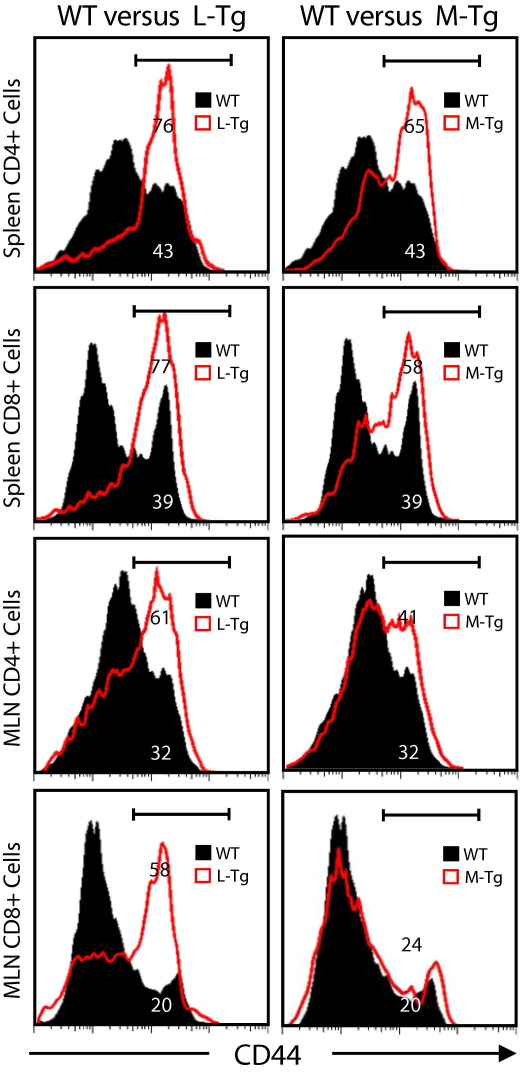
Sustained TL1A expression leads to increased percentage of activated T cells in DSS-induced chronic colitis. Flow cytometry plot of splenocytes and MLN cells showing expression of activation markers CD44. CD4+ and CD8+ cells were gated as indicated. Data shown are representative of at least five independent experiments.
Figure 7
Figure 7
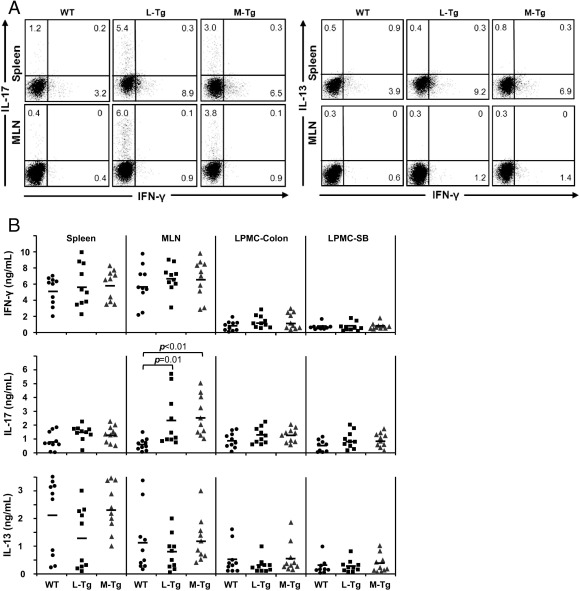
Sustained TL1A expression leads to increased IL-17 expression in DSS-induced chronic colitis. A: Flow cytometry plots of gated CD4+ cells from spleen and MLN, stained for intracellular IFN-γ, IL-17, and IL13 expression, are shown. Data shown are representative of ≥5 mice per group. B: IFN-γ, IL-17, and IL13 secretion after stimulation with anti-CD3 and anti-CD28 were assessed by enzyme-linked immunosorbent assay. Each data point represents cytokine expression for splenocytes, MLN cells, or LPMC from an individual mouse. P values are indicated where significant.
Figure 8
Figure 8
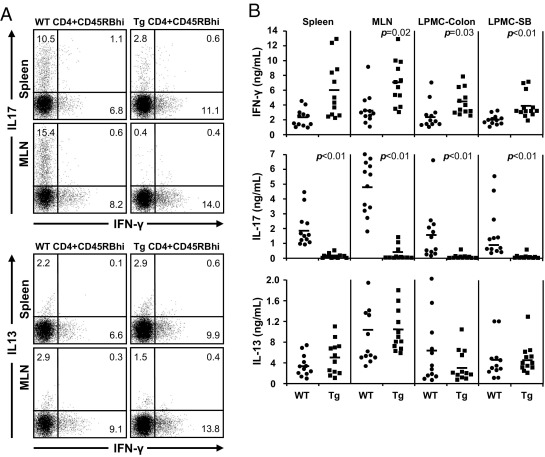
Sustained TL1A expression leads to increased IFN-γ and reduced IL-17 expression in the adoptive-transfer model. A: Flow cytometry plots of gated CD4+ cells from spleen and MLN, stained for intracellular IFN-γ, IL-17, and IL13 expression, are shown. Data shown are representative of ≥5 mice per group. B: IFN-γ, IL-17, and IL13 secretion after stimulation with anti-CD3 and anti-CD28 were assessed by enzyme-linked immunosorbent assay. Each data point represents cytokine expression for splenocytes, MLN cells, or LPMC of an individual mouse. P values are indicated where significant.
Figure 9
Figure 9
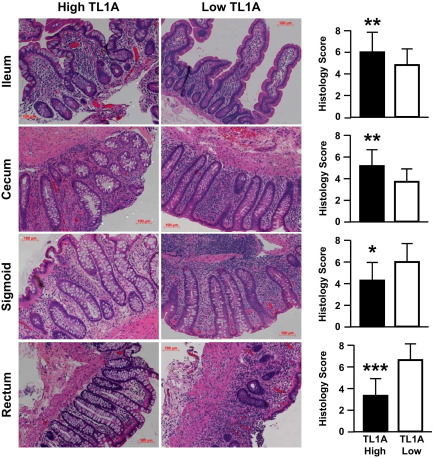
CD patients with elevated TL1A expression have increased ileocecal inflammation but reduced rectosigmoid inflammation. Representative H&E-stained intestinal and colonic sections are shown, and corresponding histology scores were determined. Data are expressed as mean ± SD. Sections were scored at ×200 magnification by two pathologists blinded to the TL1A haplotype and its expression level. *P < 0.05, **P < 0.01, and ***P < 0.001.

References

    1. Peyrin-Biroulet L., Loftus E.V., Jr., Colombel J.F., Sandborn W.J. The natural history of adult Crohn's disease in population-based cohorts. Am J Gastroenterol. 2010;105:289–297. - PubMed
    1. Shih D.Q., Targan S.R. Insights into IBD pathogenesis. Curr Gastroenterol Rep. 2009;11:473–480. - PMC - PubMed
    1. Michelsen K.S., Thomas L.S., Taylor K.D., Yu Q.T., Mei L., Landers C.J., Derkowski C., McGovern D.P., Rotter J.I., Targan S.R. IBD-associated TL1A gene (TNFSF15) haplotypes determine increased expression of TL1A protein. PLoS One. 2009;4:e4719. - PMC - PubMed
    1. Picornell Y., Mei L., Taylor K., Yang H., Targan S.R., Rotter J.I. TNFSF15 is an ethnic-specific IBD gene. Inflamm Bowel Dis. 2007;13:1333–1338. - PMC - PubMed
    1. Wellcome Trust Case Control Consortium Genome-wide association study of 14,000 cases of seven common diseases and 3,000 shared controls. Nature. 2007;447:661–678. - PMC - PubMed

Publication types

Substances