. 2012 May;26(4):362-73.
doi: 10.1177/1545968311425926. Epub 2011 Dec 2.

Need for speed: better movement quality during faster task performance after stroke

Affiliations

Need for speed: better movement quality during faster task performance after stroke

Stacey L DeJong et al. Neurorehabil Neural Repair. 2012 May.

Abstract

Background: . Although slow and insufficient muscle activation is a hallmark of hemiparesis poststroke, movement speed is rarely emphasized during upper-extremity rehabilitation. Moving faster may increase the intensity of task-specific training, but positive and/or negative effects on paretic-limb movement quality are unknown.

Objective: . To determine whether moving quickly instead of at a preferred speed either enhances or impairs paretic-limb task performance after stroke.

Methods: . A total of 16 people with poststroke hemiparesis and 11 healthy controls performed reach-grasp-lift movements at their preferred speed and as fast as possible, using palmar and 3-finger grip types. The authors measured durations of the reach and grasp phases, straightness of the reach path, thumb-index finger separation (aperture), efficiency of finger movement, and grip force.

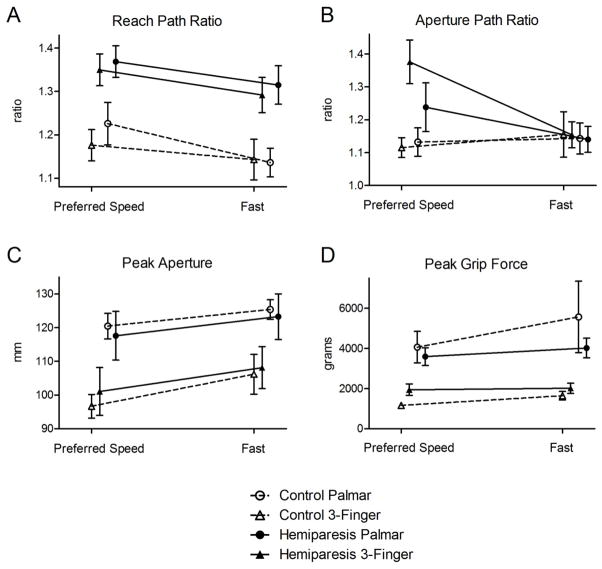
Results: . Reach and grasp phase durations decreased in the fast condition in both groups, showing that participants were able to move more quickly when asked. When moving fast, the hemiparetic group had reach durations equal to those of healthy controls moving at their preferred speed. Movement quality also improved. Reach paths were straighter, and peak apertures were greater in both groups in the fast condition. The group with hemiparesis also showed improved efficiency of finger movement. Differences in peak grip force across speed conditions did not reach significance.

Conclusions: . People with hemiparesis who can perform reach-grasp-lift movements with a 3-finger grip can move faster than they choose to, and when they do, movement quality improves. Simple instructions to move faster could be a cost-free and effective means of increasing rehabilitation intensity after stroke.


Figures

Figure 1
Figure 1
Assessment of task performance. Illustration of the experimental set-up and a participant beginning (A) and finishing (B) the reach-grasp-lift task with a 3-finger grip.
Figure 2
Figure 2
Example data from a healthy control participant performing one trial of the reach-grasp-lift task at preferred speed, using a 3-finger grip. Vertical dashed lines and solid black circles demonstrate division of the task into movement phases. The reach phase began when speed of the hand sensor first exceeded 5 mm/sec and ended when grip force first exceeded 5 grams. Pre-lift delay began at the end of the reach and ended when the vertical position of the object increased by 3 mm from its initial value.
Figure 3
Figure 3
Comparison of phase durations in the preferred speed versus fast conditions. Values are means ± 1 standard error. For healthy controls in the fast condition, some of the standard errors do not extend past the edges of the symbols (circles or triangles), and error bars therefore do not appear. Reach duration (A) and pre-lift delay (B) were shorter in the fast condition, in both groups. Reach duration was longer in the hemiparetic group compared to controls. When moving fast, however, the hemiparetic group had reach durations equal to that of the control group moving at preferred speed.
Figure 4
Figure 4
Examples of improved movement quality in the fast condition compared to the preferred speed condition in individual participants with hemiparesis. Trajectories of the forearm sensor in the sagittal plane (A), plotted from the start of movement (open circle), until the hand contacted the object. In one representative participant with hemiparesis, reach paths were straighter during three fast trials (middle panel) compared to three preferred speed trials (left panel). Aperture traces (B) plotted from the start of movement (0 msec) until the hand contacted the object. In a different representative participant with hemiparesis, aperture traces were smoother during three fast trials (middle panel) compared to three preferred speed trials (left panel). In each example, performance of the participant with hemiparesis during three fast trials (middle panels) approached that of a representative healthy control participant performing three trials at preferred speed (right panels).
Figure 5
Figure 5
Comparison of movement quality in the preferred speed versus fast conditions. Both groups showed lower reach path ratios (A) and greater peak apertures (C) in the fast condition compared to the preferred speed condition. In the hemiparetic group only, aperture path ratios were lower in the fast condition compared to the preferred speed condition (B). The standard error for peak grip force in healthy controls in the preferred speed condition did not extend past the edges of the symbol (triangle), and error bars therefore do not appear.

References

    1. Adkins DL, Boychuk J, Remple MS, Kleim JA. Motor training induces experience-specific patterns of plasticity across motor cortex and spinal cord. J Appl Physiol. 2006;101:1776–1782. - PubMed
    1. Nudo RJ, Milliken GW, Jenkins WM, Merzenich MM. Use-dependent alterations of movement representations in primary motor cortex of adult squirrel monkeys. J Neurosci. 1996;16:785–807. - PMC - PubMed
    1. Mueller MJ, Maluf KS. Tissue adaptation to physical stress: A proposed “Physical stress theory” To guide physical therapist practice, education, and research. Phys Ther. 2002;82:383–403. - PubMed
    1. Jones TA, Allred RP, Adkins DL, Hsu JE, O’Bryant A, Maldonado MA. Remodeling the brain with behavioral experience after stroke. Stroke. 2009;40:S136–138. - PMC - PubMed
    1. Askim T, Indredavik B, Vangberg T, Haberg A. Motor network changes associated with successful motor skill relearning after acute ischemic stroke: A longitudinal functional magnetic resonance imaging study. Neurorehabil Neural Repair. 2009;23:295–304. - PubMed

Publication types