. 2011;6(11):e27910.
doi: 10.1371/journal.pone.0027910. Epub 2011 Nov 28.

Phosphodiesterase-5 inhibition mimics intermittent reoxygenation and improves cardioprotection in the hypoxic myocardium

Affiliations

Phosphodiesterase-5 inhibition mimics intermittent reoxygenation and improves cardioprotection in the hypoxic myocardium

Giuseppina Milano et al. PLoS One. 2011.

Erratum in

  • PLoS One. 2012;7(1). doi:10.1371/annotation/f7aebee7-7b7e-4a44-aa23-56e9a32f14f6

Abstract

Although chronic hypoxia is a claimed myocardial risk factor reducing tolerance to ischemia/reperfusion (I/R), intermittent reoxygenation has beneficial effects and enhances heart tolerance to I/R.

Aim of the study: To test the hypothesis that, by mimicking intermittent reoxygenation, selective inhibition of phosphodiesterase-5 activity improves ischemia tolerance during hypoxia. Adult male Sprague-Dawley rats were exposed to hypoxia for 15 days (10% O₂) and treated with placebo, sildenafil (1.4 mg/kg/day, i. p.), intermittent reoxygenation (1 h/day exposure to room air) or both. Controls were normoxic hearts. To assess tolerance to I/R all hearts were subjected to 30-min regional ischemia by left anterior descending coronary artery ligation followed by 3 h-reperfusion. Whereas hypoxia depressed tolerance to I/R, both sildenafil and intermittent reoxygenation reduced the infarct size without exhibiting cumulative effects. The changes in myocardial cGMP, apoptosis (DNA fragmentation), caspase-3 activity (alternative marker for cardiomyocyte apoptosis), eNOS phosphorylation and Akt activity paralleled the changes in cardioprotection. However, the level of plasma nitrates and nitrites was higher in the sildenafil+intermittent reoxygenation than sildenafil and intermittent reoxygenation groups, whereas total eNOS and Akt proteins were unchanged throughout.

Conclusions: Sildenafil administration has the potential to mimic the cardioprotective effects led by intermittent reoxygenation, thereby opening the possibility to treat patients unable to be reoxygenated through a pharmacological modulation of NO-dependent mechanisms.


Conflict of interest statement

Competing Interests: The authors have declared that no competing interests exist.

Figures

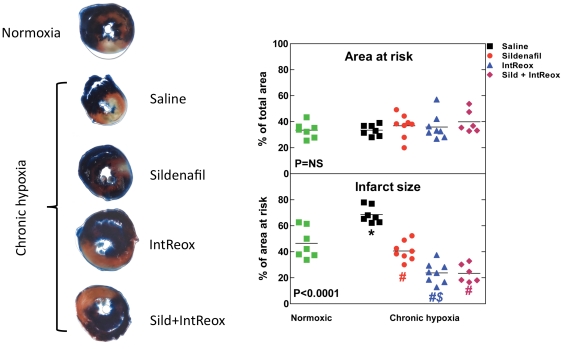
Figure 1
Figure 1. Tolerance to acute infarct.
Hearts were subjected to 30-min occlusion of the left anterior descending coronary artery followed by 3-h reperfusion, and were stained as described in Materials and Methods. The left panel shows sample photographs of the central sections of one heart per group. The right panel shows average area at risk (top) and infarct size (bottom) along withvalues obtained in single experiments. The P value in the insets reports ANOVA. *, P<0.05 when comparing untreated chronic hypoxia vs. normoxia; #, P<0.05 when comparing the various treatments vs. untreated chronic hypoxia; $, P<0.05 when comparing the two treatments between them. All post-tests performed with the Bonferroni method.
Figure 2
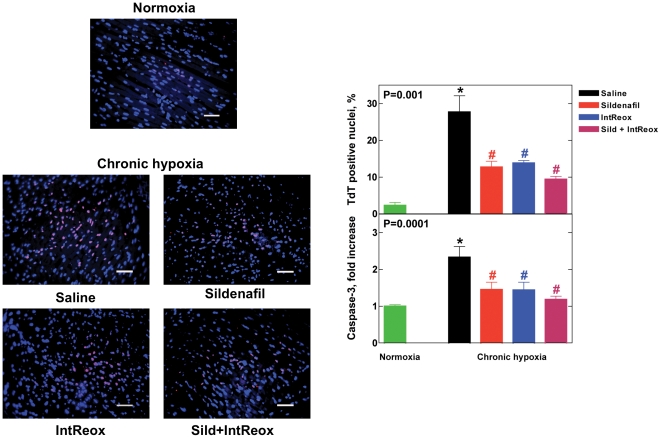
Figure 2. Apoptosis.
The left panel shows representative immunofluorescence images from the various groups under study. TdT-positive nuclei are marked in red, whereas total nuclei are marked in blue. Overlap red+blue gives pink. Magnification 40×, the bar represents 20 µm. Right top panel. The left axis reports the percent of TdT-positive/total nuclei in all the samples (five sections per each biopsy, and five fields per each section). In the Right bottom panel, the activation of caspase-3 activity is reported. The P value in the insets reports ANOVA. Sample photographs of the central sections of one heart per group are shown. *, P<0.05 when comparing untreated chronic hypoxia vs. normoxia; #, P<0.05 when comparing the various treatments vs. untreated chronic hypoxia; $, P<0.05 when comparing the two treatments between them. All post-tests performed with the Bonferroni method.
Figure 3
Figure 3. Effects of NO.
Myocardial level of cGMP (top panel), plasma level of nitrates/nitrites (middle panel) and myocardial nitrates/nitrites level (botton panel). The P value in the insets reports ANOVA. *, P<0.05 when comparing untreated chronic hypoxia vs. normoxia; #, P<0.05 when comparing the various treatments vs. untreated chronic hypoxia. All post-tests performed with the Bonferroni method.
Figure 4
Figure 4. eNOS activity.
The left panel shows representative Western blots performed using antibodies against total eNOS protein and phosphorylated eNOS, with β-actin as loading control. All blots were subjected to densitometry and the right panel shows the average expression of total eNOS (top) and phosphorylated eNOS (bottom). The P value in the insets reports ANOVA. *, P<0.05 when comparing untreated chronic hypoxia vs. normoxia; #, P<0.05 when comparing the various treatments vs. untreated chronic hypoxia. All post-tests performed with the Bonferroni method.
Figure 5
Figure 5. Akt activity.
The left panel shows representative Western blots performed using antibodies against total Akt protein and phosphorylated Akt, with β-actin as loading control. All blots were subjected to densitometry and the right panel shows the average expression of total Akt (top) and phosphorylated Akt (bottom). The P value in the insets reports ANOVA. *, P<0.05 when comparing untreated chronic hypoxia vs. normoxia; #, P<0.05 when comparing the various treatments vs. untreated chronic hypoxia. All post-tests performed with the Bonferroni method.

References

    1. Milano G, Bianciardi P, Corno AF, Raddatz E, Morel S, et al. Myocardial Impairment in Chronic Hypoxia Is Abolished by Short Aeration Episodes: Involvement of K+ATP Channels. Exp Biol Med (Maywood) 2004;229:1196–1205. - PubMed
    1. Milano G, Corno AF, Lippa S, Von Segesser LK, Samaja M. Chronic and intermittent hypoxia induce different degrees of myocardial tolerance to hypoxia-induced dysfunction. Exp Biol Med (Maywood) 2002;227:389–397. - PubMed
    1. Morel S, Milano G, Ludunge KM, Corno AF, Samaja M, et al. Brief reoxygenation episodes during chronic hypoxia enhance posthypoxic recovery of LV function : Role of mitogen-activated protein kinase signaling pathways. Basic Res Cardiol. 2006;101:336–345. - PubMed
    1. Corno AF, Milano G, Morel S, Tozzi P, Genton CY, et al. Hypoxia: unique myocardial morphology? J Thorac Cardiovasc Surg. 2004;127:1301–1308. - PubMed
    1. Milano G, Corno AF, Samaja M, Morel S, Vassalli G, et al. Daily reoxygenation decreases myocardial injury and improves post-ischaemic recovery after chronic hypoxia. Eur J Cardiothorac Surg. 2010;37:942–949. - PubMed

Publication types

MeSH terms