. 2011;6(11):e28283.
doi: 10.1371/journal.pone.0028283. Epub 2011 Nov 29.

Inducible gene manipulations in brain serotonergic neurons of transgenic rats

Affiliations

Inducible gene manipulations in brain serotonergic neurons of transgenic rats

Tillmann Weber et al. PLoS One. 2011.

Abstract

The serotonergic (5-HT) system has been implicated in various physiological processes and neuropsychiatric disorders, but in many aspects its role in normal and pathologic brain function is still unclear. One reason for this might be the lack of appropriate animal models which can address the complexity of physiological and pathophysiological 5-HT functioning. In this respect, rats offer many advantages over mice as they have been the animal of choice for sophisticated neurophysiological and behavioral studies. However, only recently technologies for the targeted and tissue specific modification of rat genes - a prerequisite for a detailed study of the 5-HT system - have been successfully developed. Here, we describe a rat transgenic system for inducible gene manipulations in 5-HT neurons. We generated a Cre driver line consisting of a tamoxifen-inducible CreERT2 recombinase under the control of mouse Tph2 regulatory sequences. Tissue-specific serotonergic Cre recombinase expression was detected in four transgenic TPH2-CreERT2 rat founder lines. For functional analysis of Cre-mediated recombination, we used a rat Cre reporter line (CAG-loxP.EGFP), in which EGFP is expressed after Cre-mediated removal of a loxP-flanked lacZ STOP cassette. We show an in-depth characterisation of this rat Cre reporter line and demonstrate its applicability for monitoring Cre-mediated recombination in all major neuronal subpopulations of the rat brain. Upon tamoxifen induction, double transgenic TPH2-CreERT2/CAG-loxP.EGFP rats show selective and efficient EGFP expression in 5-HT neurons. Without tamoxifen administration, EGFP is only expressed in few 5-HT neurons which confirms minimal background recombination. This 5-HT neuron specific CreERT2 line allows Cre-mediated, inducible gene deletion or gene overexpression in transgenic rats which provides new opportunities to decipher the complex functions of the mammalian serotonergic system.


Conflict of interest statement

Competing Interests: The authors have declared that no competing interests exist.

Figures

Figure 1
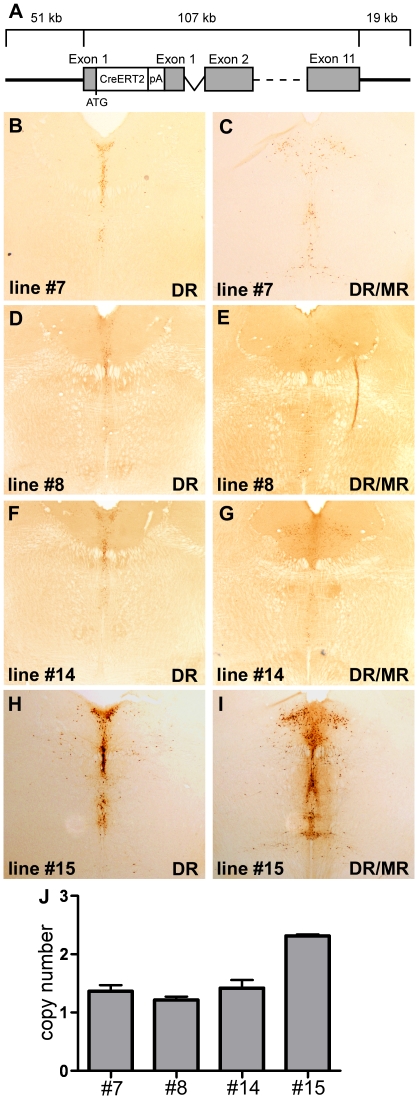
Figure 1. Copy number dependent Cre expression in TPH2-CreERT2 founder rats.
(A) Mouse TPH2-CreERT2 expression cassette for DNA microinjection. (B–I) DAB-immunohistochemistry with a Cre antibody shows weak Cre expression in the brain stem and mid-brain of TPH2-CreERT2 rat founder lines #7 (Fig. 1B,C), #8 (Fig. 1D,E), and #14 (Fig. 1F,G). Founder line #15 shows extensive Cre staining in areas where serotonergic raphe nuclei are located (Fig. 1H,I). Intensity of Cre expression correlates with the transgene copy number of TPH2-CreERT2 rat founders (Fig. 1J).
Figure 2
Figure 2. Cre expression is restricted to serotonergic neurons of the raphe nuclei.
(A,C,E,G) DAB-immunohistochemistry with a Cre antibody of line #15 shows Cre staining in the brain stem and mid-brain, regions which contain serotonergic somata while extraserotonergic brain regions show no staining. (B,D,F,H) Coronal sections of dual-label fluorescence immunohistochemistry with Cre and TPH1 antibodies. The TPH1 antibody crossreacts with TPH2 and detects both isoenzymes. Colocalization of TPH1 and Cre confirms exclusive Cre expression in 5-HT neurons of the raphe nuclei. Caudal raphe nuclei (CR); dorsal raphe nuclei (DR); median raphe nuclei (MR). Scale bars: 100 µm.
Figure 3
Figure 3. Baseline βgal expression in the brain of CAG-loxP.EGFP Cre reporter rats.
(A,B) X-Gal staining of sagittal sections shows ubiquitous βgal activity throughout the brain of adult CAG-loxP.EGFP rats (P90). (C–K) Dual-label fluorescence immunohistochemistry (IHC). (C–E) βgal/NeuN IHC of the cerebellum (C), cortex (D) and OB (E) shows strong colocalization of βgal with the neuronal marker NeuN. (F–H) βgal IHC with the serotonergic marker TPH2 (F), and the dopaminergic and noradrenergic marker tyrosine hydroxylase (TH) (G,H) shows abundant colocalization of βgal with 5-HT neurons in the dorsal raphe (F), with dopaminergic neurons in the ventral tegmental area and substantia nigra (G) and noradrenergic neurons in the locus coeruleus (H) confirming strong βgal expression in all monoaminergic neurons. (I,J) βgal/GAD67 IHC shows βgal expression in GABAergic neurons of the granular layer of the OB (I) and in the hippocampus (J). (K) βgal/GFAP IHC in the hippocampus shows infrequent βgal expression in glia. OB, olfactory bulb; DR, dorsal raphe nuclei; VTA, ventral tegmental area; SN, substantia nigra; LC, locus coeruleus; HC, hippocampus. Scale bars: 100 µm.
Figure 4
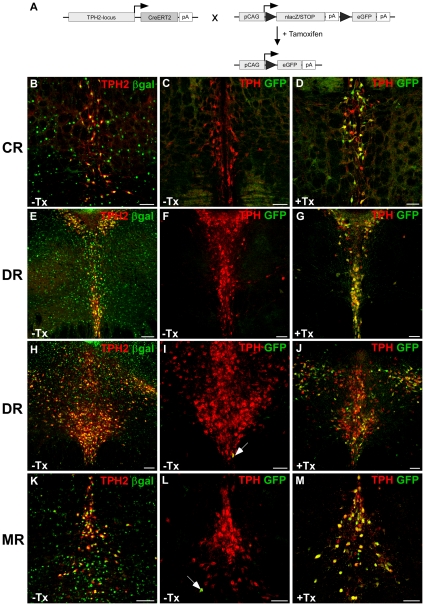
Figure 4. Inducible recombination is restricted to serotonergic neurons of adult TPH2-CreERT2/CAG-loxP.EGFP rats.
(A) TPH2-CreERT2 rats were bred to CAG-loxP.EGFP rats to generate double-transgenic TPH2-CreERT2/CAG-loxP.EGFP rats. Under uninduced baseline conditions, the loxP-flanked lacZ minigene is expressed reflecting cell-type specific CAG-promoter activity. Upon Cre-mediated recombination (+ Tamoxifen), lacZ is replaced with the second reporter gene enhanced green fluorescent protein (EGFP). The appearance of EGFP serves as an indicator of Cre mediated recombination in double transgenic rats. TPH2-CreERT2/CAG-loxP.EGFP rats were daily injected with tamoxifen (40 mg/kg) or vehicle for five consecutive days starting between P60–90. Coronal sections show dual-label fluorescence immunohistochemistry for TPH/βgal (B,E,H,K) and TPH/GFP (C,F,I,L) in vehicle-treated rats (-Tx) and TPH/GFP in tamoxifen-treated (+Tx) rats (D,G,J,M). Colocalization is visualized at the level of caudal raphe nuclei (CR) (B–D), dorsal raphe nuclei (DR) (E–J) and median raphe nuclei (MR) (K–M) using confocal images. In vehicle-treated rats, TPH2-CreERT2/CAG-loxP.EGFP rats display strong basal, non-recombined βgal expression in TPH2+ 5-HT neurons (B,E,H,K) making these rats ideally suited to monitor tamoxifen-induced Cre-mediated recombination in 5-HT neurons. (C,F,I,L) Without tamoxifen treatment, background recombination, i.e. EGFP expression (arrows) hardly occurs. (D,G,J,M) After tamoxifen treatment, the majority of TPH+ 5-HT neurons in all raphe nuclei now show EGFP expression indicating Cre-mediated recombination in these neurons (GFP+/TPH+). Scale bars: 100 µm.

References

    1. Cools R, Roberts AC, Robbins TW. Serotoninergic regulation of emotional and behavioural control processes. Trends Cogn Sci. 2008;12:31–40. - PubMed
    1. Murphy DL, Fox MA, Timpano KR, Moya PR, Ren-Patterson R, et al. How the serotonin story is being rewritten by new gene-based discoveries principally related to SLC6A4, the serotonin transporter gene, which functions to influence all cellular serotonin systems. Neuropharmacology. 2008;55:932–960. - PMC - PubMed
    1. Leonardo ED, Hen R. Anxiety as a developmental disorder. Neuropsychopharmacology. 2008;33:134–140. - PubMed
    1. Alenina N, Kikic D, Todiras M, Mosienko V, Qadri F, et al. Growth retardation and altered autonomic control in mice lacking brain serotonin. Proc Natl Acad Sci U S A. 2009;106:10332–10337. - PMC - PubMed
    1. Liu C, Maejima T, Wyler SC, Casadesus G, Herlitze S, et al. Pet-1 is required across different stages of life to regulate serotonergic function. Nat Neurosci. 2010;13:1190–1198. - PMC - PubMed

Publication types