


A multi-institutional experience of repeat regional chemotherapy for recurrent melanoma of extremities
- PMID: 22143576
- PMCID: PMC4515968
- DOI: 10.1245/s10434-011-2151-z
A multi-institutional experience of repeat regional chemotherapy for recurrent melanoma of extremities
Abstract
Background: Hyperthermic isolated limb perfusion (HILP) or isolated limb infusion (ILI) are well-accepted regional chemotherapy techniques for in-transit melanoma of extremity. The role and efficacy of repeat regional chemotherapy for recurrence and which salvage procedure is better remains debatable. We aimed to compare toxicities and clinical outcomes by procedure types and the sequence.
Methods: Data from 44 patients, who underwent repeat HILPs or ILIs from 3 institutions beginning 1997 to 2010, were retrospectively reviewed. Regional toxicity assessed by Wieberdink grade, systemic toxicity assessed by serum creatine phosphokinase level, length of hospital stay (LOS), response rates at 3 months after the procedure, and time to in-field progression (TTP) were analyzed.
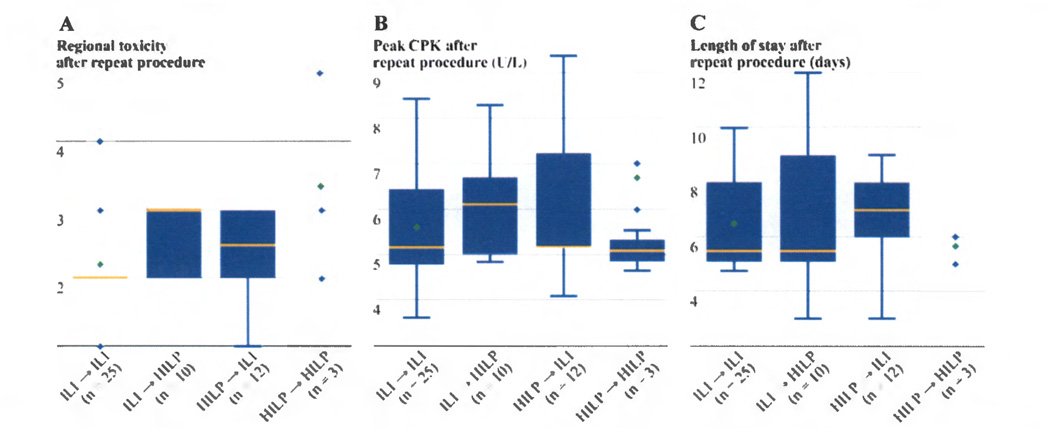
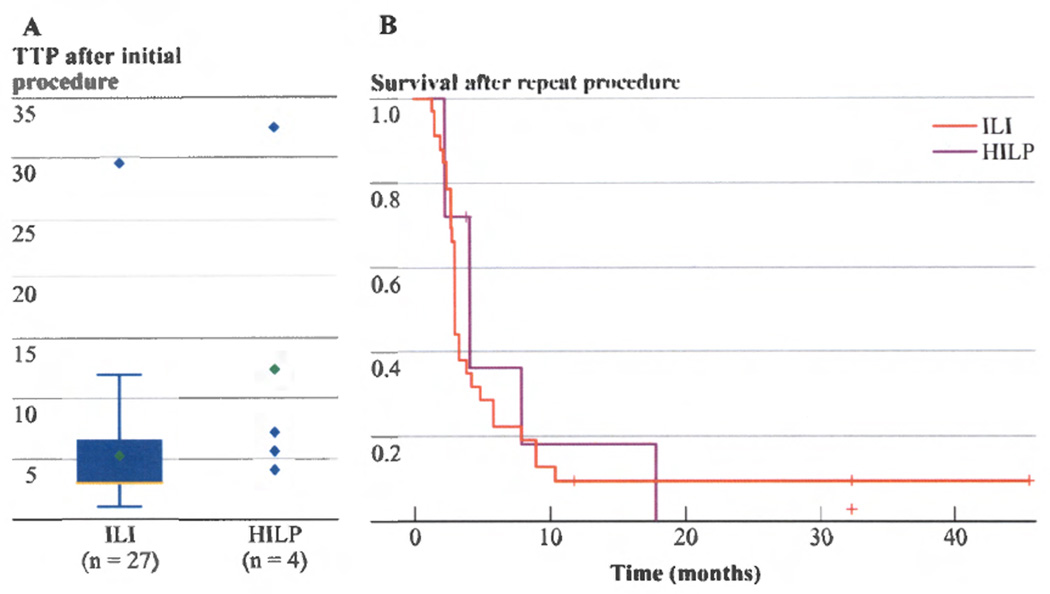
Results: Of 44 patients, 46% were men and 54% women with a median age of 66 (range 29-85) years at diagnosis. The median follow-up was 21.4 (range 4-153) months. Of 70 ILIs and 28 HILPs, the following groups were identified: group A, ILI → ILI (n = 25); group B, ILI → HILP (n = 10); group C, HILP → ILI (n = 12); and group D, HILP → HILP (n = 3). The comparison of Wieberdink grade, serum creatine phosphokinase level, LOS, and response rate between procedures (HILP vs. ILI), between sequence (initial vs. repeat), and among their interactions showed no statistically significant differences. TTP after initial procedure did not differ between HILP and ILI (P = 0.08), and no survival difference was seen (P = 0.65) when TTP after repeat procedure was compared.
Conclusions: Most patients tolerated repeat regional chemotherapy without increased toxicity or LOS. No statistical difference in clinical outcomes was noted when comparing repeat procedures, even though repeat HILPs showed higher complete response compared to repeat ILIs.
Conflict of interest statement
No financial support was needed to conduct this study and all authors state that they have no conflicts of interest relevant to our paper.
Figures
References
-
- Thompson JF, Lai DT, Ingvar C, Kam PC. Maximizing efficacy and minimizing toxicity in isolated limb perfusion for melanoma. Melanoma Res. 1994;4(Suppl 1):45–50. - PubMed
-
- Muchmore JH, Wanebo HJ. Regional chemotherapy: overview. Surg Oncol Clin N Am. 2008;17:709–730. vii. - PubMed
-
- Eggermont AM, de Wilt JH, ten Hagen TL. Current uses of isolated limb perfusion in the clinic and a model system for new strategies. Lancet Oncol. 2003;4:429–437. - PubMed
-
- Noorda EM, Takkenberg B, Vrouenraets BC, et al. Isolated limb perfusion prolongs the limb recurrence-free interval after several episodes of excisional surgery for locoregional recurrent melanoma. Ann Surg Oncol. 2004;11:491–499. - PubMed
Publication types
MeSH terms
Substances
Grants and funding
LinkOut - more resources
Full Text Sources
Other Literature Sources
Medical
