Horizontal transmission of Streptococcus mutans in schoolchildren
- PMID: 22143733
- PMCID: PMC3476088
- DOI: 10.4317/medoral.17592
Horizontal transmission of Streptococcus mutans in schoolchildren
Abstract
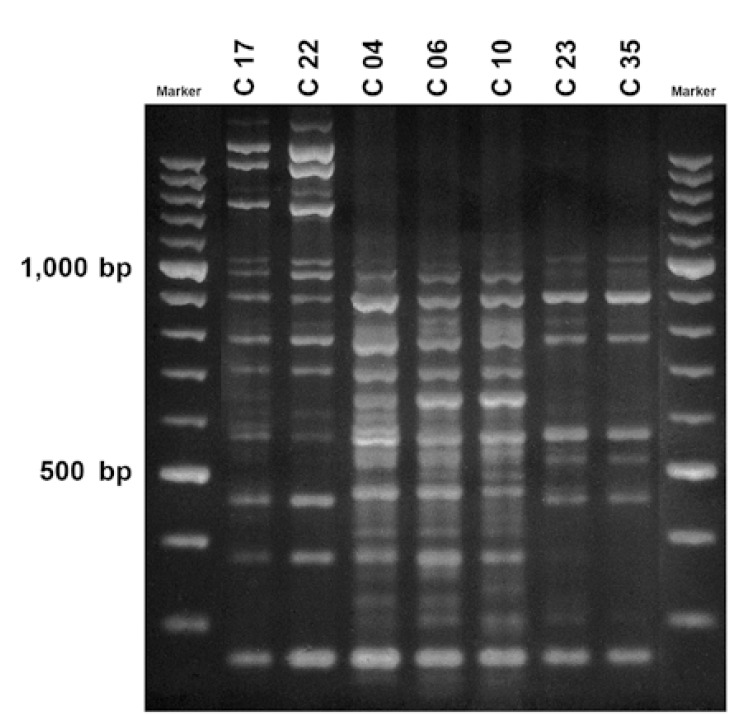
Objective: The aim of this study was to analyze possible horizontal transmission patterns of S. mutans among 6-7-yr-old schoolchildren from the same class, identifying genotypes and their diversity and relationship with caries disease status.
Study design: Caries indexes and saliva mutans streptococci and lactobacilli counts were recorded in 42 schoolchildren. Mutans streptococci colonies were identified by means of biochemical tests and all S. mutans strains were genotyped by arbitrarily primed polymerase chain reaction. A child was considered free of S. mutans when it could not be isolated in 3 samples at 1-week intervals.
Results: S. mutans was isolated in 30 schoolchildren: 20 having one genotype and 10 two genotypes. Higher mutans streptococci and caries index values were found in those with two genotypes. Five genotypes were isolated in more than 1 schoolchild and one of these was isolated in 3 schoolchildren. Our results suggest that horizontal transmission may take place.
Conclusion: Schoolchildren aged 6-7 yrs may be the source of mutual transmission of S. mutans.
Figures
References
-
- Caufield PW, Cutter GR, Dasanayake AP. Initial acquisition of mutans streptococci by infants: evidence for a discrete window of infectivity. J Dent Res. 1993;72:37–45. - PubMed
-
- Straetemans MM, Van Loveren C, De Soet JJ, De Graaff J, Ten Cate JM. Colonization with mutans streptococci and lactobacilli and the caries experience of children after the age of five. J Den Res. 1998;77:1851–5. - PubMed
-
- Napimoga MH, Höfling JF, Klein MI, Kamiya RU, Gonçalves RB. Transmission, diversity and virulence factors of Sreptococcus mutans genotypes. J Oral Sci. 2005;47:59–64. - PubMed
-
- Berkowitz RJ. Mutans streptococci: Acquisition and transmission. Pediatr Dent. 2006;28:106–9. - PubMed
MeSH terms
LinkOut - more resources
Full Text Sources
Medical