


Sterol-induced degradation of HMG CoA reductase depends on interplay of two Insigs and two ubiquitin ligases, gp78 and Trc8
- PMID: 22143767
- PMCID: PMC3251157
- DOI: 10.1073/pnas.1112831108
Sterol-induced degradation of HMG CoA reductase depends on interplay of two Insigs and two ubiquitin ligases, gp78 and Trc8
Abstract
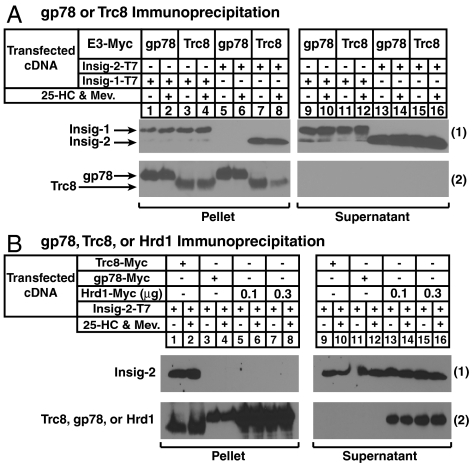
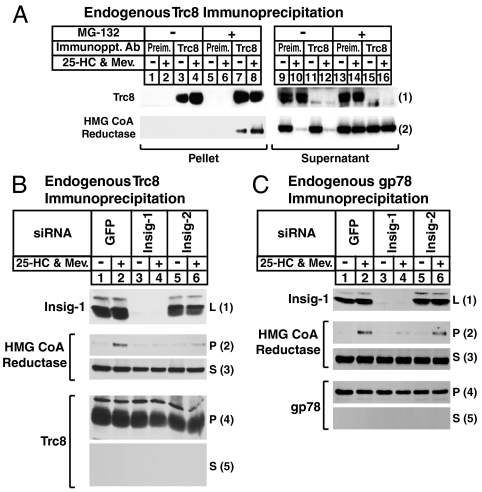
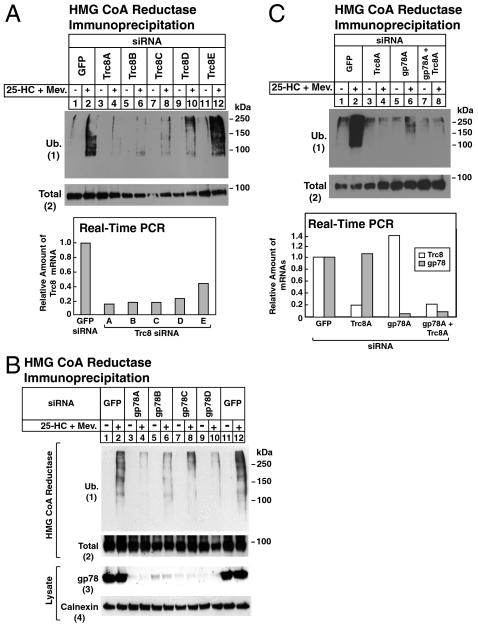
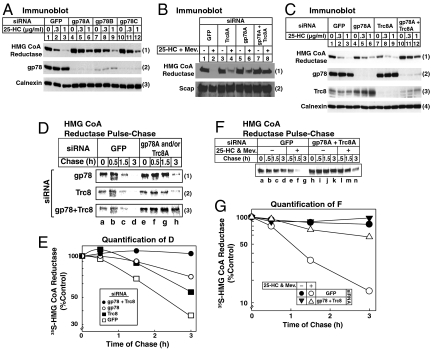
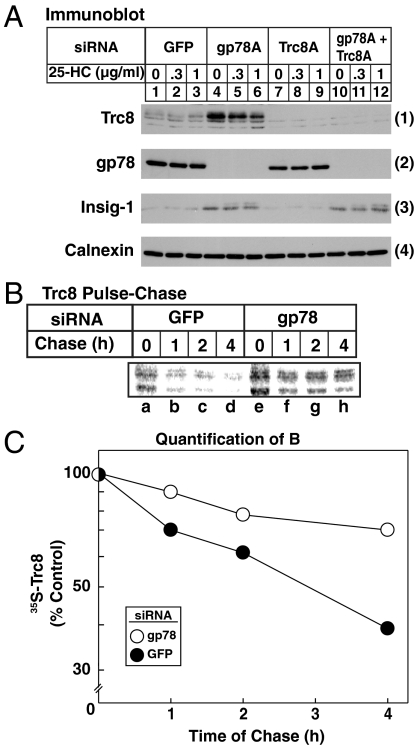
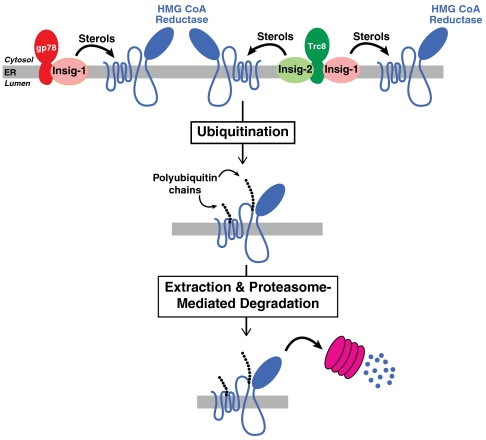
Accumulation of sterols in membranes of the endoplasmic reticulum (ER) leads to the accelerated ubiquitination and proteasomal degradation of 3-hydroxy-3-methylglutaryl coenzyme A reductase, a rate-limiting enzyme in synthesis of cholesterol and nonsterol isoprenoids. This degradation results from sterol-induced binding of reductase to the Insig-1 or Insig-2 proteins of ER membranes. We previously reported that in immortalized human fibroblasts (SV-589 cells) Insig-1, but not Insig-2, recruits gp78, a membrane-bound RING-finger ubiquitin ligase. We now report that both Insig-1 and Insig-2 bind another membrane-bound RING-finger ubiquitin ligase called Trc8. Knockdown of either gp78 or Trc8 in SV-589 cells through RNA interference (RNAi) inhibited sterol-induced ubiquitination of reductase and inhibited sterol-induced degradation by 50-60%. The combined knockdown of gp78 and Trc8 produced a more complete inhibition of degradation (> 90%). Knockdown of gp78 led to a three to fourfold increase in levels of Trc8 and Insig-1 proteins, which opposed the inhibitory action of gp78. In contrast, knockdown of Trc8 had no effect on gp78 or Insig-1. The current results suggest that sterol-induced ubiquitination and proteasomal degradation of reductase is dictated by the complex interplay of at least four proteins: Insig-1, Insig-2, gp78, and Trc8. Variations in the concentrations of any one of these proteins may account for differences in cell- and/or tissue-specific regulation of reductase degradation.
Conflict of interest statement
The authors declare no conflict of interest.
Figures
References
-
- Brown MS, Goldstein JL. Multivalent feedback regulation of HMG CoA reductase, a control mechanism coordinating isoprenoid synthesis and cell growth. J Lipid Res. 1980;21:505–517. - PubMed
-
- Sever N, Yang T, Brown MS, Goldstein JL, DeBose-Boyd RA. Accelerated degradation of HMG CoA reductase mediated by binding of insig-1 to its sterol-sensing domain. Mol Cell. 2003;11:25–33. - PubMed
-
- Sever N, et al. Insig-dependent ubiquitination and degradation of mammalian 3-hydroxy-3-methylglutaryl-CoA reductase stimulated by sterols and geranylgeraniol. J Biol Chem. 2003;278:52479–52490. - PubMed
-
- Liscum L, et al. Domain structure of 3-hydroxy-3-methylglutaryl coenzyme A reductase, a glycoprotein of the endoplasmic reticulum. J Biol Chem. 1985;260:522–530. - PubMed
Publication types
MeSH terms
Substances
Grants and funding
LinkOut - more resources
Full Text Sources
Molecular Biology Databases
